

This post concludes my series on what morality is. It recaps the key ideas I have put forward and answers some of the questions left open by the previous posts.
In his Histories, Herodotus recounts how, in the late sixth or early fifth century BCE, King Darius I of Persia asked the Greeks at his court what price would persuade them to eat their fathers’ dead bodies. They replied that no price would suffice. He then asked the Callatiae, an Indian people whom Herodotus reports as eating their dead parents, what payment would persuade them to burn their fathers’ bodies. The Callatiae cried out in horror and told him not to speak of such things. Herodotus concludes: “these things are established by usage.”
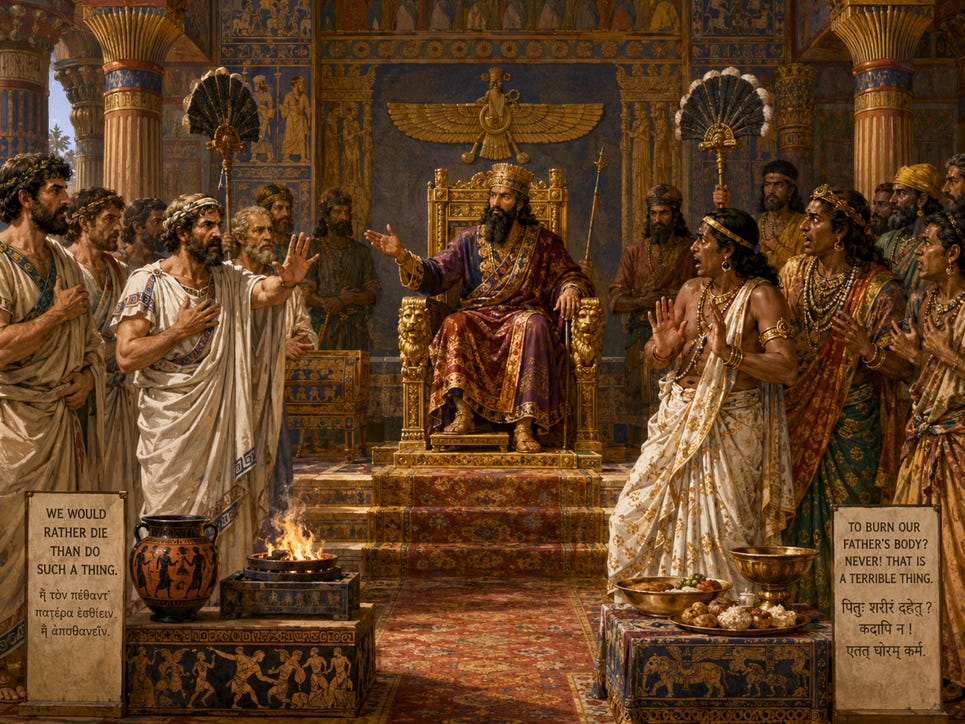
This early instance of a thought experiment in moral philosophy stresses how different moral norms can be across societies and how obvious we find the norms we observe in our own. Why are moral norms so important? Why are we so attached to them? And why do they differ so much across societies?
Putting the pieces together: what morality is
Morality plays a very important role in our lives. We feel strongly about moral transgressions in ways that seem very far from the cold and rational agent often assumed by economists.
Mentions of what we “ought” to do, what is “right” and what is “wrong” are pervasive. Surprisingly enough, the foundations of such statements are often unclear. Why ought we to do something? Why are some things “right” and some others “wrong”? The self-evidence of our moral stance easily crumbles when submitted to the toddler acid test of simply asking “why?” questions without accepting skyhooks as an answer.
In this series, I have made a clear, and in my view inescapable, point: moral rules are shared and accepted conventions in a social community, helping organise and smooth social interactions. Moral rules are neither handed to us by a god nor some natural laws woven into the fabric of the universe, nor do they stem from the logic of human rationality alone. Moral rules are human conventions: they define the behaviour that is considered seemly in a given community.
Why adopt such conventions? Because any group needs commonly understood ways to interact. Absent such conventions, society would fall into the kind of chaos seen in catastrophe movies, where the fabric of social life is torn down and expectations of common decency have disappeared. Social communities are therefore characterised by social contracts: sets of rules for the Game of Life that regulate social interactions and create stable expectations. Many different rules can fill that role. It is better when everybody drives on the same side of the road, but a country can coordinate either on the left or on the right. This is why moral rules differ across societies: there are many conventions that can work to regulate social life.
This is the central claim of the series: moral rules are not mysterious commands floating above social life. They are shared conventions that organise cooperation by defining rights, duties, expectations, sanctions, rewards, and signs of trustworthiness.
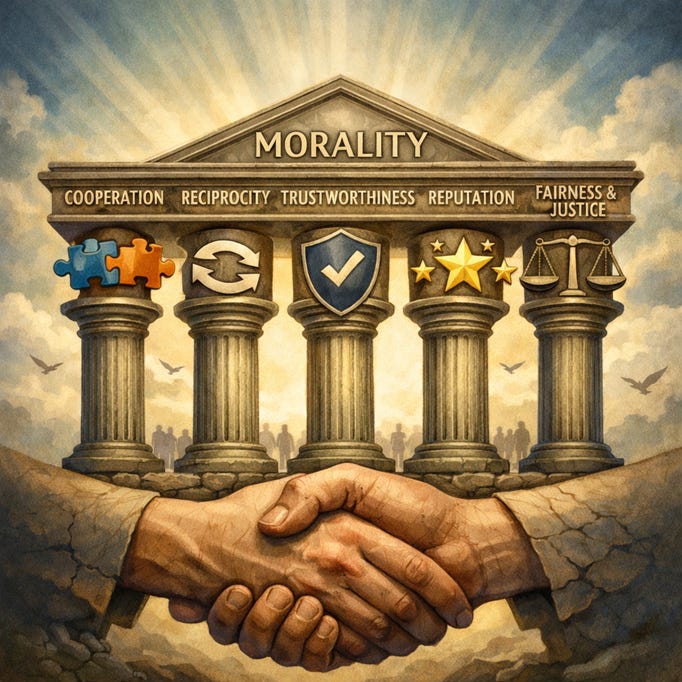
Critics might retort: “But this is relativistic; there is no absolute right and wrong then!” The answer is: yes, there is a relativistic aspect to this view. Not because it says that morality is fake or meaningless, but because moral rules vary from one community to another and there is no universal moral yardstick standing outside all communities and all times. This does not mean that we have to agree with views and actions which we reject here and now.
A key reason we live in societies rather than alone is that, by cooperating with each other, we are able to do much better than by going on alone. Unlike the caricature description of evolution leading to selfishness, a key insight from modern evolutionary theory is that cooperation is a key scaffolding principle of life. It has appeared again and again between organisms, and humans, with their incredibly powerful brains, have been able to tap into the potential of cooperation in ways unachieved by any other animals. Humans have a unique ability to navigate complex webs of social interactions from small communities to large networks.

We know from game theory that even though humans have imperfectly aligned interests, the possibility of repeated interactions creates the opportunity for fruitful cooperation. There is no need to assume purely self-sacrificial motives that would conflict with natural selection. Cooperation can be rational in the long run.
But cooperation then creates a distributional problem: how to share its benefits and burdens. Game theory shows that there are typically many possible cooperative arrangements. Game theorist Ken Binmore has proposed that this is what fairness is. Fairness norms provide shared conventions about who can claim what, who owes what, and what counts as an acceptable settlement, from household chores to political institutions.
With this framework, Binmore proposes a simple explanation for how fairness rules are set. They are, de facto, solutions to the bargaining problems we face in our social interactions. Instead of haggling to decide who should do what and who should get what, we have a shared understanding of what should be agreed in a given situation. As a result, we do not need to spend time haggling all day. We seamlessly resolve countless questions of allocation of rights and duties, from who should give way in the corridor to who should get the lead on a company project, because we know what we can reasonably claim and what others will accept as “fair.”
Because fairness norms are solutions to bargaining problems, they will tend, in the long run, to reflect the distribution of bargaining power in society. In fairly equal societies like modern liberal democracies, fairness rules will be fairly egalitarian. Looking at the existence of substantial economic inequality in our modern societies may mask to us that ancient societies could also be very unequal economically. Bargaining power in modern liberal democracies is often more balanced than in many past societies: each citizen has one and only one vote, is equal before the law, and is free to criticise the country’s leader without fear of going to jail or worse.1
That perspective provides a general framework to understand fairness norms even in societies that are not as equal as our modern ones. In unequal societies, fairness norms will provide a modus vivendi that reflects the balance of power and rewards those with more power, but only to an extent compatible with the actual balance of power in that society. This explains why patriarchal societies, class or caste societies, and slave societies still use the language of fairness, describing some level of imbalance as correct and seemly while condemning abuse of power from the powerful and insubordination of members of dominated groups as unacceptable. This is not a bug. It is not that people from other societies were wrong about morality or evil. It is a feature of fairness rules: they reflect the long-term balance of power in society.

Changes in fairness norms occur over time in large part because societies evolve and the structure of bargaining power between the groups composing them changes. Capitalism, markets and urbanisation increased the bargaining power of the trading and producing classes working in towns (bourgs): the bourgeoisie. Mass industrialisation increased the bargaining power of the working class, who could organise politically and mobilise collectively in the urban centres of power. All this led to the advent of more egalitarian fairness norms and of formal institutions like democratic rules that enshrined these norms in the social contract. The rise of automation and services facilitated women’s access to paid labour. Coupled with growing access to higher education, it increased their access to the public sphere and their ability to organise to change their collective rights.
As a conclusion to this series, I want to address several objections that the view may invite. Can this account of morality—as the reflection of a social contract—explain more than fairness? Can it make sense of purity, loyalty, supererogation, law, and the felt authority of moral rules? These may look like separate domains. I will argue that they are not. They are different mechanisms through which cooperation is regulated.
Fairness and morality
One possible criticism is that the explanation I have presented makes sense to explain fairness but cannot explain the rich tapestry of morality. For instance, in Jonathan Haidt’s influential Moral Foundations Theory, fairness is only one out of five moral considerations:
Care/harm: concern for suffering, cruelty, protection.
Fairness/cheating: concern for reciprocity, justice, rights.
Loyalty/betrayal: concern for group commitment and betrayal.
Authority/subversion: concern for hierarchy, respect, tradition.
Sanctity/degradation: concern for purity, contamination, sacredness.
I contend that this kind of division misses the deep underlying logic of morality. Everything in morality is about setting the rights and duties of individuals for social life to work. Moral rules form the social contract that allows a group to cooperate and limit conflict. Understood that way, morality is not a patchwork of systems without clear relations, it has one underlying logic: the organisation of social cooperation.
This organisation requires assigning rights and duties in clearly distributive questions. This is the domain of fairness (point 2) in the narrow sense of distributive justice. It also typically requires specifying individual rights and therefore puts limits on the suffering that can be exerted on others (point 1). It also needs to organise hierarchical relations (point 4). Groups gain from having some leadership and the gains from leadership need to be shared between leaders and the common members of the group. When leaders gain access to greater bargaining power, for instance from greater access to means of organised violence against other group members, their bargaining power may increase and influence how rights and duties are split between them and their followers.
We are left with two domains in Moral Foundations Theory: loyalty/betrayal (point 3) and sanctity/degradation (point 5). These two domains can be thought of as two sides of one question: the duty to express signals of good character. There are at least two reasons this duty emerges.
First, the cognitive and evolutionary scientists Léo Fitouchi, Jean-Baptiste André and Nicolas Baumard argue that many puritanical and ascetic norms can be understood as forms of moral disciplining.2 Practices such as sobriety, fasting, sexual restraint, modesty and ritual observance are valued because long-term cooperation requires the ability to resist short-term temptations. Conversely, signs of intemperance are condemned not necessarily because they directly harm others, but because they are taken to reveal weak self-control, or to weaken self-control. Cooperation among strangers is possible only when people are patient enough to delay the potential benefits of acting selfishly now and invest instead in relationships whose cooperative benefits will pay off in the future. This explains why practices that indicate self-restraint can serve as signals of cooperative reliability.

In the perspective I present here, the further step is to explain why these signals become part of the social contract as rules of cooperation. A likely reason is that trust in others’ cooperativeness is itself a condition of cooperation. Once cooperation depends on visible signs of trustworthiness, failing to display them is not just a private matter. It undermines the shared expectations that sustain the cooperative order.
Second, another class of signals of trustworthiness concerns group loyalty. To the extent that some benefits of group membership are public goods, groups are always exposed to free riding: some members may enjoy the protection, status, resources, or solidarity provided by the group without contributing to it. Many rules of morality and fairness already address this problem. But in a world where individuals can belong to, interact with, or defect to other groups, a more specific risk arises: betrayal.
Throughout history, communities have been endangered by members who opened gates to invaders, passed critical information to enemies, or shifted allegiance at decisive moments. Groups therefore develop moral concerns around loyalty and betrayal. Since declarations of loyalty are cheap, members are often expected to demonstrate their commitment through visible, costly, or hard-to-fake signals of attachment to the group.
The founder of sociology, Émile Durkheim, had noticed that Australian Aboriginal veneration of totems was driven by their representation of group identity:
[I]t is also the symbol of the determined society called the clan. It is its flag; it is the sign by which each clan distinguishes itself from the others, the visible mark of its personality, a mark borne by everything which is a part of the clan under any title whatsoever, men, beasts or things.
In a similar way, modern societies have modern totems in the form of flags, national anthems, iconic symbols, and historical figures. This is why disrespect for these symbols arouses such strong reactions, often including violence. Respecting the flag and other cultural icons gets a moral tint because not doing so breaches the social contract that requires members to contribute to social cohesion by signalling commitment to the group. Even though such signs may seem unrelated to social cooperation, they are fully part of it because common trust requires a shared confidence that people are committed to the group.

The signs of commitment go beyond the acknowledgement of explicit symbols of the group, like a flag, an anthem, a sports team, or a leader. They also extend to cultural practices that take a particular meaning as distinctive. In a group, some practices, however arbitrary and historically contingent their origin might be, take on a special meaning because they are what “we” do. They become markers of group identity. Hence, the moral tint of seemingly morally irrelevant things such as what to wear, what to eat, and how to speak.
Let’s take, for instance, the moral duty not to eat pork that is part of the injunctions of Judaism and Islam. The absence, or near absence, of pig bones in many early Israelite settlements in the Iron Age suggests that the practice existed before the biblical law was fully codified. The archaeologist Max Price argues in Evolution of a Taboo: Pigs and People in the Ancient Near East that the taboo evolved over time: first in opposition to pork-eating Philistines, and later through its mobilisation by Judah’s kings and priestly class as they sought to consolidate a pan-Israelite identity after the fall of the Northern Kingdom.3
Moral supererogation
Another possible criticism is that this explanation does not make sense of supererogatory moral rewards, which are attached to actions that go beyond what morality can reasonably demand. They include praise, esteem, gratitude, honour, admiration, and moral credit. They allow a society to encourage valuable forms of behaviour without turning them into duties. A person who refrains from stealing has done what is required. A person who takes a personal risk to stop a thief has done something more. The first case belongs to the baseline of social cooperation; the second belongs to the domain of supererogation.
If moral rules set what must be done, why are people rewarded with extra praise for going above and beyond duty? The usual explanation is that morality is divided between compulsory actions and desirable but non-compulsory actions. Failing to perform the first generates punishment; performing the second generates reward. But this is not an explanation. It is only a description. Why does morality have this division? Why are some moral actions compulsory while others are merely desirable?
The enigma of supererogatory rewards disappears when one considers the features that an optimal system of punishments and rewards for a social contract should have. First, one key aspect of such a reward scheme is that it depends heavily on the ability to observe not only the actions of an individual but also the possible actions not taken that the individual could have taken. In the case where all the possible actions available to an individual are observable, the optimal reward scheme is simple: put a single and steep reward on the best action. This is the best way to incentivise the individual to take the most desirable action.
When there is uncertainty about what an individual can do, a unique reward for a given action may fail to provide the best incentives. If the agent cannot do the desired action, the reward will do nothing. If the agent could do much more, the reward may not motivate the agent to go beyond the minimum set by the reward. In that case, the optimal reward scheme is smoother: it tracks the likelihood that the agent could have reached different levels of achievement.
Second, supererogatory rewards are associated with an asymmetry between moral punishments and rewards. Doing the wrong thing comes with a steep punishment, while going above and beyond what is required leads to lower and incremental rewards. The explanation lies in the distinction between acts of commission, doing something, and acts of omission, not doing something. Acts of commission are more directly observable and can be associated with steep punishment. Acts of omission are less directly observable and are therefore associated with looser punishment and smoother rewards.4
Consider a situation where Bob witnesses a truck transporting bags of cash crash on the road. He sees one person grabbing a bag and about to leave the scene with it. Bob could 1) grab a bag himself and try to leave with it, 2) do nothing, or 3) try to prevent the other person from stealing the money. From a social point of view, 3 > 2 > 1. Imagine now that he is interviewed by the police afterwards. It is clear that 1 is worse than 2. Bob had the choice not to steal. Trying to steal the money is obviously bad and should therefore be associated with a steep punishment.
But consider the difference between 3 and 2. If Bob did nothing, can he really be held responsible? It is less clear. Did Bob really understand what was going on and identify the thief as such? Even if he did, did Bob think he was physically able to stop the thief? Did he think the thief might be armed and dangerous? The omission to do 3 should be less punished than the commission to do 1. Since there is uncertainty about what Bob could have done, an optimal social response should be graded and increase in the range of what was credibly feasible, so as to motivate people to do the right thing without turning every possible good action into a duty.

Hence, the structure of moral punishments and rewards: steep for violations of clear rules, and graded for actions above and beyond these rules when it is unclear how much more the individual could have done.
What is legal and what is moral?
Another possible question is how this explanation makes sense of the difference between morality and legality. Why are some rules enshrined into formal laws, while others remain unwritten conventions?
The difference between law and morality is not a difference of nature but of enforcement. Law is the part of the social contract formally enforced by the state and its monopoly on organised violence. It is used when formal enforcement is worth the cost and when violations can be publicly verified. Murder, theft, assault, fraud, and breach of contract are legal matters because the stakes are high and the relevant facts can often be adjudicated. By contrast, failures of courtesy, loyalty, gratitude, modesty, or generosity may matter morally while remaining too frequent, ambiguous, or context-dependent for courts.
This explains why the legal and the moral can clash. As the formalised part of the social contract, laws might not always perfectly track the moral conventions. Sometimes they lag behind moral change. Some other times, they impose a clean public rule on situations where moral conventions are more ambiguous. When people say that something is legal but immoral, or illegal but morally justified, they are pointing to a gap between the formal and informal layers of the social contract.
Thus, law codifies the part of the social contract where formal enforcement is both valuable and feasible. Morality is broader. It includes all the rules, expectations, sanctions, and rewards through which a community regulates social life, including many that no court could or should enforce.
In what way do we “ought” to be moral?
One frequent criticism of this conventionalist explanation of morality is that it is too deflationary. It removes from the description of morality what we tend to feel morality is about. In particular, moral rules seem to have a normative force: we feel that we ought to be moral, not that morality is just a convention.
The conventionalist approach does not leave any place for an external “ought.” In Kantian language, acting morally is not a categorical imperative, imposing on us to act morally just because we should. Instead, it is a hypothetical imperative:
[I]f we want to be well-accepted players of the game of life, we ought to abide by the rules of the social contract
This conclusion hurts many of our intuitions and may be hard to accept. In some cases, it is leveraged as a drawback of the conventionalist approach. In a very well-informed commentary on Binmore’s theory, the economist, philosopher and Substacker Cyril Hédoin sees this as a limitation of Binmore’s theory:
the morality of fairness norms is epiphenomenal since ultimately it reduces to (rather than merely supervenes on) power relations. Conventionalists like Binmore have to argue that there is nothing more to morality than ‘conversation stopping’ devices.
[…] A genuinely moral convention is a convention that has [a] moral authority. — Hedoin (2018)
In fact, instead of being a weakness, I see Binmore’s conclusion as a strength: the strength of a theory that follows rigorously where logic and evidence lead, with the courage of accepting conclusions that may not be our preferred ones.
The “no-ought” criticism of conventionalism can be summarised as: “Morality is about what we ought to do. Since there is no proper ought in the conventionalist explanation, it is not a theory of morality.” There are two ways to understand this criticism.
First, morality is about absolute oughts, so conventionalism is just a wrong explanation because it does not produce absolute oughts. This objection assumes the very thing conventionalism rejects: the existence of absolute moral oughts. It builds its argument on a skyhook, an assumed and unjustified thing which we must accept. The simple answer to this question is: why should we accept that there are absolute moral oughts in the first place? This is a central question about morality. It should be argued, not assumed.
Second, perhaps morality is just conventions, but then why do we “ought” to obey moral rules? This objection seems to empty morality of meaning and, in a sense, begs the question of why we need to talk about morality altogether. This take is understandable, but misguided. Suppose Alice and Bob are playing a match of tennis and Candice comes and points out to them that the rules of tennis are purely conventional and therefore they have no duty to follow them. Alice and Bob might be somewhat puzzled by this assertion. Sure, they do not have an external absolute duty to follow the rules, but if they want to proceed with their game of tennis, which they both enjoy, they ought to follow them. If they do not, for instance if Bob starts claiming Alice’s balls are out when they are in, the game might unravel and stop short.
Morality is the same, but at the social level. Moral rules are our meta-rules: the rules that rule all the rules of social interaction. We care about them, and feel we ought to follow them, because our lives are embedded in society. Social interactions pervade our experience. Respecting their rules is key for society to work efficiently and peacefully, and for us to remain accepted members of it.

What about our moral intuitions?
One remaining question to answer is: if morality is only conventional, why do we feel that it is not? We typically feel that “murder is wrong” and “torturing a baby is wrong,” not because it is a convention but because it is, full stop. These intuitions are heavily relied on by moral realists to argue that morality is objective: moral facts are “stance independent”; they do not depend on what you and I think, they exist “out there.” This is an important question, but moral realists are too quick to enrol our intuitions as hard evidence to determine the true nature of morality.

First, one must observe that our moral intuitions are not “realist” all across the board. We tend to have realist intuitions for big things like cruelty, betrayal, and murder. These things are bad, full stop. We feel they are bad here and now, but also in other societies and in the past. But we also often adopt conventionalist attitudes toward rules about dress codes and manners, dietary prohibitions, purity rules, and sexual norms. For these, we may accept that different societies have different conventions without thinking that only one of them is necessarily the “right” one.
The empirical literature on folk metaethics has often found what philosophers call “metaethical pluralism”: the same person may give realist-looking answers for some moral issues and relativist-looking answers for others. A person may treat murder or torture as objectively wrong while treating abortion, euthanasia, dietary rules, or sexual norms as more dependent on cultural, religious, or personal standards.5
Second, our moral intuitions are not consistent and rigorous like moral realists might want to think they are. In his dissertation on folk metaethics, the philosopher Lance S. Bush argues that the evidence does not show that ordinary people are consistent moral realists in the technical philosophical sense. Many people do not interpret questions about moral objectivity in the technical way intended by philosophers. They often understand “objective” to mean unbiased, clear, shared, universal, serious, or not merely personal. They often understand “relative” to mean that people or cultures disagree, or that context matters. As a result, surveys about moral realism may overinterpret people’s views as being in line with a clear moral realism in ethics while people’s intuitions are actually messier than how they are interpreted.
Nonetheless, it is clear that people often describe some moral rules as objective or absolute. One possible reason is that some of our intuitions may be deeply ingrained. Biological evolution may have embedded some moral intuitions in us over the long run. Our ancestors repeatedly faced similar problems of social life, and recurrent problems can favour recurrent psychological responses. Restraints against harming others, for instance, are a basic requirement for social cohesion. This may help explain why some reactions against cruelty, especially cruelty toward the vulnerable and defenceless, are deeply ingrained in our psychology. The long history of our species may also have shaped intuitions that sit uneasily with later social realities. For most of human history, humans lived in relatively small foraging groups, where bargaining power was more evenly distributed than in the hierarchical societies that followed. This may have left us with deep egalitarian intuitions that have repeatedly conflicted with the unequal structure of large-scale societies.
Another reason is cultural history. The feeling that moral rules are absolute is likely stronger in societies shaped by moralising gods. In many societies, gods are not merely powerful beings. They are watchers, judges, and punishers. They care whether people lie, cheat, steal, betray, or break obligations. At the individual level, religiosity in cultures with moralising gods is often associated with more objectivist and less relativist moral views. Studies by Yilmaz and Bahçekapılı, Sarkissian and Phelan, and others find links between belief in God, especially a punishing or morally concerned God, and stronger endorsement of objectivist moral claims. The appeal of objectivist moral language in many modern societies may partly reflect the long cultural influence of religions centred around moralising gods.
Finally, one reason we might feel that moral rules are absolute is that this belief can be socially helpful. It may help solve the commitment problem. Social cooperation requires trust. But trust is fragile because people often have incentives to defect when the context changes. A person may promise to cooperate today and betray tomorrow if betrayal becomes profitable, if no one is watching, or if a new coalition offers a better deal. We therefore want partners whose cooperative behaviour is not too dependent on local contingencies. We want people who will not steal merely because they can get away with it, who will not betray merely because the opportunity is profitable, who will not abandon an ally as soon as the balance of power shifts. Moral realist intuitions help make this kind of commitment credible. A person who believes that stealing is wrong regardless of advantage, approval, or immediate consequence is a more reliable partner. The belief makes future behaviour less conditional. It functions as a psychological commitment device.
This may help explain, in turn, why religions with moralising gods were successful. The idea of absolute moral rules to follow may have been intuitively appealing and may have formed what Sperber called “cultural attractors” (Sperber 1996; Claidière and Sperber 2007). Boyer similarly argues that religious representations are easily transmitted because they recruit ordinary cognitive mechanisms such as agency detection, hidden knowledge, intention, and punishment (Boyer 2001). By fostering social trust, religions with moralising gods may also have made societies better at creating social cohesion. This is the cultural-evolutionary argument developed by Norenzayan and colleagues (Norenzayan 2013; Norenzayan et al. 2016), and Purzycki and colleagues, who provide cross-cultural evidence that belief in knowledgeable and punitive gods is associated with greater fairness toward distant co-religionists (Purzycki et al. 2016).
There is no reason to see in our intuitions some kind of substrate revealing the true nature of morality. It is surprising that such intuitions are sometimes treated as strong evidence about the metaphysical nature of morality. Modern physics has shown that while our intuitive physics helps us navigate our surrounding world, it is deeply unsuited to understand the deep nature of its laws from the very small (quantum physics) to the very large (general relativity). In the same way, our moral intuitions are useful to navigate our local social world, but it is strange to assume without much more evidence that they are a path to understanding the deep nature of morality.

Morality is both pervasive and mysterious. Statements about things being fair or unfair, just or unjust, right or wrong are frequent both in everyday life and in public debate. But people often struggle to articulate what these normative statements mean. Why is something unfair or unjust? What does this mean exactly?
The naturalist perspective I have developed in this series provides a simple answer. What are moral rules? Human conventions that help regulate social life and make it possible, with all the benefits from social cooperation that it entails. Why do we feel strongly about these rules? Because the Game of Life determines all our outcomes. There is no reset, restart, or replay in the Game of Life. We have only one shot, and we should care greatly about others abiding by the rules we all respect.
This perspective stands on the shoulders of thinkers such as Hume, Sugden and Binmore, and draws on the cumulative work of generations of game theorists, evolutionary theorists and behavioural scientists. It provides clear answers to some of the most discussed questions in moral philosophy because it abandons wishful thinking and the temptation to hold up desired conclusions with skyhooks. Instead, it starts from the basic facts of human interaction: the possibility of cooperation, the unavoidable conflicts over resources and duties, and the need for conventions to make social life work.
The surprising thing is that, if one opens many moral philosophy textbooks today, one finds little of the framework I have presented in this series. The discipline seems to have remained strikingly oblivious to the developments in evolutionary theory and game theory, leading to endless meandering through self-created conceptual mazes.
The view I have presented is not new, though. David Hume had already laid out its philosophical foundations. Adam Smith reported that, on his deathbed, Hume imagined trying to negotiate with Charon, the figure from Greek mythology who ferries souls to the underworld:
Have a little patience, good Charon; I have been endeavoring to open the eyes of the public. If I live a few years longer, I may have the satisfaction of seeing the downfall of some of the prevailing systems of superstition.
To which Hume imagined Charon replying:
You loitering rogue, that will not happen these many hundred years.
More than two hundred years later, at a time when humanity can decode DNA, identify the Higgs boson, and measure gravitational waves from black holes colliding billions of light years away, Hume’s quip was prescient. Many prevailing views about morality remain strikingly ungrounded in logical and empirical rigour, not just among laypeople but also in intellectual circles.
This is not because the evidence is especially hard to understand. The difficulty is that morality is a domain where our intuitions are strong and reality’s feedback is weak. In physics, bad theories can quickly hit the wall of observation. In morality, bad theories that flatter our preferred narratives, or serve as coalition ideologies can survive much longer because they are removed from direct tests of predictions against observations.
But misguided moral theories are not removed from all contact with reality, and facts are stubborn things. As Mill famously said, truth may be suppressed many times, but if an opinion is true, “in the course of ages” people will generally rediscover it, until one of its reappearances comes at a time when it can finally withstand attempts to suppress it.6
With this series, I have tried to provide the intellectual tools and conceptual clarity for this better understanding of morality to gain ground. One should not expect old systems of superstition to disappear quickly. Hume was right about that. But we can expect them to fade away over time. If this series helps others think more clearly about morality, social cooperation, and the rules of the Game of Life, it will have done what I hoped it would do.
References
Alfani, G., and Carballo, A. (2023). “Income and inequality in the Aztec Empire on the eve of the Spanish conquest.” Nature Human Behaviour, 7, 1265–1274.
Alfani, G., Bolla, M., and Scheidel, W. (2025). “A comparison of income inequality in the Roman and Chinese Han empires.” Nature Communications, 16, Article 3248.
Binmore, K. (1994). Game Theory and the Social Contract, Volume 1: Playing Fair. Cambridge, MA: MIT Press.
Binmore, K. (1998). Game Theory and the Social Contract, Volume 2: Just Playing. Cambridge, MA: MIT Press.
Boyer, P. (2001). Religion Explained: The Evolutionary Origins of Religious Thought. New York: Basic Books.
Bush, L. S. (2023). Schrödinger’s Categories: The Indeterminacy of Folk Metaethics. PhD thesis, Cornell University.
Claidière, N., and Sperber, D. (2007). “The role of attraction in cultural evolution.” Journal of Cognition and Culture, 7(1–2), 89–111.
Durkheim, É. (1912). Les formes élémentaires de la vie religieuse. Paris: Alcan.
Finkelstein, I., and Römer, T. (2014). “Comments on the Historical Background of the Abraham Narrative: Between ‘Realia’ and ‘Exegetica.’” Hebrew Bible and Ancient Israel, 3, 3–23.
Fitouchi, L., André, J.-B., and Baumard, N. (2023). “Moral disciplining: The cognitive and evolutionary foundations of puritanical morality.” Behavioral and Brain Sciences, 46, e293.
Goodwin, G. P., and Darley, J. M. (2008). “The psychology of meta-ethics: Exploring objectivism.” Cognition, 106(3), 1339–1366.
Haidt, J. (2012). The Righteous Mind: Why Good People Are Divided by Politics and Religion. New York: Pantheon.
Hédoin, C. (2018). “Naturalism and Moral Conventionalism: A Critical Appraisal of Binmore’s Account of Fairness.” Erasmus Journal for Philosophy and Economics, 11(1), 50–79.
Herodotus (1890). The History of Herodotus. Translated by G. C. Macaulay. London: Macmillan.
Hoffman, M., Yoeli, E., and Navarrete, C. D. (2016). “Game Theory and Morality.” In T. K. Shackelford and R. D. Hansen (eds.), The Evolution of Morality. Cham: Springer.
Milanovic, B. (2006). “An Estimate of Average Income and Inequality in Byzantium Around Year 1000.” Review of Income and Wealth, 52(3), 449–470.
Milanovic, B., Lindert, P. H., and Williamson, J. G. (2007). “Measuring Ancient Inequality.” World Bank Policy Research Working Paper 4412.
Mill, J. S. (1859). On Liberty. London: John W. Parker and Son.
Norenzayan, A. (2013). Big Gods: How Religion Transformed Cooperation and Conflict. Princeton: Princeton University Press.
Norenzayan, A., Shariff, A. F., Gervais, W. M., Willard, A. K., McNamara, R. A., Slingerland, E., and Henrich, J. (2016). “The cultural evolution of prosocial religions.” Behavioral and Brain Sciences, 39, e1.
Pölzler, T., and Wright, J. C. (2020). “Anti-realist pluralism: A new approach to folk metaethics.” Review of Philosophy and Psychology, 11, 53–82.
Price, M. D. (2020). Evolution of a Taboo: Pigs and People in the Ancient Near East. Oxford: Oxford University Press.
Purzycki, B. G., Apicella, C., Atkinson, Q. D., Cohen, E., McNamara, R. A., Willard, A. K., Xygalatas, D., Norenzayan, A., and Henrich, J. (2016). “Moralistic gods, supernatural punishment and the expansion of human sociality.” Nature, 530, 327–330.
Saini, M., and Nishant, N. (2026). “SpaceX IPO makes Elon Musk the world’s first trillionaire.” Reuters, 11 June 2026.
Sarkissian, H., and Phelan, M. (2019). “Moral objectivism and a punishing God.” Journal of Experimental Social Psychology, 80, 1–7.
Smith, A. (1777). “Letter from Adam Smith, LL.D. to William Strahan, Esq.” In D. Hume, The Life of David Hume, Esq. Written by Himself. To which is added, a letter from Adam Smith, LL.D. to William Strahan, Esq. London: W. Strahan and T. Cadell, pp. 39–62.
Sperber, D. (1996). Explaining Culture: A Naturalistic Approach. Oxford: Blackwell.
Weber, M. (1919). “Politics as a Vocation.”
World Inequality Database. WID.world.
Wright, J. C., Grandjean, P. T., and McWhite, C. B. (2013). “The meta-ethical grounding of our moral beliefs: Evidence for meta-ethical pluralism.” Philosophical Psychology, 26(3), 336–361.
Yilmaz, O., and Bahçekapılı, H. G. (2015). “Without God, everything is permitted? The reciprocal influence of religious and meta-ethical beliefs.” Journal of Experimental Social Psychology, 58, 95–100.
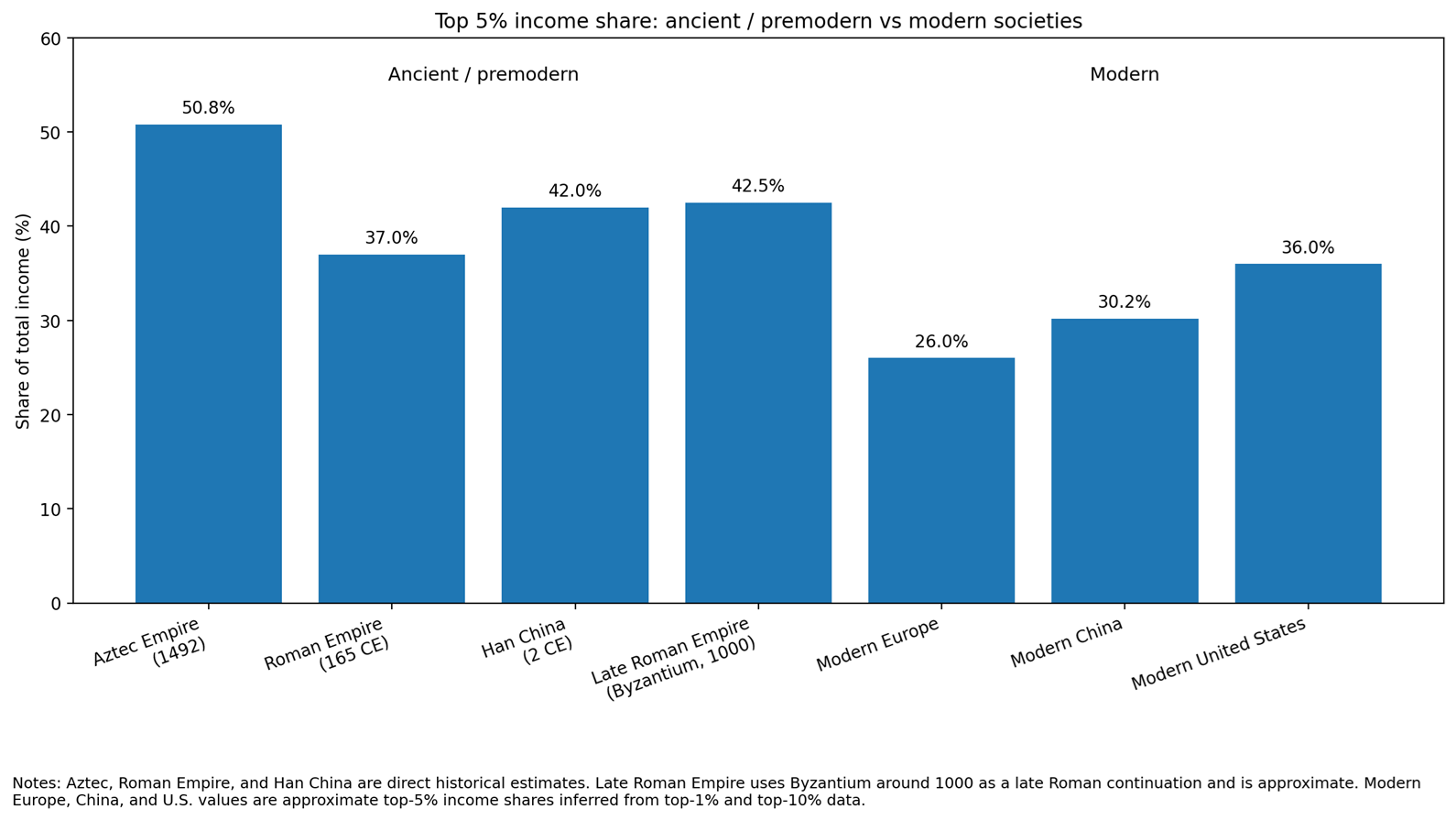
The idea that modern societies have relatively equal bargaining power is often criticised on the ground that they remain highly unequal economically. At the time of writing, Elon Musk has been reported to have become the world’s first trillionaire after the SpaceX IPO; even allowing for the fact that this wealth is largely the valuation of assets rather than cash, the scale of modern inequality is striking. To what extent, then, can we say that bargaining power is more balanced in modern liberal democracies?
First, past societies were often at least as unequal as modern ones, and sometimes more unequal. The comparison in the figure below shows this for Europe, China, and the Americas. In several ancient and premodern societies, narrow elites received shares of income or wealth comparable to, or larger than, those received by much broader elite groups today.
Second, bargaining inequality is not identical to economic inequality as conventionally measured. In a Binmore/Nash bargaining frame, what matters is not only the distribution of income or wealth, but the distribution of fallback positions if agreement fails. A given level of inequality has, for instance, very different implications when most people are close to bare survival, as in many past societies, than when they have secure access to housing, food, public services, legal protection, and alternative employment, as in many modern societies. In societies close to subsistence, economic inequality often meant that elites controlled most of the surplus available above survival, leaving non-elites with little capacity to wait, refuse, migrate, litigate, organise, or take risks.
Beyond economic resources, bargaining power also depends critically on the distribution of coercive power. In many historical societies, economic inequality was partly the result of unequal access to the means of organised violence. For bargaining purposes, the crucial question is therefore not only who owns resources, but who can credibly threaten force, who is protected from force, and who can appeal to institutions that restrain arbitrary violence. A peasant facing an armed landlord, a slave facing a master, or a debtor facing imprisonment is not merely poorer; their bargaining position is shaped by coercive vulnerability.
These points help us assess the modern balance of bargaining power. Modern liberal-democratic and welfare-capitalist societies tend to give non-elites stronger fallback positions than they had in many ancient, imperial, and feudal societies. People are more often above bare subsistence, and legitimate organised violence is monopolised by the state, which in liberal democracies is formally accountable to citizens with equal votes. Hence, despite substantial economic inequality, people have a much greater ability to act and organise in defence of their interests against the powerful. Today, people can criticise Elon Musk on his own platform, and they can organise campaigns to get lawmakers to tax and regulate his activities. They can do so without normally fearing physical punishment, dispossession, or arbitrary imprisonment. This was not true for most people who lived in more hierarchical societies.
Fitouchi et al. (2023)
The same point can be made about circumcision. Circumcision was an old Near Eastern practice, already present before the biblical text in Genesis 17 gave it a distinctive theological meaning. What is distinctive in that text is the interpretation of circumcision as the sign of the covenant with Abraham, to be performed on the eighth day after birth. This passage is usually attributed to the Priestly tradition, which many scholars date to the period when many Judeans had been forcibly exiled to Babylon. This chronology makes the exile a plausible context for this reinterpretation: after the destruction of Jerusalem in the 6th century BCE, circumcision could function as a portable marker of Judean identity, at a time when the community had lost its king, temple, and land (Finkelstein and Römer, 2014).
Hoffman, Yoeli and Navarrete make a related point in their game-theoretic discussion of morality. The difference between omission and commission is not merely a psychological bias. It reflects a problem of moral enforcement. Harmful commissions are easier to observe, interpret and punish collectively. Omissions are harder to distinguish from ignorance, incapacity, lack of opportunity, or reasonable fear. If we punished every omission as harshly as every harmful commission, we would often punish people for things they could not reasonably have done. This helps explain why morality often punishes clear violations harshly while rewarding additional effort more gradually.
Goodwin and Darley (2008), Wright, Grandjean, and McWhite (2013).
Mill (1859, ch. 2).
Throughout this series my understanding of morality evolved much like my understanding of natural selection evolved over the years (only a bit quicker).
The way you set out the argument has a remarkable inevitability and simplicity to it, it g has been a kind of massive Aha!-Erlebnis, in which you keep thinking for a while, “surely it cannot be that simple?” until eventually all the pieces drop into place.
The parallel is strong to me: life in all its incredible complexity and intricacy, all of it, emerged from one simple process, natural selection, and morality evolved in much the same way, with selection pressures for certain choices over others, and with multiple solutions to the same problems.
Just like there is no “right” number of legs, method of propulsion, mechanism for spreading seed etc, so there is nothing unconditionally “right” about whether/how we ought to cooperate, raise offspring, honour the dead, keep secrets, exploit others for our own benefit etc.
Fantastic stuff, Lionel. Bravo!👏
Great series, unless I missed it you should create a table of contents for the previous posts