

In this series of posts, I am explaining what human morality is. In previous posts, I have described fairness norms as generic solutions to the everyday problem of allocating rights and duties in society. I have also discussed the psychology and game theory behind the fairness judgements we make in everyday interactions. Here, I extend that reflection to the question of fairness at the level of society.
From Occupy Wall Street to Black Lives Matter, calls for social justice have taken centre stage in political debate in the United States and, more broadly, in Western liberal democracies.

This raises a question: what is “social justice”, and what would a “just” society look like? There are long and complex debates about this. The left-wing thinker Slavoj Žižek once remarked that social justice activists often struggle to articulate what, exactly, a just society would be.
I am, of course, fundamentally anti-capitalist. But let’s not have any illusions here. No. What shocks me is that most of the critics of today’s capitalism feel even embarrassed, that's my experience, when you confront them with a simple question, “Okay, we heard your story . . . protest horrible, big banks depriving us of billions, hundreds, thousands of billions of common people's money. . . . Okay, but what do you really want? What should replace the system?” And then you get one big confusion. — Slavoj Žižek interview
In this post, I argue that the seemingly impenetrable layers of debate about social justice become much easier to make sense of through the contractualist approach of game theorist Ken Binmore.
What is social justice about?
Open almost any textbook on political philosophy, and you will find a long list of questions about justice at the level of society. Justice concerns how income and wealth are distributed, how social relationships are structured, how respect and social status are allocated, and how political power is distributed and constrained. It is not always clear which of these questions matters most.
There is also no shortage of answers. Some theories argue that society must protect individual rights. Others say that happiness is what matters. Others claim that objective outcomes matter more than subjective satisfaction, so what must be allocated justly is resources. Still others add that resources are not enough, because we also need to ask what people can actually do with them.
As you read, you quickly meet a familiar list of dilemmas without clear answers. Should society protect liberty or ensure equality? Should institutions prioritise economic efficiency or fairness through redistribution? Should society focus on improving the situation of the worst-off, or on rewarding those whose effort and talent contribute most to innovation and wealth creation?
If you end up confused, that is not surprising. The paradox of social justice is that we share many intuitions about it without sharing a clear and coherent intellectual framework for thinking about it.
One theory, however, does provide such a unifying framework. In two books published in 1994 and 1998, Ken Binmore makes a kind of Copernican move in political philosophy. Most approaches assume that there is some independent justice “out there”, and that the task of political philosophy is to discover the just answer to questions such as liberty or equality, or efficiency or redistribution. Binmore reverses the perspective. Fairness is not something we discover. It is a social solution to pervasive bargaining problems: who should do what, and who should get what, in society. The result of this bargaining is a social contract, and what we call “fair” is what respects that contract.
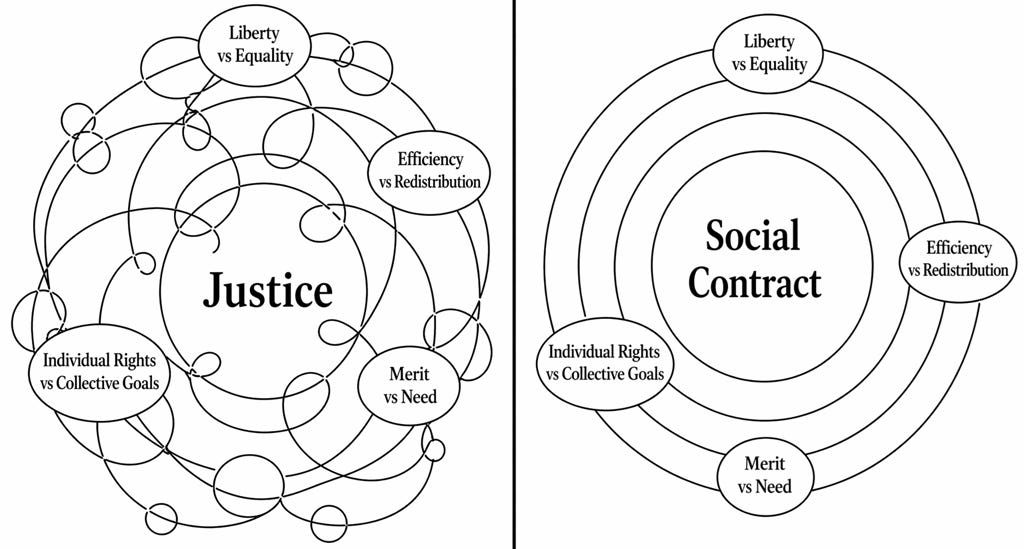
Binmore’s starting point is that social interactions are primarily characterised by cooperation. This is easy to overlook because we tend to notice failures of cooperation rather than its constant presence in everyday life. Yet social cooperation—from not running away from a café without paying to having a product made on the other side of the world delivered to your doorstep—generates benefits. The key question is therefore how to divide those benefits, as well as the work required to produce them. An agreement about how to cooperate, the rules needed to sustain cooperation, and the way the gains from cooperation are shared are a social contract.1
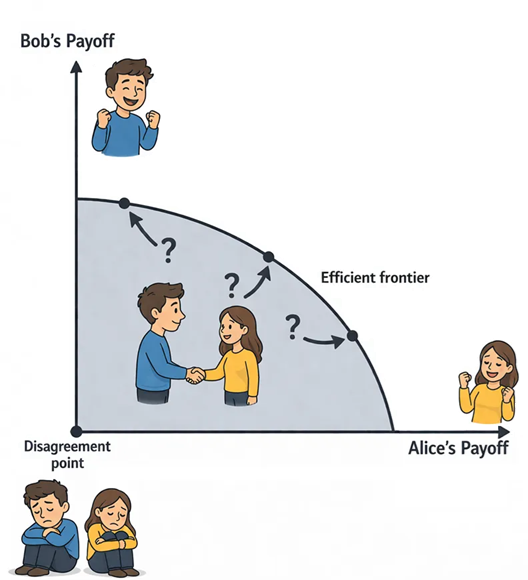
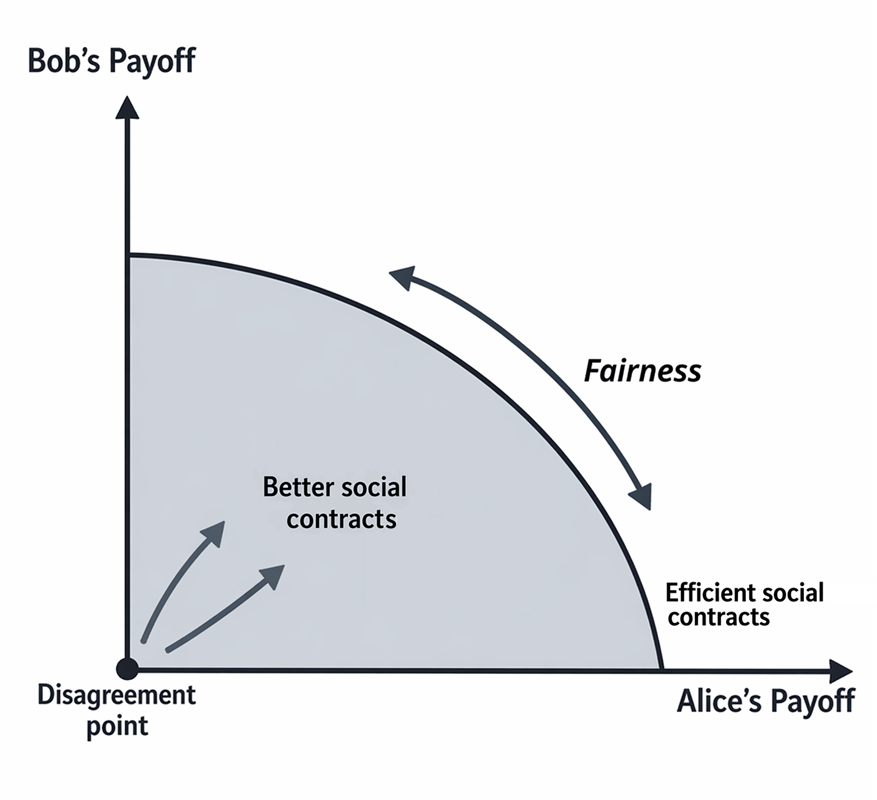
It is common to represent this problem with the picture below. By cooperating, Alice and Bob can get benefits. A social contract organises their cooperation and determines both the benefits and their splits. Some social contracts leave some potential benefits untapped: either Alice, or Bob, or both could get more with a better agreement. A pattern of cooperation is efficient when it is not possible to improve the outcome of anybody anymore without making some people worse off. In short, a social contract is efficient when it does not leave any money on the table. There are typically many efficient social contracts.2
One possible way of organising social life would be to haggle all the time. But haggling is costly. It would take time and effort all day, from deciding who speaks first in a meeting to deciding what to watch on television at home.
Because haggling is costly, it makes sense for social groups to develop conventions that smooth such conflicts by aligning expectations around commonly accepted ways of allocating rights and duties. These conventions are fairness norms. They guide us towards what everybody agrees is the “right” thing to do. They are common knowledge: we know them, we know that others know them, and we know that others know that we know them. When we make a “fair” offer, we do so knowing that it fits an accepted norm, and knowing that the other person knows that too.
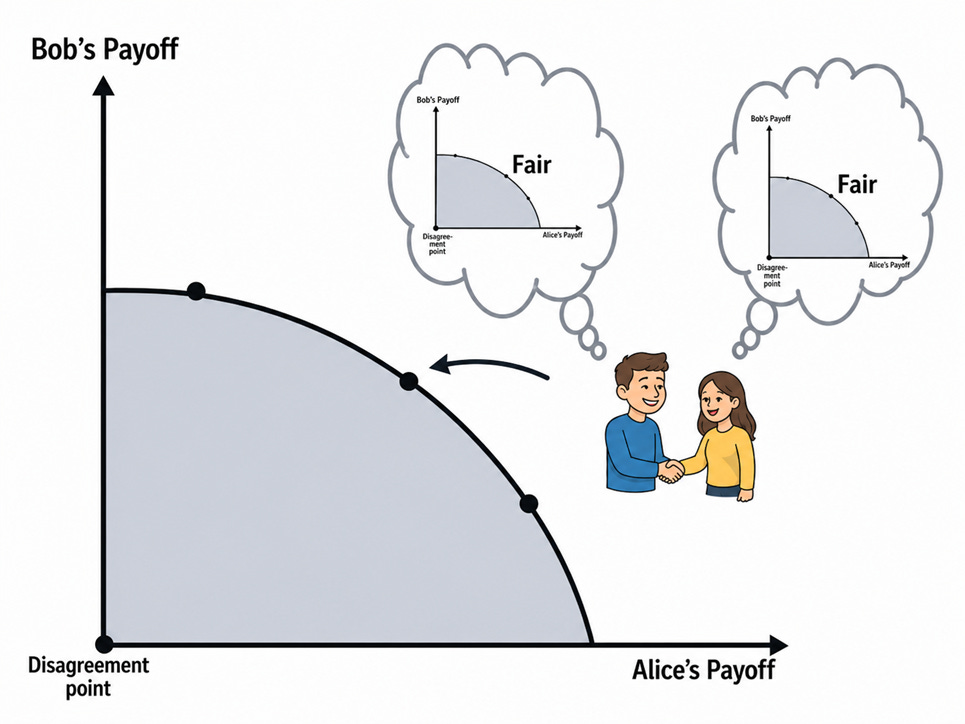
These fairness norms shape social interactions of all kinds, from how long we can speak in a discussion without sounding overbearing to how much of a pay rise we can reasonably ask for after a run of good performance. They may seem invisible because they are typically voiced explicitly only when they are violated. At a cinema, for example, everybody may quietly queue according to a “first come, first served” norm. The norm is stated out loud only when someone breaks it, and another person says, “We were here first.”
Binmore thinks that our moral sense and our psychology of fairness judgements evolved to solve bargaining problems in the relatively small-scale social environments of tribes and villages. We now use those same cognitive tools when we think about social justice in large societies. Sometimes our intuitions are ill-suited to that scale and can mislead us. Even so, Binmore thinks we can build on that psychological apparatus, and on a better understanding of it, to construct social contracts that work in large-scale societies.
Answers to classical questions about social justice
Individual rights vs social goals
A major question in political philosophy is how strongly individual rights should be protected, and when society may fairly ask individuals to sacrifice their own interests for collective goals. At one end of the spectrum are those who treat individual rights as sacrosanct. At the other end are those who think personal interests should largely efface themselves in the pursuit of a better society. In Binmore’s contractualist and naturalist perspective, both extremes are misguided.
The full subordination of individual interests to collective goals cannot work as a sustainable social contract. The idea that, in a good society, people would fully sacrifice their personal interests to the collective has appeared repeatedly in both religious and political ideologies. Karl Marx famously described a socialist society as one where everyone's endeavours would be to contribute to society and make it just.
From each according to his ability, to each according to his needs! — Marx (1875)
Unfortunately, such a vision is poorly suited to a social contract among human beings. Humans are only imperfectly related genetically and have typically no desire to sacrifice themselves completely for others. They will therefore resist a fully collectivist social contract. As E.O. Wilson famously remarked about communism: “Good ideology. Wrong species.” Communism would be much better suited to a society of clones, or near-clones, like ants.3

Given the imperfect alignment of interests within human society, such a philosophy is bound to fail. As Binmore ironically points out, it would encourage people to exaggerate their needs and understate their abilities, to the detriment of social outcomes.
In the socialist utopia that would ensue after the state had eventually withered away, the rule was to be: from each according to his ability—to each according to his need. Human nature being what it is, such an incentive scheme seems designed to convert the able of a large society into the needy overnight. — Binmore (1998)4
The misleading idea of a single common good. One of the mistakes behind the idea of the importance of social goals is even more fundamental. It is the idea that there is a well-defined common good to pursue. It is important to depart from such a commonly expressed view. There would be a unique common good only if we were clones. In that case, there would be a single efficient outcome under full cooperation, where all get the same payoffs because our interests would be perfectly aligned.5
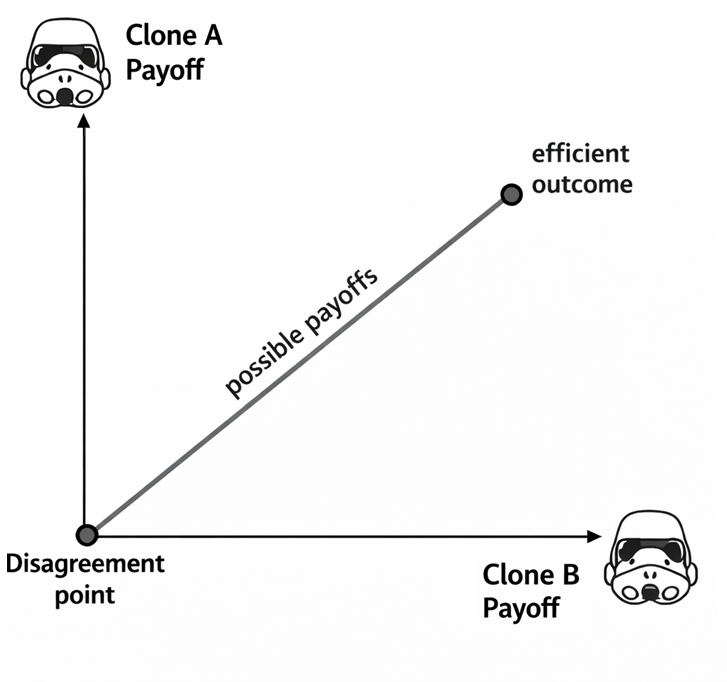
But we are not clones. Our interests are not perfectly aligned, and humans care about how the benefits and costs are divided among themselves.
To say that there is no single common good is not to deny that society can be improved for everyone. When Alice and Bob move from disagreement to a social contract that gives both of them higher payoffs, they find a mutually beneficial arrangement. But their interests still diverge over which mutually beneficial arrangement to choose. Political debate is therefore partly about finding mutually advantageous improvements, but also, and often mainly, about finding an acceptable compromise among competing advantageous outcomes.
To tap into the benefits of cooperation, some constraining rules are required. The fact that people are unlikely to accept a full sacrifice of their interests does not mean that social contracts can be free of constraints on individuals. Working together requires some rules, some modus operandi, about who does what, who gets what and what the sanctions are for failing to respect these rules. People might be willing to accept such constraining rules because repeated interactions create potential mutual gains that align the interests of the members of a group: they have an incentive to make successful cooperation happen.
The agreed-upon rules of cooperation in a group define the rights of the group members. Rights are the actions allowed and the guarantees offered by the social contract. They are the product of the social contract. There are no mystical “rights” that predate the social contract.
Those who claim that “individual rights” pre-exist the social contract are therefore mixing things up. Of course, all else equal, people prefer fewer constraints and being allowed to do more things. They will generally prefer social contracts with more rights, in that sense. But they will also accept constraints when those constraints improve the outcome for all. Who would want to live in a society where everybody has the “right” to choose on which side of the road to drive?
As a metaphor, consider a group of people deciding the rules of a ball sport. May they carry the ball, as in rugby, or touch it only with their feet, as in football? Someone claiming that players have a pre-existing “right” to carry the ball would be missing the point. The issue is precisely to determine which rules will make the game work. What players will be allowed to do is the result of that decision. There is no prior right that already existed before any decision was made.
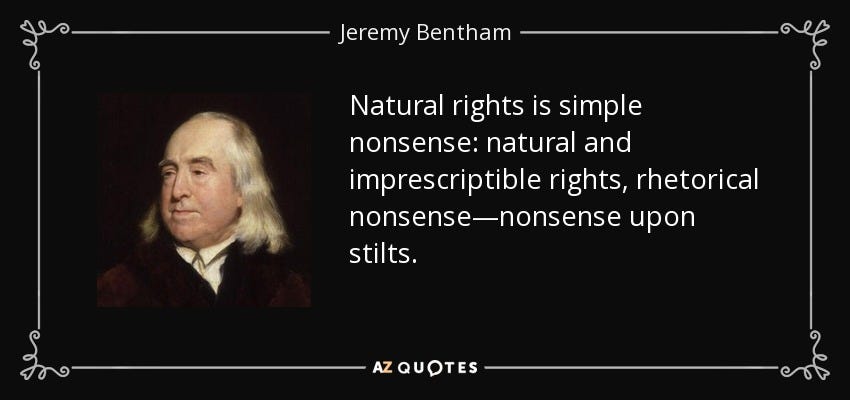
The idea of natural rights might seem appealing, but, as Jeremy Bentham famously put it, it is nonsense.
From this perspective, there is no real dilemma between individual rights and collective endeavour, because there are neither rights to defend in the abstract nor collective goals that stand above individuals’ interests. The whole opposition is misleading. A good social contract contains whatever rules are needed to make cooperation work for all, but no more than that.
Liberty vs equality
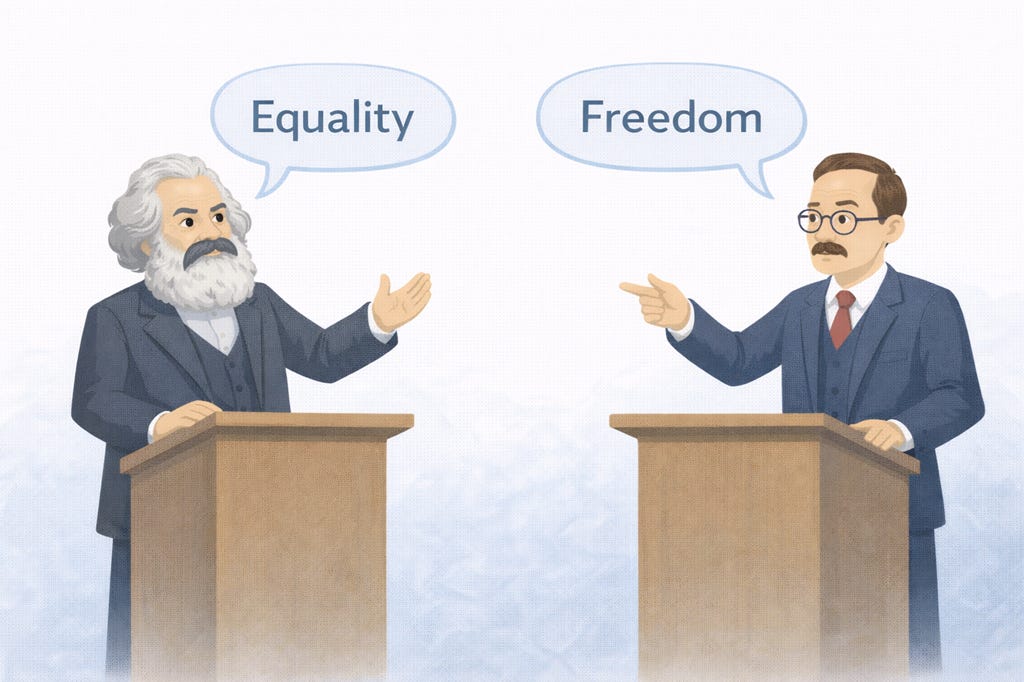
A related debate asks whether a society should aim primarily at liberty or at equality. This question takes on particular importance in modern societies. There is broad agreement on political rights (e.g. every adult should have the right to vote), but much less agreement on economic rights. Some defend leaving the outcomes of market interactions largely untouched. Others favour regulating markets and redistributing resources so that outcomes are more equal than those generated by market exchange alone.
Deontological defence of freedom and markets. For some free-market thinkers, such as philosopher Robert Nozick, it is a matter of principle that the state has no right to interfere with private property rights and the exchanges that follow from them. In the opening line of his book Anarchy, State, and Utopia, he writes:
Individuals have rights, and there are things no person or group may do to them (without violating their rights). — Nozick
But, as with natural rights more generally, the idea that property rights pre-exist the social contract does not make much sense. Property rights are social conventions backed by institutions. As 19th-century liberal thinker Benjamin Constant put it:
Property, to the extent it is a social convention, falls within the scope of political jurisdiction. — Constant (1815)6
So it is a mistake to claim that property rights cannot be touched. Property rights are an important part of a good social contract, but they are the result of that contract. Without police, courts, and a wider willingness to respect ownership, talk of “property rights” would be little more than talk. In a Wild West setting, property would be respected only to the extent that each owner could defend it by force.
Binmore insists that markets are not “natural”. They are part of the social contract:
[I]t seems obvious that the existence of a well-developed social contract is a precondition for the emergence of a market. — Binmore (1998)
Said simply, markets will work and their outcomes will be respected only if people are happy for it to be the case. Experiments in psychology have shown that in many situations, lay people find the “market price” that matches supply and demand unacceptable.
Market transactions are just one kind of social interaction. They do not enjoy a legitimacy that stands outside the social contract. They are accepted only if they fit within it. Nothing says that all market transactions, of every kind, ought to be accepted by everyone. People bring to markets social and moral preferences that were often shaped long before modern market societies existed.7 A social contract that ignored those preferences and relied blindly on market outcomes would not be sustainable, simply because people would disagree with it.
On the left, people often justify taxing the rich by saying that their wealth was created thanks to social institutions. That is not quite Binmore’s argument. Binmore’s point is simpler. Markets can function as mechanisms for allocating resources and organising production only if enough members of society agree to the social contract in which those markets operate. If market outcomes do not sufficiently benefit the worst-off, nothing compels them to keep supporting that arrangement. For the wealthy to enjoy large fortunes, they need enough poorer citizens not to overturn the system politically by, for instance, voting for a communist party. There are no mystical property rights that morally bind the poor not to expropriate the rich. Remember, it is all about social bargaining. It is about finding an acceptable compromise for all.
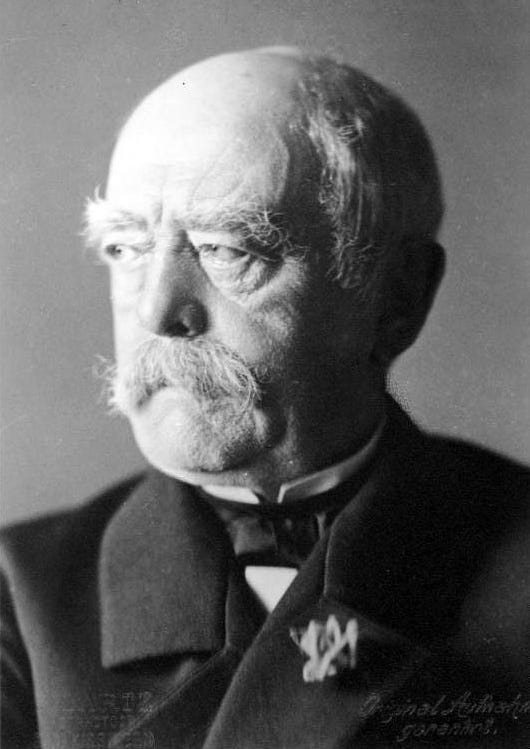
To prevent poor people from expropriating them, rich people might want to offer them a social contract that gives them a better deal. This was, in part, one historical function of the welfare state. Elites often supported social insurance not just out of benevolence, but also to reduce the appeal of revolutionary ideologies. Bismarck, the architect of the German welfare state, put it quite clearly:
My idea was to bribe the working classes, or shall I say to win them over, to regard the state as a social institution existing for their sake and interested in their welfare. — Bismarck
In that perspective, markets are neither to be worshipped nor despised. They are valuable because they tend to generate wealth, and because their decentralised character helps avoid the concentration of power associated with a politically administered economy. But their outcomes are not sacred.8
Consequentialist defence of economic freedom. A different argument for markets is simply that they tend to work better and therefore should be left relatively unconstrained. This is the line associated with economist Friedrich Hayek, for instance. Like most economists, I would agree, and I suspect Binmore would too, that Hayek was right about a great deal in his account of how markets coordinate decentralised information and organise production. But, again, like most economists, I would also say that he took too large a leap in assuming their broad superiority in all relevant circumstances. Markets may fail in many ways, and ensuring that they deliver good outcomes for consumers and producers often requires a lot of regulation.9
Defenders of markets are right, however, to reply that the risk of market failure does not by itself justify political intervention. There is no benevolent policy-maker standing above society. Public Choice theory has correctly emphasised that politicians and administrators pursue their own interests, and these are often at odds with those of the broader public. There is therefore no guarantee that state intervention will correct market failures rather than worsen them.
The sensible conclusion is not that markets are always right or that politics is always worse. It is that proposals for reform should be informed by both the strengths and the limitations of markets and representative democracy. In fact, the design of market rules and political institutions should be treated as a problem in mechanism design: how to structure the rules of the game so that, despite divergent interests, the resulting behaviour leads to good outcomes.
David Hume had anticipated this way of thinking:
When there offers, therefore, to our censure and examination, any plan of government, real or imaginary, where the power is distributed among several courts, and several orders of men, we should always consider the separate interest of each court, and each order; and, if we find that, by the skilful division of power, the interest must necessarily, in its operation, concur with the public, we may pronounce that government to be wise and happy. — Hume (1742, Of the independency of parliament)
Efficiency vs fairness
This is one of the most frequent dilemmas mentioned in political philosophy discussions. In his book, Equality and Efficiency. The Big Tradeoff (2015), economist Okun said
The contrasts among American families in living standards and in material wealth reflect a system of rewards and penalties that is intended to encourage effort and channel it into socially productive activity. To the extent that the system succeeds, it generates an efficient economy. But that pursuit of efficiency necessarily creates inequalities. And hence society faces a tradeoff between equality and efficiency. — Okun (2015)
Sometimes reducing inequality does indeed come at a cost. If inequality is generated by market incentives that encourage work, investment, or innovation, then reducing it may weaken those incentives. Taxing entrepreneurs more heavily may reduce the creation of products and services that benefit everyone.
Yet, from Binmore’s perspective, the standard fairness-versus-efficiency dilemma vanishes. The reason is that it rests on an ill-posed question: fair relative to what? For Binmore, fairness concerns how the gains from cooperation are shared. That immediately separates two issues. First, society should make cooperation as productive as possible and therefore consider only efficient social contracts. Second, among those efficient social contracts, society should choose one. That is where fairness comes in. Fairness norms are used to select one of the efficient social contracts.
Binmore spells out this point in that way:
It is true that people sometimes so focus on the question of how a cake is to be divided that they forget that it may be worse for everybody to divide a small cake equally than a large cake unequally, but such inefficiencies are not somehow inevitable when fairness criteria are applied. […] When fairness criteria are employed in the manner for which they evolved, they are used to select among the set of efficient equilibria. Efficiency therefore takes priority over equity. — Binmore (1994)
So there is no genuine conflict between fairness and efficiency if fairness is understood properly. The fairness question arises only when considering social contracts that are efficient. It would not make sense to consider social contracts that are not efficient.
To go back to Okun’s point, markets may create wealth, and reducing inequality may lead to less total wealth in society. But the most suitable social contract, in the sense of being the most likely to be accepted and sustained, is not the one that leads to the greatest wealth creation without regard for who benefits from it. If a social contract leads to a lot of wealth creation but all that wealth is concentrated at the top, those who are not at the top might instead argue for another efficient social contract that benefits them as well.10
People who defend the sacred nature of property rights might feel that people have no “right” to claim the wealth created by successful workers and entrepreneurs. But a social contract approach à la Binmore does not claim that people have, in principle, a “right” to the wealth created by others in society. It says something more fundamental. All the opportunities for wealth creation, and the rights to enjoy wealth privately, are the products of a social contract. Who gets what and how is part of the negotiation of that contract. There would be little reason for people to support a social contract that creates a lot of wealth if that wealth ends up concentrated only at the top.11

Binmore’s framework gives a rather different perspective on political debate. It is not that equality, liberty, or fairness are absolute principles that should guide political decisions. Instead, political debates about fair decisions need to look for mutually beneficial and sustainable solutions.
What is a just society, on this view? It is a society that abides by commonly accepted norms for solving bargaining questions about how to allocate rights and duties, and costs and benefits, across social life. Those accepted norms define what counts as “fair”. This also helps explain why it is often difficult to give a neat abstract definition of a just society. Our shared principles of justice are often embedded in practices and expectations rather than stated explicitly. They become visible mainly when they are violated.
That is one reason why social justice is typically—as stated by left-wing intellectual Nancy Fraser—experienced negatively, when our norms of fairness are violated.
[J]ustice is never actually experienced directly. By contrast, we do experience injustice, and it is only through this that we form an idea of justice. Only by pondering the character of what we consider unjust do we begin to get a sense of what would count as an alternative. Only when we contemplate what it would take to overcome injustice does our otherwise abstract concept of justice acquire any content. Thus, the answer to Socrates’s question, ‘What is justice?’ can only be this: justice is the overcoming of injustice. — Fraser (2012)
In addition, fairness norms are always partly renegotiated, as different social groups try to improve their position in the social contract, whether in wages, social status, or political recognition. Criticisms of “injustice” and calls to make society more “just” are often, in practice, attempts to move the needle of fairness norms in favour of some groups rather than others. When such movements succeed, society comes to accept a new answer to the question of what counts as just.
This also explains a key feature of political debate. Although politics is largely about the allocation of material resources and social recognition in the Game of Life, it is often conducted in the Game of Morals. Social groups and their representatives do not merely haggle over money and status directly. They argue about merit, need, dignity, and respect, because these are the moral categories through which claims to a larger share of social resources are made.
In the next post, I will look at what kind of fairness norms we actually adopt in society and why.
References
Bentham, J. (1843) ‘Anarchical fallacies’. In: Bowring, J. (ed.) The Works of Jeremy Bentham. Vol. 2. Edinburgh: William Tait.
Binmore, K. (1994) Game Theory and the Social Contract, Volume 1: Playing Fair. Cambridge, MA: MIT Press.
Binmore, K. (1998) Game Theory and the Social Contract, Volume 2: Just Playing. Cambridge, MA: MIT Press.
Binmore, K. (2005) Natural Justice. New York: Oxford University Press.
Constant, B. (2003 [1815]) Principles of Politics Applicable to All Governments. Edited by E. Hofmann, translated by D. O’Keeffe. Indianapolis, IN: Liberty Fund.
Harsanyi, J.C. (1955) ‘Cardinal welfare, individualistic ethics, and interpersonal comparisons of utility’, Journal of Political Economy, 63(4), pp. 309–321.
Harsanyi, J.C. (1975) ‘Can the maximin principle serve as a basis for morality? A critique of John Rawls’s theory’, American Political Science Review, 69(2), pp. 594–606.
Hayek, F.A. (1945) ‘The use of knowledge in society’, American Economic Review, 35(4), pp. 519–530.
Hayek, F.A. (1960) The Constitution of Liberty. Chicago: University of Chicago Press.
Hume, D. (1742) ‘Of the independency of parliament’. In: Essays, Moral and Political. Edinburgh: A. Kincaid.
Marx, K. (1875) ‘Critique of the Gotha Programme’. In: Marx, K. and Engels, F. Selected Works. Vol. 3. Moscow: Progress Publishers, pp. 13–30.
Nozick, R. (1974) Anarchy, State, and Utopia. New York: Basic Books.
Okun, A.M. (1975) Equality and Efficiency: The Big Tradeoff. Washington, DC: Brookings Institution.
Rawls, J. (1971) A Theory of Justice. Cambridge, MA: Belknap Press of Harvard University Press.
Talking about a social contract does not mean that this agreement is explicitly stated. Instead, it is what economists call an implicit contract: a set of rules that are commonly agreed upon and socially respected.
We can think of efficiency as the search for win-win improvements: changes that make at least one person better off without making anyone worse off. An agreement is inefficient if such an improvement is still possible, because it leaves mutual gains unrealised. By contrast, an agreement is efficient when no win-win improvement remains. Once we choose between efficient social contracts, trade-offs are unavoidable: moving from one efficient agreement to another will help some people only at the expense of others.
In social insects like ants and bees, haplodiploidy means full sisters can share around 75% of their genes, which makes their incentive to cooperate unusually strong and helps sustain extreme levels of cooperation.
Merit and needs are bound to play a role in the determination of a social contract for very good reasons. Merit should play a role to start with because rewarding effort is key to making a society successful. In addition, both merit and needs will play a role because they will impact the bargaining power of society members and, therefore, the type of bargain they can get in the social contract adopted at the group level.
To be clear, this is not how our present human psychology works, but how it would work if we were a species of clones. In human societies, clones exist only in the form of monozygotic twins, who are very rare (0.4% of births worldwide). It is therefore not clear that there would have been enough evolutionary pressure for our psychology to have been tuned to treat an identical twin as a full clone, instead of simply as a normal sibling. Ants give us an idea of the lengths to which individuals would be willing to sacrifice themselves in a species of clones.
The liberal tradition has historically been divided between the view that property rights are something that pre-exists social contracts (Locke, Nozick) and the view that they are something that is conventional and emerges from the social contract (Hume, Constant).
Take, for instance, Uber’s surge pricing practice. The company uses an algorithm to detect a surge in demand and raise fares. This increase leads to an increase in available drivers and to travellers with other options opting out of using Uber. As a consequence, a higher demand meets a lower supply, leading to an absence of a queue for a ride. This surge pricing practice is the model of what economists see as a good adaptive behaviour of prices. A sudden strike starts at the main train station? Plenty of drivers will log on thanks to surge pricing. This textbook mechanism received, however, popular backlash in 2014 when several people were taken hostage in a café by a terrorist. Public transport was cancelled, and Uber’s algorithm picked up an increase in demand, triggering a surge in pricing. The consequence was a public outcry: how could Uber profit from such a social tragedy to make more money with higher prices?
The careful reader might question whether “all” members of society are required to approve the social contract, instead of simply a large proportion of members. Here, we need to acknowledge a limitation of his framework, explicitly stated by Binmore. He deliberately leaves aside considerations about coalition formation in a large society because coalitional game theory is an area not yet settled.
As a consequence, he only considers a society composed of two individuals, like Alice and Bob. For them to agree on a social contract, both of them need to agree. When considering society, we should consider Alice and Bob as the representatives of different social groups (e.g. the rich and the poor). Coalitional considerations certainly add important additional insights, which, in my view, do not conflict with Binmore’s core ideas.
The quantity of regulation produced by the European Union to make its single market function is a good case in point. The EU single market rests on more than 12,000 legal acts, covering competition rules but also the broader framework needed to keep markets open and integrated.
The notion of efficiency, as economists use the term, should not be confused with maximising total output. A social contract is efficient if there are no win-win improvements available: there is no feasible alternative that would make at least one person better off without making anyone worse off. In some cases, a more equal arrangement may produce less total output than a more unequal one, yet still be efficient if no further mutual gains are available from changing it.
Consider Alice and Bob cooking and selling pizzas. Bob’s productivity is highly dependent on his wage, while Alice produces the same quantity of pizzas regardless of her income. When Bob receives all the revenue from their cooking activity, he is very motivated, and Alice and Bob make $500 from pizza, all of it pocketed by Bob. If Alice and Bob split the revenue evenly, then they produce $400 worth of pizza, because Bob is slightly less motivated, and take $200 each.
Both contracts can be efficient. When Alice and Bob split the revenue 50-50, it might be that there are no win-win gains to be made. For one of them to get more, the other might have to get less. While the first contract produces the highest revenue, it is clear that it is a poor candidate for a viable social contract. Why would Alice agree to it? The fact that equality might lead to a smaller cake to split should not be confused with a loss in efficiency. This is a subtle but important point that is often lost in these discussions.
For rich people to be able to create wealth and enjoy it, they need enough people to support a social contract that allows them to do so without running the risk of being mugged at every street corner or expropriated by the next government. Social contracts that provide these guarantees might feature some redistribution.
Let me ask a few simple questions to try to understand better.
Let’s say we defeat our enemies in battle and offer them death or slavery and they choose slavery. And they do all the work and we get 90% of the cooperative rewards (10% feeds the slaves). Is this just as long as we all agree to the terms of the social contract? What would make it more just?
Let’s say we have a system where some people are soldiers and some are laborers. The laborers suggest they get 90% because they did all the work. The soldiers suggest they get 90% “or else”? Which is just? What is the more efficient social contract? Is it the point(s) along the spectrum where laborers work and soldiers don’t take everything?
Appreciate your posts as always, Lionel. What I have still struggled with when it comes to this game theory and bargaining account of morality is the question of scope. We are embedded in a nested hierarchy of groups that each claim our loyalty (i.e., our commitment to cooperate). Much conflict (or need for cooperation) is not between "self" and "group" nor between "my team" and "your team" but between "my team" and the larger organization that contains my team and is trying to coordinate its efforts with other teams.
To borrow a classic (if extreme) example: In joining your nation-state's resistance against the conquering empire (which, after, all, just wants to bring "peace, freedom, justice and security" to the Galaxy), you are cooperating at the nation-state level, "defecting" at the empire level, and "defecting" from your family by putting them in danger. Entire mafia-themed epics are built on these tensions.
Each level has a narrative telling you why that level should command your highest loyalty. What's the calculus that tells you what level to optimize for? Any choice you make constitutes a defection at some level, cooperation at another.