

In this series of posts, I am explaining what morality and fairness are. In previous posts, I described how societies whose members have fairly equal bargaining power tend to develop fairly egalitarian social contracts. Here, I discuss what happens in societies with unequal bargaining power. The conclusion reached here is probably the most contentious in this series, so this post is a bit longer in order to develop the conceptual argument and illustrate it with historical evidence.
In 486, Clovis, king of the Salian Franks, defeated Syagrius near the town of Soissons. Syagrius ruled the last substantial Roman enclave in northern Gaul. This event marked the end of the Roman era on the territory of what is now France and the start of the Frankish kingdoms, which would eventually give the country its present-day name.
After a victory, Frankish soldiers apparently shared the booty among themselves by drawing lots to allocate valuable items. This convention applied to all, including the king. During the allocation of the booty, however, Clovis asked to receive more than his allocated share. He wanted a specific vase, described as being of marvellous size and beauty, to be added to it:1
I ask you, O most valiant warriors, not to refuse to me the vase in addition to my rightful part.
One soldier stood up against this breach of the warriors’ social contract:
Thou shalt receive nothing of this unless a just lot give it to thee
The soldier then struck the vase, refusing Clovis’ claim to more than his fair share. One year later, as Clovis was inspecting his soldiers’ equipment, he came face to face with that soldier. Criticising the poor condition of his equipment, he threw the soldier’s axe to the ground. As the soldier bent down to pick it up, Clovis raised his own axe and split the soldier’s skull, uttering the words:
This is what you did to the vase at Soissons.
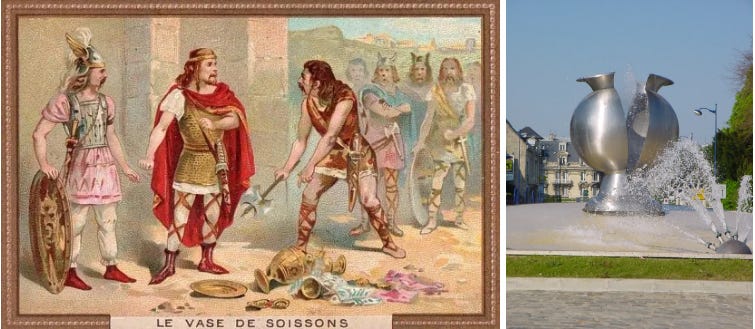
This story has an important lesson: a social contract has no binding force in itself. It can hold only if the balance of power makes it a stable compromise. For an egalitarian social contract to persist, bargaining power needs to be fairly equally distributed among members of society. If power is concentrated in some hands, anyone who tries to uphold an egalitarian social contract, like the Frankish soldier, risks being sanctioned by the exercise of raw power.
The consequence is important: when bargaining power is unequally distributed in society, the prevailing social contract cannot be egalitarian. In fact, what is seen as fair and just in an unequal society will typically justify existing inequalities in status and resources. I discuss here why, and how this helps explain differences in views about fairness across times and places.

Fairness and bargaining power in society
Many societies have had fairness norms at odds with those in modern liberal democracies.
Countries around the world have very different fairness norms. For instance, Iranian law states that in cases of wrongful death or bodily injury, a woman is worth only half a man for the financial compensation paid to the victim or the victim’s family (diya, or “blood money”).2
It is not just geography. A given country typically had very different fairness norms in the past from those it has now. Modern societies profess to give equal respect to all citizens, whatever their origin or life situation. This was not the case throughout history. For instance, in the Roman Republic, citizens could vote in the centuriate assembly, but it explicitly gave more influence to the rich than to the poor. Ancient authors presented this as a fair constitutional arrangement: those with greater property, greater military obligations, and a greater stake in the commonwealth were granted greater political weight. Cicero defended the principle explicitly in De re publica:
[T]hose who had the greatest power in voting were those with the greatest interest that the civil community was in the best form. — Cicero, De re publica 2.40
As the novelist L. P. Hartley famously wrote:
The past is a foreign country; they do things differently there. — Hartley (1953)
Why are there so many different fairness norms across places and times? Why do some of them look so unfair to our modern eyes? Are citizens of modern liberal democracies morally superior? Were ancient people either evil or ignorant? Have we attained a better knowledge and understanding of what is “right”, leading to “moral progress” and to the norms we have now?
The implicit, and sometimes explicit, answer given in modern liberal democracies often seems to be “yes”. From the perspective of this Substack, one should always be sceptical of stories that too quickly dismiss seemingly puzzling behaviour as irrational or mistaken. Instead, one should look for possible good reasons behind such behaviour. There are good reasons to think that if some societies have less egalitarian fairness norms, it is not because their citizens were less enlightened than us, but because fairness norms have to solve different problems in more equal and more unequal societies.
Fairness as a reflection of the long-run balance of bargaining power
Game theorist Ken Binmore has shown how fairness norms can be explained as generic solutions to the recurring problems of bargaining over the allocation of rights and duties in social situations.
An important and necessary implication of this approach is that, as solutions to bargaining problems, fairness norms will, in the long run, reflect the structure of bargaining power in a given society. They will be egalitarian in equal societies and inegalitarian in unequal societies. This answer can seem somewhat shocking at first. Would fairness, which is about what is just and right, really be a reflection of power balances?
However, once we understand fairness norms as solutions to social bargaining problems, Binmore’s conclusion is unavoidable. Fairness does not come from external principles that exist in the universe and bind us. Fairness norms are human solutions. They are the rules for playing the game of life properly and agreeing on everyone’s due in society.
Fairness norms allow people to avoid having to haggle all the time in real life and to agree quickly on how to split rewards and costs in their interactions. But they can work in practice only if they are not too far from what people could actually claim using their raw bargaining power in a hard-fought bargaining process. Only norms that are broadly in line with actual differences in bargaining power will tend to last. Those that are not will be eroded as people with greater bargaining power than the existing norm recognises progressively chip away at them.
A soldier might ask the king to abide by a principle of equality, but if the king can kill that soldier later on, the equality norm will not persist. Soldiers will rationally prefer to let the king have his way rather than risk their lives. New stories and norms can then arise, establishing as “fair” the share that the king can claim, given his greater bargaining power.
Social views on justice tend to justify social inequalities. The shocking truth is that it is not a bug; it is a feature. It is not an error made by those expressing these views. It is the way fairness norms work. They are social agreements, which, in the long run reflect the distribution of power in society.
Fairness in unequal societies: an ideological veneer?
There is a parallel here with one of Karl Marx’s key ideas. He got many things wrong about how society works, but he got at least one thing right: the social contract of a society reflects the distribution of power in that society.
The ruling ideas are nothing more than the ideal expression of the dominant material relationships, the dominant material relationships grasped as ideas. — Marx and Engels (1845–46)
In Marxist circles, this point is typically presented as a morally charged criticism rather than as a factual observation. It is easy to jump from Marx’s observation to the conclusion that dominant ideas about what is just and fair in society are a form of intellectual scam, an ideological veil used to convince dominated classes to accept their lower status. As the French writer La Fontaine put it in his retelling of Aesop’s fable of the wolf and the lamb:
The powerful always find a justification for what they want to do.
In a similar vein, the left-wing economist Thomas Piketty wrote a 1,100-page book about ideology and inequality, and his discussion of the role of ideology was largely limited to the claim that it acts as a legitimisation device:
Every human society must justify its inequalities: unless reasons for them are found, the whole political and social edifice stands in danger of collapse. Every epoch therefore develops a range of contradictory discourses and ideologies for the purpose of legitimizing the inequality that already exists or that people believe should exist. — Piketty (2020)3
From that perspective, dominated classes are misled into accepting their own servitude. They fall prey to what Marxists have called “false consciousness”, defending ideas that are actually opposed to their class interest. The justifying ideology is useful because it prevents people from seeing their real interests and rebelling. It is a kind of glue that holds together a society with unequal relationships.4
One thinker who helped popularise this view and gave it important concepts is the French sociologist Pierre Bourdieu, who proposed the term “doxic acceptance” to describe how dominated groups adopt conceptual frames shaped by dominant groups, thereby justifying domination. In Bourdieu’s famously convoluted style:
When the dominated apply to what dominates them schemes that are the product of domination, or, to put it another way, when their thoughts and perceptions are structured in accordance with the very structures of the relation of domination that is imposed on them, their acts of cognition are, inevitably, acts of recognition, submission. — Bourdieu (2001)
The idea that ruling ideas about fairness are an ideological veneer used to placate dominated groups is, however, unsatisfactory. If what matters are actual relations of power, why do powerful people need justifications in the domain of ideas? What role do these justifications play?
Another question is “why would dominated classes believe in spurious justification of their situation”? Contrary to Bourdieu’s picture of domination as sustained by the internalisation of dominant categories, people are not simply gullible recipients of ideas that run against their interests. The idea that people accept unequal fairness norms simply because they are socialised into accepting their justifications is therefore suspicious: the psychological evidence points instead to people being overly sceptical and very apt at identifying when their interests are not met in social situations.5
The reality of the balance of power in unequal societies
Prevailing ideas about justice and fairness reflect the formulation of a social contract that is in line with the long-term balance of power between social groups. The notion of “balance” is important here because it is easy to forget that there is a balance of power even when power is unequally distributed.
The notions of dominant and dominated, popular in modern left-wing circles, can be misleading because they suggest a radical all-or-nothing view of power: some have it all, while others have none. One of the most important facts to appreciate about power imbalances is that inequality in power is always graded.
Robert Dahl is the political scientist who proposed the definition of power most commonly accepted by those trying to characterise this notion: Alice has power over Bob if she can get Bob to do what Alice wants.6 One key insight from Dahl’s work on power is that even in unequal relationships, the weaker partner nearly always has residual power because the welfare of the stronger depends on the weaker party’s willingness to cooperate.
In a company, the quality of the work an employee produces for a manager depends on that employee’s willingness not to shirk when the manager is not looking. In a slave society, output depends on enslaved workers’ willingness not to sabotage production to the extent they can. In a patriarchal society, the quality of a husband’s domestic life depends on the care, effort and cooperation of his wife.
Hence, even in unequal relationships, there is a need to negotiate a modus vivendi about who should do what and who should get what. This modus vivendi is not equal, but it nonetheless limits the claims of the most powerful partner, and these limits reflect the balance of bargaining power in the relationship.
All stable human relationships, without exception, represent a compromise of sorts—including the modus vivendi established between the victor and the vanquished after a war. The balance of power may be very unequal in such a relationship. But even a slave is not totally powerless. Only a stupid master does not eventually learn to be sparing with the whip in seeking to persuade a slave to labor efficiently on his behalf. Those who fail to curb their brutal impulses find themselves sitting on a powder keg. — Binmore
Because of the strong principles of equality at the heart of our modern fairness norms, the idea that fairness could regulate highly unequal relationships typically conflicts with our intuitions. But we should beware of intuitions shaped in the cosy environment of liberal democracies, where people vote for their leaders and can say what they think in the street without ending up in jail or worse. The fairly equal distribution of bargaining power in society is an unusual feature in the history of large-scale societies since they appeared around 4000 BC.
Fairness norms across times and places
Looking at what people say in an unequal society about fairness supports Binmore’s view: people will call their masters “fair” to the extent that they use, but do not abuse, their greater power. In that perspective, ruling ideas about fairness in an unequal society do indeed justify the domination of the group or groups in power. But they do not do so against the interests of the dominated classes. They reflect the balance of power in that society.
As a consequence, the unequal social contracts of the past could be seen as fair by those dominated.
In an aristocratic society, even the lower orders commonly accepts that it is right and proper that they be regarded as unworthy. — Binmore (2005)
Since this is alien to our modern perspective, it is useful to look at a range of historical examples.
Fairness in societies with class inequalities
The French Revolution is famous for stating that every man (not woman) is born equal in rights. If this is notable, it is because this view was not the one prevailing throughout history, even among the poorest members of society.
In feudal societies, where warlords with a monopoly on military violence ruled over territorial domains, fairness norms did not grant unlimited power to the local lord. They defined reciprocal, though asymmetric, rights and duties. A serf owed labour, rents and dues, but also held customary rights and had some protection against arbitrary treatment. The lord enjoyed superior status, but was expected to protect dependants and uphold local order. In such a setting, a “fair” relationship was not an equal one, but one that respected the recognised terms of this asymmetric bargain.
Feudal Europe, 14th century. A rare document from 1341 in England stated the rights and duties of the lord of the manor of Alrewas in Staffordshire. The tenants submitted the document to the lord for him to sign and described him as a “good lord”:
Sir Philip de Somerville, we are told, had “governed the manor amicably and graciously these last forty years and more”, and has “more knowledge than anyone else living of the certainty of the customs of the tenants”. So, when disagreements had arisen on the manor — between the tenants and Sir Philip’s officials, we should note, not between them and Sir Philip himself — it was to him, “trusting in his faith as a good lord’” that they appealed.7
Tokugawa Japan, 17th-19th century. In his essay Benevolent Lords and Honorable Peasants, historian Irwin Scheiner describes how peasants did not reject hierarchy as such. Instead, when they protested, they framed their demands in terms of the lord’s duty to be benevolent and their own duty to remain honourable. Later historians summarise this as a political language in which the legitimacy of unequal order was accepted, provided rulers fulfilled the moral obligations of lordship. The historian Luke Roberts, who worked on the petition box in eighteenth-century Tosa, also pointed to petitions by peasants praising a “benevolent lord”.
E. P. Thompson’s idea of a “moral economy” captures this logic well. He observed that eighteenth-century crowds did not typically protest in the name of political equality or market freedom. They defended customary expectations about fair prices, subsistence, and the obligations of the powerful. Their protests were therefore not outside the existing moral order. They appealed to its recognised limits.
It is possible to detect in almost every eighteenth-century crowd action some legitimizing notion. By the notion of legitimation I mean that the men and women in the crowd were informed by the belief that they were defending traditional rights or customs; and, in general, that they were supported by the wider consensus of the community. On occasion this popular consensus was endorsed by some measure of licence afforded by the authorities. — Thompson (1971)
The same point is central to Barrington Moore’s historical sociology of injustice. Moore argues that moral outrage often arises when relations of mutual obligation are violated. Such obligations do not imply equality. They can coexist with hierarchy and authority, but they still require some form of reciprocity:
[A] conception of what social relationships ought to be. It is a conception that by no means excludes hierarchy and authority, where exceptional qualities and defects can be the source of enormous admiration and awe. At the same time, it is one where services and favors, trust and affection, in the course of mutual exchanges, are ideally expected to find some rough balancing out. — Moore (1978)
Looking again at the Soissons vase story, the type of norms that will arise when the king can kill a rebellious soldier with few consequences will not be egalitarian. But a king cannot claim everything either. Soldiers can rebel, desert, or support a rival. The king therefore needs to leave them enough to make loyalty preferable to defection.
Fairness in societies with slaves
The historical record of the words of slaves or former slaves is scarce, but here again we observe that they could consider some of their masters fair and good.
In ancient Rome, little writing from slaves has survived, but one type of writing persisted in Roman epitaphs where dependants and freedmen could speak of superiors in warmly deferential terms. For example, one epitaph read:
To my old master and mistress I was an obedient servant […] for they gave me freedom.8

In the United States, the record of former slaves contains many instances of them describing their masters as “good”. For instance, one former slave, born around the Civil War, made the following statement when he was interviewed at 77:
Our folks’ master was William E. Johnson. Oh Lord, they was just as good to us as could be to be under slavery. […] Oh Lord, my parents sho was well treated. Yes ma’m. If he had a overseer, he wouldn’t low him to whip the folks. He’d say, “Just leave em till I come home.” Then he’d give em a light breshin’.
In Islamic societies, the written record from enslaved people is also scarce, but here again we find evidence that slavery was not experienced simply as arbitrary domination. It was also governed by local expectations about what masters could legitimately demand and what they owed in return. In a collection of testimonies from the Gulf, Sanqur bin Abdul Khair, a Swahili slave in Muscat, made this contrast very clearly in 1931:
I was well treated by him. When my master died about 8 years ago, I was transferred as an inheritance of the estate to his son Abdullah bin Shaikh Sultan Al Naimi. The latter was ill treating me. He never provided me with sufficient food and clothes. If I ever happened to ask him for a little money which is earned by me and taken by him, he used to beat me severely. Thereupon I seized the opportunity and ran away from Braimi.9
This statement illustrates how domination could be judged excessive within the moral terms of an unequal order. Sanqur does not present his escape as an abstract rejection of slavery, but as a response to a master who failed to meet the recognised obligations of his position: providing sufficient food and clothing, allowing some access to earnings, and refraining from severe violence. Once these limits were breached, the relationship became unjust even by the standards of that unequal social world. Sanqur then seized an opportunity to run away.10 11
Fairness in patriarchal societies
Our modern societies are characterised by equality in rights between men and women, but historically inequality in status, rights and social worth was frequently not only enshrined in law, but accepted by both men and women.
It is particularly noticeable that women who historically promoted improvements in women’s position often argued within an acceptance of patriarchal society, giving men and women different places in social life.
In the USA in 1819, Emma Willard, one of the major early advocates of women’s education in the country, argued in favour of women’s access to education as a way to help them better fulfil their roles as mothers and wives:
Domestic Instruction should be considered important in a female [school]. It is the duty of our sex to regulate the internal concerns of every family; and unless they be properly qualified to discharge this duty, whatever may be their literary or ornamental attainments, they, cannot be expected to make either good wives, good mothers, or good mistresses of families: and if they are none of these, they must be bad members of society; for it is by promoting or destroying the comfort and prosperity of their own families, that females serve or injure the community. — Willard
In Victorian England in 1855, Caroline Norton, an early feminist who campaigned to reform women’s legal position in marriage, explicitly affirmed male superiority. In A Letter to the Queen, she wrote:
The natural position of woman is inferiority to man. Amen! That is a thing of God’s appointing, not of man’s devising. - Norton
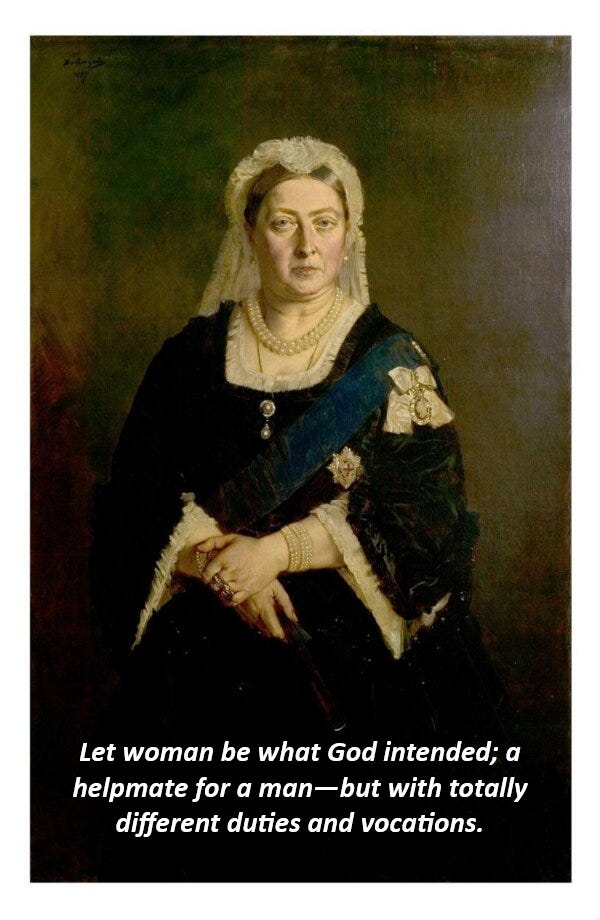
Even Queen Victoria, the female head of state at the time, wrote in opposition to women’s rights in a private letter to Prime Minister Gladstone in 1870.
Let woman be what God intended; a helpmate for a man—but with totally different duties and vocations.
This is by no means a pattern specific to Western history.
In modern Iran, women face harsh repression to comply with strict rules constraining their behaviour: compulsory veiling, no dancing, no singing, and so on. A morality police enforces these rules, often violently, for instance by arresting women who reveal too much hair under their veil. This police force includes many women. Typical patrols are mixed male-female units.

The anachronistic nature of modern visions of fairness
If people in the past accepted very unequal social organisations as fair, it is because, given the balance of power they faced, it often made sense to accept unequal norms and create a workable modus vivendi.
It would have made little sense for a 13th-century English serf to assess the fairness of his world by asking whether it satisfied democratic equality, since such an order was not within the feasible set of political possibilities available to him. Monty Python and the Holy Grail famously features a peasant rejecting the authority of King Arthur by mocking the myth that the Lady of the Lake granted him his authority:
Listen, women lying in ponds distributing swords is no basis for a system of government. Supreme executive power derives from a mandate from the masses, not from some farcical aquatic ceremony.
The outcome of the encounter is telling: the king ends up beating him. In a world where feudal lords controlled organised violence, serfs had no interest in demanding an unattainable political equality. What they could more realistically demand was that lords respect the customary limits of their authority.

Understanding fairness without moral absolutes
Not a justification of past inequality
Listing statements by past slaves who described some masters as “good” or “fair” is in no way saying that slavery is acceptable relative to our modern fairness norms; it is to stress that our modern norms do not reflect how people in such unequal societies assessed what was “good” and “bad” in the same way we do now.12
Nonetheless, it might seem like saying “see? some of them were happy”. This is not the point I am making. To be clear, the level of inequality in past feudal, patriarchal and slave-holding societies is far outside of what is deemed acceptable nowadays. Our moral preferences, including mine, have been shaped in liberal democracies and strongly reject the models of these past societies.
But one should not shy away from the implications of a naturalistic take on fairness. If fairness regulates a modus vivendi between dominant and dominated in unequal societies, it is indeed the case that, in the past, those dominated who experienced overlords and masters who respected this modus vivendi might have considered these as “fair”, “good”, “charitable”, and so on. Fairness norms regulated the rules of an unequal game, and respecting these rules was seen as fair. This is a factual statement, and we have ample records of this having been the case.
More importantly, we have to recognise that there is nothing more to fairness than this. We might have strong moral intuitions that these social relations were unjust and that we should condemn them. But we condemn these societies from within our modern liberal-democratic outlook. This is different from saying that people in those societies were making a moral error in the way they might have been making a factual error about medicine or astronomy. If fairness norms are social rules, they are not external principles given by God, written into the fabric of the universe, or dictated by pure reason. They are human conventions that emerge in particular social worlds. This does not make them arbitrary or meaningless. It means that fairness has to be understood relative to the social order in which it operates.
Using the rules of a board game as a metaphor is useful. The game of chess did not always have its current rules. The modern game emerged gradually, especially between about the 15th and 19th centuries. For instance, the queen and the bishop were initially much weaker. I am totally entitled today to say that I dislike these past rules of chess and that our modern version of the game is better according to my taste or because of the quality of gameplay it generates. But it would not make sense for me to argue that people were playing chess “wrong” in the past, that they were making a mistake because they did not follow the “proper” rules of chess we now use. People were playing with different rules, and that’s it.
The evolution of moral norms
Our tendency to judge past actions as “wrong” based on our modern moral standards is often associated with a sense of moral superiority relative to our ancestors. We should be sceptical about such feelings. Who says that if we had lived in the past, we would have been morally outstanding and opposed the then-accepted social contract? Can we claim to be outstanding now, judging our present moral contract on the basis of deep knowledge of absolute moral principles? Or are our views mostly shaped by where and when we were born? Should we morally condemn the philosopher Aristotle because he thought slavery was a natural order of society? Binmore has the courage to adopt a modest stance here:
If I had been brought up in classical Greece, I would no doubt have joined Aristotle in regarding the enslavement of barbarians as entirely right and proper. — Binmore (2005)
This exact same point was made, in a provocative way, by comic Ricky Gervais, who almost seems to have read Binmore on that matter:
I am anti-racist, of course I am. But I am willing to admit that if I had been born 300 years ago and I was white and wealthy, I’d have probably have owned slaves. I’d have been nice to him […] I’d be the best slave owner […] If one of them got a bit too familiar I would have to punish him […] My point is morality evolves. It moves with the times, like everything else.13
Many dominant accounts of morality assume a Newtonian picture of fairness: one universal moral frame, valid for all societies at all times. Cicero expressed this view when he wrote:
There will not be different laws at Rome and at Athens, or different laws now and in the future; but one eternal and unchangeable law will be valid for all nations and all times. — Cicero
The irony is that Cicero could affirm this eternal law while defending a Roman order that gave greater political weight to the wealthy and rested on slavery, both of which are far outside what modern liberal democracies regard as acceptable.
The naturalistic perspective developed here departs from this Newtonian picture. It does not treat morality as absolute. It is closer to a relativistic picture: there is no single external clock of fairness against which all societies can be measured. This does not mean that fairness is meaningless, that rules of fairness are empty words, or that they could take any form. Fairness norms everywhere respond to the same basic problem: how to sustain cooperation despite conflicts over rights, duties, costs and benefits. But the solution to that problem depends on the local social world, especially on the balance of bargaining power. Fairness norms can therefore be understood only relative to the society in which they operate. We can still have a general theory of fairness, but without believing in universally true principles of fairness existing outside human societies. There are only humans, their conflicts, their need to cooperate, and the rules they adopt to regulate their interactions in particular social settings.
We can still favour some social contracts
The absence of universal and absolute moral principles does not mean that we cannot defend some forms of social organisation as better than others. Social contracts can be better or worse in at least two ways. Some are better at organising cooperation and producing the benefits of shared social life. Others are more stable because they reflect a bargain in line with the relative power of different groups. Both features matter. A social contract that fails to produce enough benefits will disappoint its members. A social contract that fails to reflect the balance of power will generate resentment, costly conflict, and pressure for change.
In our modern societies, where power is relatively widely distributed, liberal-democratic principles have something important in their favour: their egalitarian nature. As I have written in a previous post:
Democratic institutions can be understood as a form of social equilibrium for organising both cooperation and conflict in society. Among the possible political arrangements, democracy is likely to result in better outcomes for most people.

Past societies, and present ones with highly unequal fairness norms, are not composed of people who differ fundamentally from us in cognitive capacity or moral sense. They have not upheld unequal norms because they are, or were, morally inferior or less enlightened. They have simply played an equilibrium of the game of life in their own societies, given the structure of the game they faced.
From this perspective, the relative egalitarianism of our own fairness norms reflects the fairly equal distribution of bargaining power in our societies. Where bargaining power is more evenly distributed, more symmetric norms tend to emerge. But this should not lead us to conclude that equality is the essence of fairness.
For modern societies like ours, this view implies a simple question: what rules of fairness can form the basis of a workable and efficient social contract? Such a contract must make society work for its members and allocate rights and duties in a way that is broadly acceptable, thereby minimising conflict.
The observation that, in the long run, fairness norms track the balance of power in society paves the way to another question. How do fairness norms change over time? What are the roles of revolutions and popular movements that have seemingly transformed the course of history and led to greater equality in modern liberal democracies? This is the topic of my next post.
References
Alpers, E.A. and Hopper, M.S. (2017) ‘Speaking for themselves? Understanding African freed slave testimonies from the Western Indian Ocean, 1850s–1930s’, Journal of Indian Ocean World Studies, 1, pp. 60–88.
Binmore, K. (1994) Game Theory and the Social Contract, Volume 1: Playing Fair. Cambridge, MA: MIT Press.
Binmore, K. (1998) Game Theory and the Social Contract, Volume 2: Just Playing. Cambridge, MA: MIT Press.
Binmore, K. (2005) Natural Justice. Oxford: Oxford University Press.
Birrell, J. (2014) ‘Manorial custumals reconsidered’, Past & Present, 224(1), pp. 3–37.
Bourdieu, P. (2001) Masculine Domination. Translated by R. Nice. Cambridge: Polity Press.
Cicero, M.T. (c.54–51 BCE) De re publica. Translated in Keyes, C.W. (1928) On the Republic. On the Laws. Loeb Classical Library 213. Cambridge, MA: Harvard University Press.
Dahl, R.A. (1957) ‘The concept of power’, Behavioral Science, 2(3), pp. 201–215.
Gardner, J.F. (2011) ‘Slavery and Roman law’, in Bradley, K. and Cartledge, P. (eds.) The Cambridge World History of Slavery, Volume 1: The Ancient Mediterranean World. Cambridge: Cambridge University Press, pp. 414–437.
Gregory of Tours (1916) History of the Franks. Selections translated with notes by E. Brehaut. New York: Columbia University Press.
Hartley, L.P. (1953) The Go-Between. London: Hamish Hamilton.
La Fontaine, J. de (1668) ‘Le loup et l’agneau’, in Fables choisies, mises en vers. Paris: Claude Barbin.
Marx, K. and Engels, F. (1845–46) The German Ideology. Moscow: Progress Publishers.
Mercier, H. (2020) Not Born Yesterday: The Science of Who We Trust and What We Believe. Princeton: Princeton University Press.
Moore, B. Jr. (1978) Injustice: The Social Bases of Obedience and Revolt. White Plains, NY: M.E. Sharpe.
Norton, C. (1855) A Letter to the Queen on Lord Chancellor Cranworth’s Marriage and Divorce Bill. London: Longman, Brown, Green, and Longmans.
Piketty, T. (2020) Capital and Ideology. Translated by A. Goldhammer. Cambridge, MA: Belknap Press of Harvard University Press.
Scott, J.C. (1990) Domination and the Arts of Resistance: Hidden Transcripts. New Haven, CT: Yale University Press.
Thompson, E.P. (1971) ‘The Moral Economy of the English Crowd in the Eighteenth Century’, Past & Present, 50, pp. 76–136.
Willard, E. (1819) An Address to the Public, Particularly to the Members of the Legislature of New-York, Proposing a Plan for Improving Female Education. Middlebury, VT: J.W. Copeland.
This story is retold by the sixth-century historian and bishop Gregory of Tours, nearly 100 years after the fact. Gregory explains that the Franks, still pagan, had looted churches during the campaign. Possibly wishing to maintain good relations with the local clergy, Clovis told the bishop’s envoys that, if the vase fell to him in the division of booty, he would return it. He then asked his warriors to let him have this vase in addition to his rightful share.
Though in a later interview, Piketty stated that “ideology is always more than this: it’s more than just a pure veil for your class interests.”
To be clear, ideologies can help coordinate on one social equilibrium rather than another. Hence, in that sense, an inegalitarian ideology can help maintain an unequal society. However, this effect is not without limit. Competing ideologies can arise whose adoption by large parts of society could lead to a switch in equilibrium. The left-wing description of ideologies as maintaining an unequal social order lost the initial materialist perspective from Marx, where ideologies reflect the structure of the social order rather than impose it. See my post on how political ideologies work.
See Mercier (2020).
Dahl (1957).
Birrell (2014)
Alpers and Hopper (2017).
A valid concern with such quotes is that they do not necessarily reveal unqualified private endorsement. As James C. Scott (1990) argued, unequal societies often produce a public language of deference shaped by dependency, fear and strategic caution. This qualification does not undermine the point made here. The argument is precisely that this language of deference was part of the accepted moral grammar of these societies. Even when dominated groups resented particular masters, lords, or husbands, their complaints often appealed to the recognised duties attached to superior status rather than to an egalitarian rejection of hierarchy itself. These quotes are therefore evidence of how fairness was understood within unequal social orders: a master, lord or husband could be judged “good” or “fair” when he respected the accepted limits of his superior position.
Another illustration of the fact that these societies had norms of fairness that regulated slavery is that there is a record of voices condemning abuse of power. In Rome, Domitian and later Hadrian prohibited castration; Claudius ruled that sick slaves abandoned by their masters could become free; Antoninus Pius treated the killing of a slave by a master as a punishable offence and allowed action against extreme cruelty (Gardner 2011). To be clear, these measures were not egalitarian. They did not deny the master’s superior status or the legitimacy of slavery. They nonetheless show that even in a slave society, domination was not necessarily treated as unlimited. The law could recognise certain abuses as going beyond what a master was entitled to do.
This is explicitly a form of moral relativism, though not an absolute one. Moral statements are meaningful and the “Game of Morals” is real. But its rules are not universal across times and places. See my post on relativism.
https://scrapsfromtheloft.com/comedy/ricky-gervais-mortality-transcript/
This is a genuinely interesting application of Binmore's framework, and the core descriptive thesis (that fairness norms reflect the long-run balance of bargaining power) is well-supported by the specific historical evidence you marshal. But I think that account is incomplete in a way that matters, because it only addresses one of the two recognized components of fairness as a moral foundation.
Jonathan Haidt's Moral Foundations Theory identifies two distinct intuitions that both operate under the heading of "fairness": equality (equal treatment, anti-domination) and proportionality (reward commensurate with contribution, merit, and effort). Your article focuses almost entirely on the equality dimension, more equal bargaining power produces more egalitarian norms, but proportionality is largely absent from the analysis. This isn't a minor gap, because proportionality turns out to be doing enormous amounts of moral work both historically and in modern liberal democracies.
Consider the surgeon and the burger flipper. Modern western societies, your own example of relatively equal bargaining power, accept very large income and status differentials between them, and crucially, burger flippers themselves typically endorse this as fair. This can't be explained purely by the surgeon's superior bargaining leverage over minimum wage workers.
What's actually happening is an intersubjective judgment of proportional desert: the surgeon's work is more valuable, more difficult, and accessible to far fewer people for reasons that are themselves recognizable as genuine rather than arbitrary. The scarcity of good surgeons isn't socially constructed; it's grounded in real cognitive and technical demands that most people cannot meet regardless of opportunity. The proportionality intuition fires even in anonymous one-shot experimental conditions where no power differential exists, which is difficult to square with a purely bargaining-power account.
But proportionality as fairness isn't a feature of modern liberal democracy specifically, or a byproduct of relatively equal bargaining power. It appears persistently across highly unequal historical arrangements and your own historical evidence, read carefully, supports this.
The clearest example may be Imperial China's keju examination system, which selected government officials through competitive written examinations for more than a millennium. This was among the most hierarchical, power-concentrated societies in human history, yet it voluntarily institutionalized a meritocratic selection mechanism that explicitly overrode hereditary privilege for its most consequential administrative positions. A peasant's son who passed could become a senior official; an aristocrat's son who failed could not. Under a pure bargaining-power account, this is hard to explain. Why would power-holders institutionalize a system that could displace their own children? It certainly wasn't by mass demand of the peasantry using their collective leverage to bargain for it.
The answer is that proportional competence-based selection was recognized as both genuinely fair and functionally necessary. Leadership and large-scale administration of a complex empire is genuinely difficult work, valuable to everyone it governs, and executable well only by a relatively small number of capable people. Concentrating resources, education, and authority in those people isn't arbitrary domination. It's a rational solution to the problem of distributing scarce, high-stakes roles. The Confucian framework underpinning the system made this explicit: legitimate authority was earned through demonstrated virtue and competence, and the Emperor's own legitimacy rested partly on maintaining a well-ordered meritocratic bureaucracy. This is Haidt's Authority foundation operating as a complement to proportional fairness rather than in tension with it.
The same logic, more clumsily instantiated, ran through European feudalism. The ideology of noble blood was a poor mechanism (hereditary transmission is a crude proxy for inheritance of an ancestor's demonstrated talent) the system removed many of the selection pressures it needed to maintain, and it calcified badly. But these are failures of system design and the practical limits of pre-modern understanding of heritability, not purely moral failures.
Noblesse oblige encoded genuinely reciprocal obligations, and the animating aspiration was proportional and practical: concentrate the scarce resources required for effective leadership in those most capable of using them. When serfs described good lords as fair, they weren't only registering that the lord had chosen not to fully exploit his power advantage. They were also recognizing, as your own citations of Thompson and Moore suggest with their language of reciprocal obligation and rough balancing out, that the lord was performing a genuinely difficult and valuable function they could not easily replace (not merely "could not replace" as in lacking the political power to do so, but in already having the best of the available candidates for the position). Running a medieval estate was demanding work; lords who did it poorly brought their families to ruin, much as a bad CEO eventually bankrupts a company.
The variation you're tracking across societies, more versus less egalitarian norms, is real, and the bargaining-power mechanism is a genuine part of the explanation. But it captures movement along the equality axis of fairness while the proportionality axis operates throughout. A framework built on Binmore alone doesn't seem to account for proportionality intuition of Fairness that is cross-cultural, empirically basic, and present even in the most unequal societies in the historical record.
The difference between a serf accepting aristocratic privilege because defiance means death and a burger flipper accepting a surgeon's higher income because they genuinely think it's warranted isn't a minor detail; it's the moral core of what fairness is actually doing in society, and it requires proportionality to explain.
You've omitted the modern case of the credentialing class hoarding opportunity in the name of fairness and merit, while it couches this in language that leaves no recourse for the people for whom it did not work fairly at all. The contemporary credentialing class needed a justification for continuing to hoard opportunities for itself through elite education. That subverts the stated goal of our supposedly egalitarian society by failing to apportion opportunity based on ability, because we know educational pedigree basically determines whether a talented but poor kid's potential will ever be met. You've concluded that we have fairly equal distribution of bargaining power, but the above would seem to contradict that conclusion.