

This post is part of a series on the new questions raised by AI.1 In this post, I look at how AI is likely to support or undermine democracy.
In George Orwell’s 1984, TV screens transmit both ways. People watch them, and they are watched through them by people working for the state apparatus to detect any sign of dissent. The novel 1984 has become the iconic representation of the logic of a totalitarian state that controls all aspects of its citizens’ lives.
I have been broadly positive about the potential of AI, but in politics the possibilities are both positive and negative. Here are two scenarios, a good one and a bad one that looks somewhat like 1984.
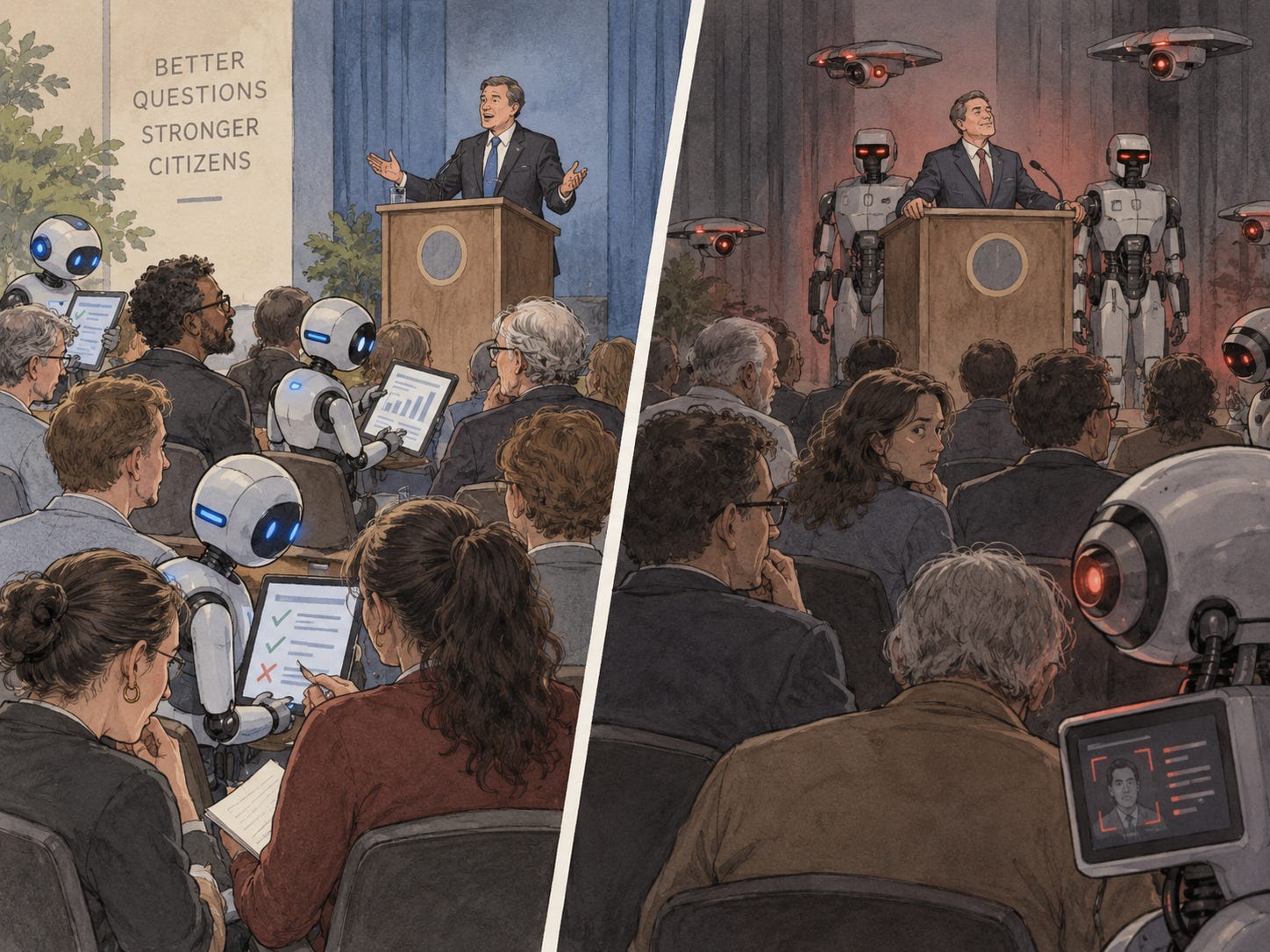
Good scenario: power to the people
This scenario stems naturally from the perspective I described in previous posts about how AI may tilt power balances in society by spreading knowledge cheaply and relatively equally. I have argued that it could benefit laypeople in their relations with experts and consumers in their relations with firms. Similarly, it could tilt the balance in favour of citizens by allowing them to check politicians’ claims, hold them accountable for their past statements and limit their incentives to use bad arguments.
For instance, citizens could use AI agents to check whether politicians’ statements are supported by evidence, and compare them with what they said in the past. Such checks currently require time and expertise but could become easily accessible to ordinary citizens. Knowing that their statements could be checked and challenged almost immediately, politicians might have stronger incentives to avoid making dubious claims in the first place.

A recent experimental study provides support for this possibility. It involved around 3,000 participants and found that using AI models to investigate political questions improved their political knowledge. Participants who used AI became more accurate and better able to distinguish true and false information, with gains comparable to those from conventional internet searches.2 If such an effect were to be observed more generally, it could empower citizens and make them harder to manipulate.
Another possible use of AI is to monitor the activities of politicians, their use of public resources, their economic involvement with private interests and so on. Such monitoring can take tremendous time and work but could be automated. An example of such a possibility took place in Brazil in 2016. A group of civic activists launched Operação Serenata de Amor, a project using automated analysis to examine Brazilian parliamentarians’ expenses. Its software, called Rosie, identifies suspicious reimbursement claims and makes the results available for public scrutiny.3
For this scenario to eventuate, AI models need to work as agents that serve each individual’s interests. AI companies, through market forces, transparency and competition, need to have limited central influence over the shaping of AI content in ways that could advantage specific interests and bias the information provided in that direction.
Bad scenario: a universal Stasi system
The risk of an AI panopticon
One way to prevent dissent is to prevent people from expressing their true views and coordinating their beliefs and actions via exchanges of ideas and information. Authoritarian regimes have achieved this by creating societies where people could not be sure that their friends, colleagues or even family members would not denounce them for instances of wrongspeak.
One of the states that went the furthest in monitoring citizens’ private dealings and discussions was East Germany. The excellent movie The Lives of Others depicts how the political police, the Stasi, monitored people’s lives, often by bugging their homes.

This system had one notable limitation: its cost. Towards the end of the regime, the Stasi employed around 90,000 people and relied on a network of roughly 190,000 informants to monitor a population of only about 16 million people. This amounted to one Stasi employee or informant for every 60 inhabitants. Much of this labour was devoted to maintaining the regime’s grip on society.
AI could provide a technical solution to this limitation. It would offer a totalitarian state the possibility of literally putting one AI agent behind every citizen, monitoring their online activity and discussions with AI, and potentially even eavesdropping on their conversations with other people.
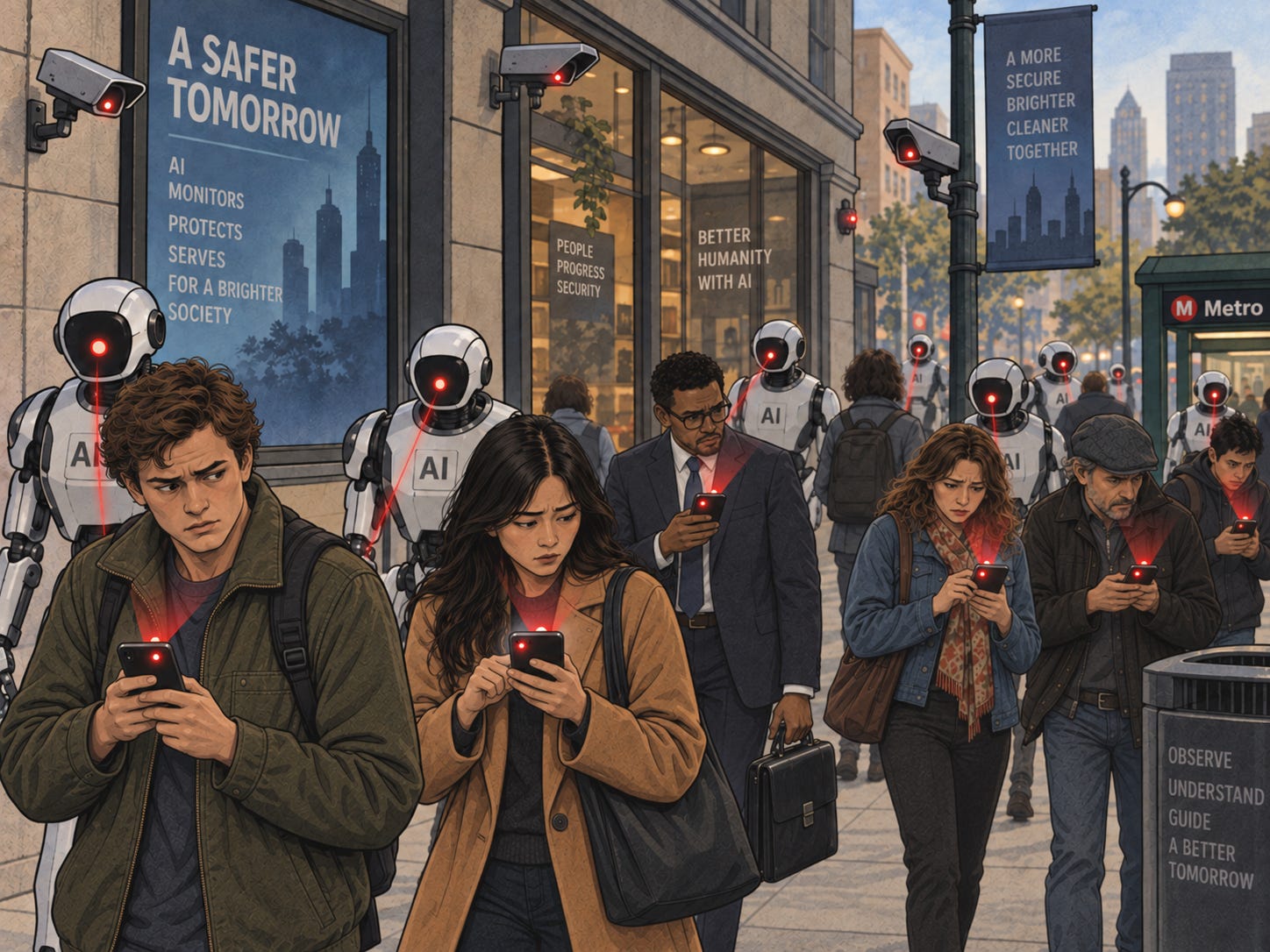
These AI agents could analyse the rich content emerging from human activity, look for patterns indicating early signs of disloyalty to the regime, and either interact directly with the citizens, for instance through warnings, or report their findings to human authorities for further action. The task of monitoring the population, which required extraordinary human resources for the Stasi, could therefore be performed on a much larger scale and at a fraction of the cost.
By allowing governments to monitor, understand, and control their citizens far more closely than ever before, AI will offer authoritarian countries a plausible alternative to liberal democracy... — Wright (2018)
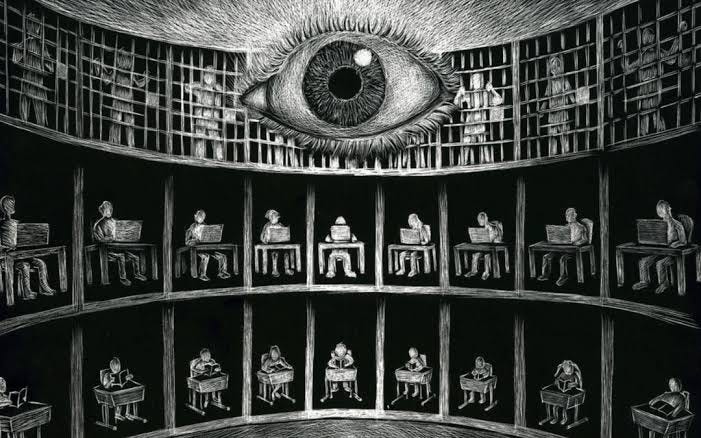
This dystopian possibility would allow authoritarian states to transform society into a panopticon, the prison design proposed by Bentham in which prisoners could at any moment be observed from a central position.
AI surveillance: the example of China
To some extent, China, with its authoritarian regime and high state capacity institutions, already has some of the conditions for such a possibility. There is already empirical evidence of AI surveillance being used to control dissent. A study of government purchases of facial recognition technology found that local unrest increased demand for this technology and that greater procurement by local governments subsequently reduced unrest.4
The combination of systematic surveillance of online activity, facial recognition in public spaces and the capacity to analyse individual behaviour could make it possible for Chinese state institutions to monitor each citizen’s behaviour in a totally unprecedented way.
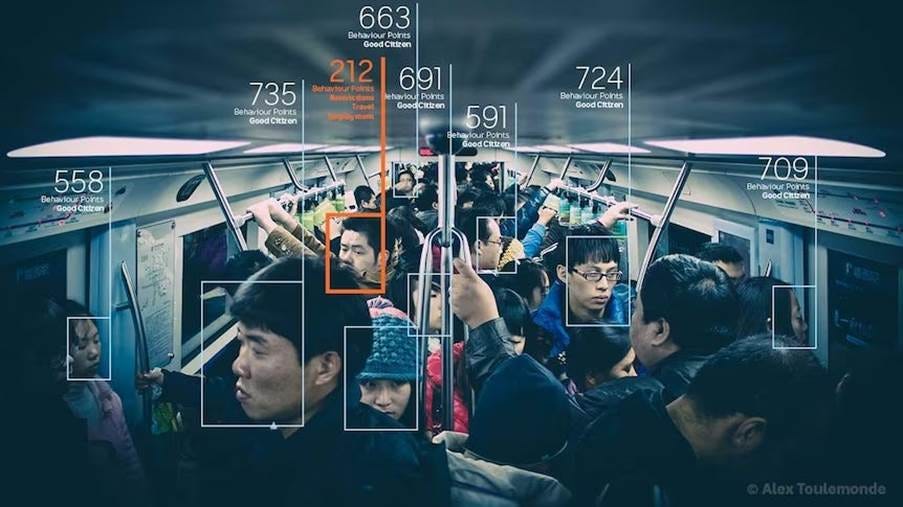
In 2019, Human Rights Watch reverse-engineered a police application connected to Xinjiang’s Integrated Joint Operations Platform. The platform assembled information from phones, identification cards, vehicles, checkpoints and other sources, and generated alerts about supposedly suspicious behaviour. Some of the behaviours triggering scrutiny were striking. Simply stopping the use of a smartphone could lead to an investigation. The system also collected information about people’s social relationships and alerted authorities about connections with certain individuals.
The prospects for liberal democracies
As some democracies have recently experienced a slide towards autocracy, these AI capabilities could help such transitions harden. In a worst-case scenario, the balance of power that makes democracy possible might be unsettled to a point where democracy could vanish and give way to new forms of authoritarian states where elites monopolise AI resources as tools of social control.
AI could allow a small ruling coalition to monitor and control society while relying on far fewer people than the Stasi needed to maintain its surveillance apparatus. In that scenario, liberal democracies might turn out to have been a temporary institutional solution in human history that reflected an ephemeral balance of power between social groups, preventing any one of them from controlling society without the support of a broad coalition.5
The effect of an authoritarian use of AI might be complex, though
We should not assume that such a level of control would necessarily be stable, that no resistance would occur and that maximum control would be the rational option for autocrats. It is hard to perfectly anticipate how such a controlling society would function and whether it would be politically stable because this scenario is quite outside the parameters of social interactions for which our intuitions and knowledge about psychology and social dynamics are well shaped. Nonetheless, we can say a few things.
First, we should appreciate that such tight control might not be coalitionally stable, because not every actor in the system would necessarily be willing to cooperate in its implementation. One aspect overlooked in 1984 is that an authoritarian regime always relies on a coalition of elites supporting the ruler. But a greater and more extensive monitoring system might be used against those elites, against their interests. A ruler willing to extend control by monitoring more closely the private lives of elite members might lose support in the coalition required to maintain the ruler’s grip on power. It is not obvious how these different forces would play out and what kind of political equilibrium would emerge.6
Perhaps an all-encompassing AI control system would prevent any rebellion from ever taking place, by making it extremely difficult for people to coordinate any opposition to the regime. But perhaps it would be so unbearable that it would leave the ruling coalition sitting on a very explosive society, with some members of the elite having enough interest in splitting away and organising a counter coalition with broader segments of society for such a system not to be stable.
Second, another issue is that the ruling elite may lose information about what people really think. The economist Ronald Wintrobe has proposed the concept of the dictator’s dilemma: preventing the expression of dissenting opinion has a cost, as it prevents the ruler from understanding the real extent of support for his rule in the population. The reason is that citizens are strategic and, faced with greater monitoring and control, engage in what Timur Kuran has called preference falsification: they claim to agree with the regime and its rulers while privately disagreeing with it. When preference falsification is widespread, a seemingly stable regime might actually be more fragile than it seems. One spark of dissent can lead to a chain reaction where more and more people are willing to dissent as they realise they are not the only ones disagreeing, generating a cascade of public dissent.
A striking example is what happened in Tunisia in 2010–11, when a street vendor, Mohamed Bouazizi, set himself on fire in December 2010 following mistreatment by the police. Protests spread across the country, leading to the dictator Ben Ali fleeing in January 2011. Ben Ali’s dictatorship was well known for maintaining tight control over the expression of dissent, which may have made it more difficult for the regime to appreciate the extent of the population’s dissatisfaction.
AI might change the dictator’s dilemma itself. If a regime could analyse people’s private discussions and behaviour, it might be able to assess the extent of discontent even when nobody dares express it publicly. But people who know they are being monitored may adjust what they say even in private, making the information collected less reliable. It is therefore not obvious whether more powerful surveillance would necessarily resolve this problem for authoritarian rulers.
Noticeably, China's strategy for controlling dissent has sometimes been more selective than the systematic repression of all criticism. The regime has somewhat tolerated criticism, but actively mitigated its impact by undermining attempts to coordinate and act upon grievances.7 This strategic response also illustrates that the optimal strategy for an autocratic government might not be a maximalist, 1984-like strategy of total control and repression of any sign of dissent.

AI is a transformational technological revolution. By making knowledge and information processing widely accessible, it is bound to profoundly reshape our societies, which are deeply structured around knowledge acquisition, processing and communication. In my series of posts on AI, I have been quite optimistic about its potential to empower those who have less access to knowledge and information, such as consumers and non-experts. The whole extent of the changes this technology will induce in politics remains hard to predict.
Historically, the emergence of large hierarchical societies came from the possibility of forming small ruling coalitions8 through control over resources and the means of violence.9 The modern rise of democracies can be understood as the erosion of the stability of regimes supported by small coalitions and an increase in the size of the minimum coalition needed to rule. Modern democracies, in that perspective, are systems where rulers require the support of large sections of the population to remain in power.
The key question with AI is therefore whether its potential for monitoring and processing information will be widely available to citizens, empowering them to scrutinise those in power and limiting rulers’ ability to make decisions without broad public support (more democratic), or whether it will primarily serve a ruling elite able to control the population and, by doing so, concentrate power in a few hands (less democratic).
The control of AI technology in the hands of governments seems, on paper, to make possible some of the most dystopian scenarios of authoritarian societies controlling every aspect of their citizens’ existence. Whether such a system would arise and remain stable is an open question, but one we should not ignore given how the technical capacities of AI could appeal to current and would-be autocrats.
In Western democracies, these scenarios provide grounds for limiting the concentration of state power over AI models and, in particular, state access to the information collected through interactions with them. The division of power, one of the principles of liberal democracies, should apply here too. There are grounds for considering constitutional limitations on the ability of state institutions to use AI technology to systematically access, record and analyse citizens’ private interactions on a mass scale.
As AI becomes increasingly integrated into our daily lives, the importance of maintaining such a separation is likely to increase. Governments might be tempted to increase their surveillance capabilities using AI because of the potential short-term benefits, for instance, to detect tax evasion or prevent terrorist attacks. But allowing these capabilities to develop could leave society at risk if an elected government progressively turns autocratic. Democratic societies should therefore consider establishing a constitutional firewall against systematic mass surveillance.10
The next post will be the last one in my series on AI. It will look into how technical progress in generating AI is reshaping our understanding of the human mind.
References
Beraja, M., Kao, A., Yang, D.Y. and Yuchtman, N. (2023). ‘AI-tocracy’, The Quarterly Journal of Economics, 138(3), pp. 1349–1402.
Bowles, S. and Fochesato, M. (2024). ‘The origins of enduring economic inequality’, Journal of Economic Literature, 62(4), pp. 1475–1537.
Bueno de Mesquita, B., Smith, A., Siverson, R.M. and Morrow, J.D. (2003). The Logic of Political Survival. Cambridge, MA: MIT Press.
Cordova, Y. and Gonçalves, E.V. (2019). ‘Rosie the Robot: Social accountability one tweet at a time’, World Bank Blogs, 29 October.
Fukuyama, F. (2011). The Origins of Political Order: From Prehuman Times to the French Revolution. New York: Farrar, Straus and Giroux.
Human Rights Watch (2019). China’s Algorithms of Repression: Reverse Engineering a Xinjiang Police Mass Surveillance App. New York: Human Rights Watch, 1 May.
King, G., Pan, J. and Roberts, M.E. (2013). ‘How censorship in China allows government criticism but silences collective expression’, American Political Science Review, 107(2), pp. 326–343.
Kuran, T. (1989). ‘Sparks and prairie fires: A theory of unanticipated political revolution’, Public Choice, 61(1), pp. 41–74.
Luettgau, L., Kirk, H.R., Hackenburg, K., Bergs, J., Davidson, H., Ogden, H., Siddarth, D., Huang, S. and Summerfield, C. (2026). ‘Conversational AI increases political knowledge as effectively as self-directed internet search’, PNAS Nexus, 5(10), pgag305.
Svolik, M.W. (2009). ‘Power sharing and leadership dynamics in authoritarian regimes’, American Journal of Political Science, 53(2), pp. 477–494.
Wintrobe, R. (1998). The Political Economy of Dictatorship. Cambridge: Cambridge University Press.
Wright, N. (2018). ‘How artificial intelligence will reshape the global order’, Foreign Affairs, 10 July.
My previous posts discussed AI risks, the moral status of AI agents, and the impact of AI on peer-reviewed research, the impact of AI on the ability of laypeople to assess experts’ takes, the possible impact of AI on the higher education sector, whether AI will improve the quality of human arguments and whether it will empower consumers.
See Luettgau et al. (2026).
See Cordova and Goncalves (2019).
Beraja et al. (2023).
I have written here how democracy has to be seen as the solution of a society where nobody can govern with a very small supporting coalition.
Political scientist Svolik (2009) has discussed how the elite supporting the ruler might feel threatened by and resist an increase in the power of the ruler.
See King, Pan and Roberts (2013) and King, Pan and Roberts (2017).
This is the insight of the selectorate theory of politics (Bueno de Mesquita et al., 2003) I discussed in previous posts.
This possibility emerged in part from the rise of agriculture, which facilitated the accumulation and transmission of wealth across generations (Bowles and Fochesato, 2024), and from the progressive reduction of opportunities to escape political authority by moving to frontier territories, voting with one’s feet (Fukuyama, 2011).
This would not necessarily rule out targeted investigations, provided they are subject to strict safeguards and independent oversight.