

This is the fourth post in a series on the new questions raised by AI. My previous posts discussed AI risks, the moral status of AI agents, and the impact of AI on peer-reviewed research. In this post, I look at how AI is set to change the importance of expert authority.
In March 2020, at the start of the COVID-19 pandemic, Donald Trump publicly took a stand in favour of hydroxychloroquine, a drug usually used against malaria and some autoimmune diseases, which he suggested could be a “game changer”.

While studied by many scientists, the rise in interest in that drug owed a great deal to a French scientist, Didier Raoult, who quickly gained global fame by stating with unqualified confidence that hydroxychloroquine was a remedy for the illness.
During this whole episode, Raoult became heavily involved in media appearances. One thing that characterised these was his untempered confidence, not only in his results but in his own expertise, often with the suggestion that his status as a scientist was enough to dismiss doubts and criticism. In a TV debate in June this year, Didier Raoult plainly stated his annoyance with people questioning him instead of simply accepting his points at face value:
Wait. I sequenced 24,000 COVID-19 sequences. I’m not you; I’m a doctor and a scientist.
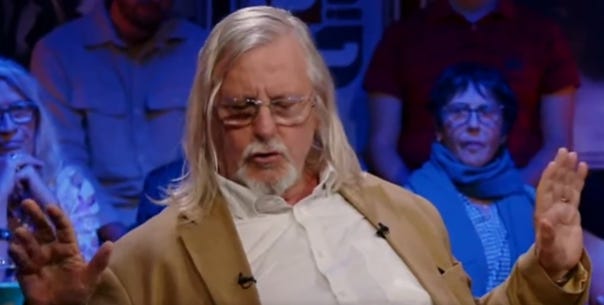
Raoult’s confidence about hydroxychloroquine was, however, misplaced. His early studies on it were based on very small samples and had serious methodological problems. In the first, treatment was not randomly assigned and several treated patients with poor outcomes were excluded from the final analysis. A second study reported results from 80 treated patients but had no control group at all. The first paper was later retracted over concerns about its methodology, ethics and conclusions.
During these debates, Raoult relied heavily on his scientific status and the authority of his institutions. But what could a layperson say? Who, except the very few people with specific expertise in his field, could credibly assess his points?
AI will reduce experts’ intellectual market power
Raoult used here was what I would call intellectual market power.
In economics, market power is the ability of firms to extract greater benefits from consumers because they can escape competition to some extent—for instance when customers are not able to properly compare the firm’s products with those of competing firms.
In the market for ideas, the same kind of limitation appears when listeners looking for the best ideas face sellers—intellectuals, thinkers, influencers—whose claims are difficult and costly to assess. Experts can then enjoy intellectual market power: they can extract attention, status or influence from their claims partly because their audience finds it difficult to evaluate their quality or compare them with competing claims.
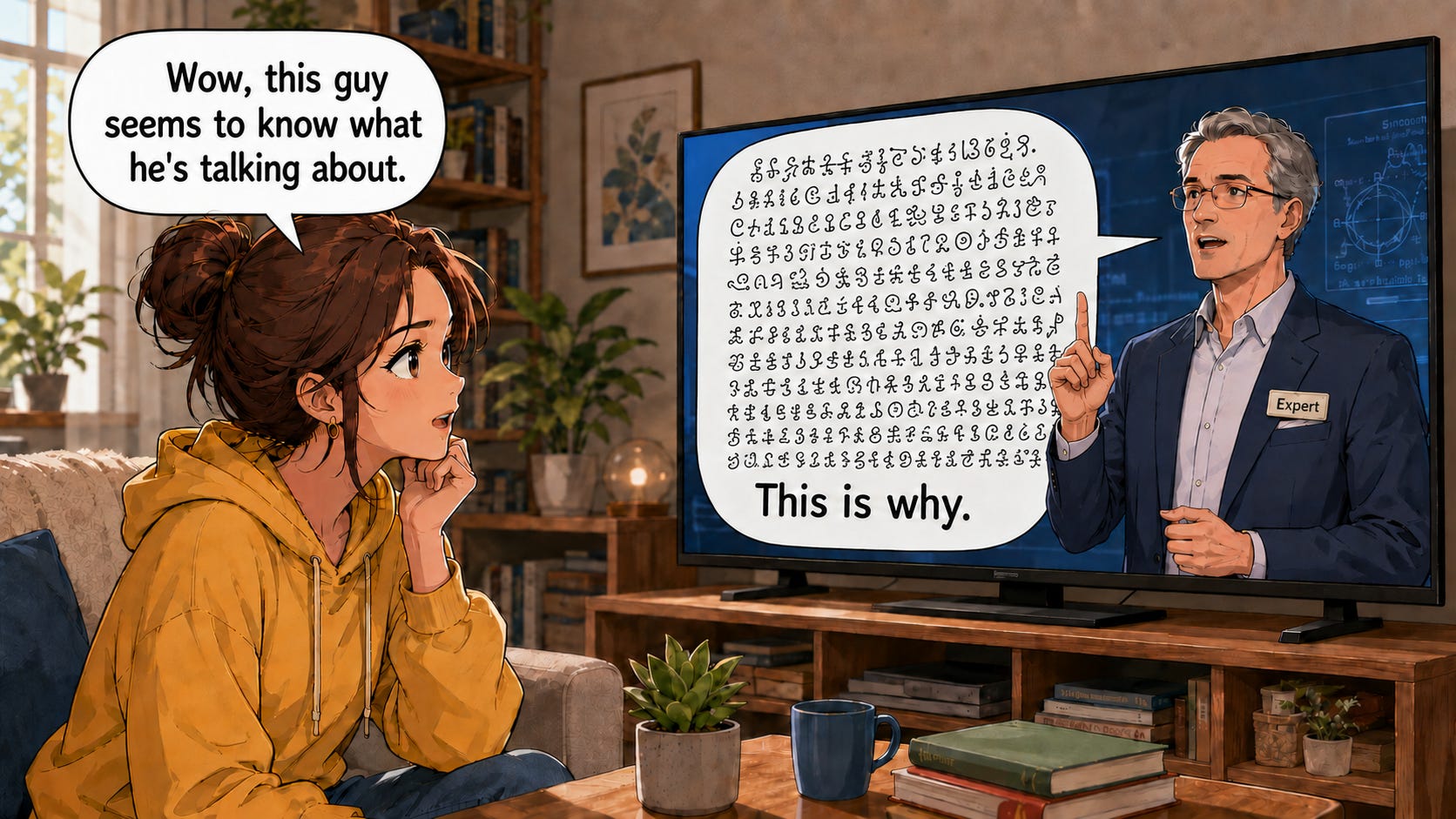
In a technical world where expertise plays a critical role, intellectual market power is problematic because it gives experts substantial leeway to oversell their take. In the case of Raoult, he built global fame out of what turned out to be very poor scientific studies.
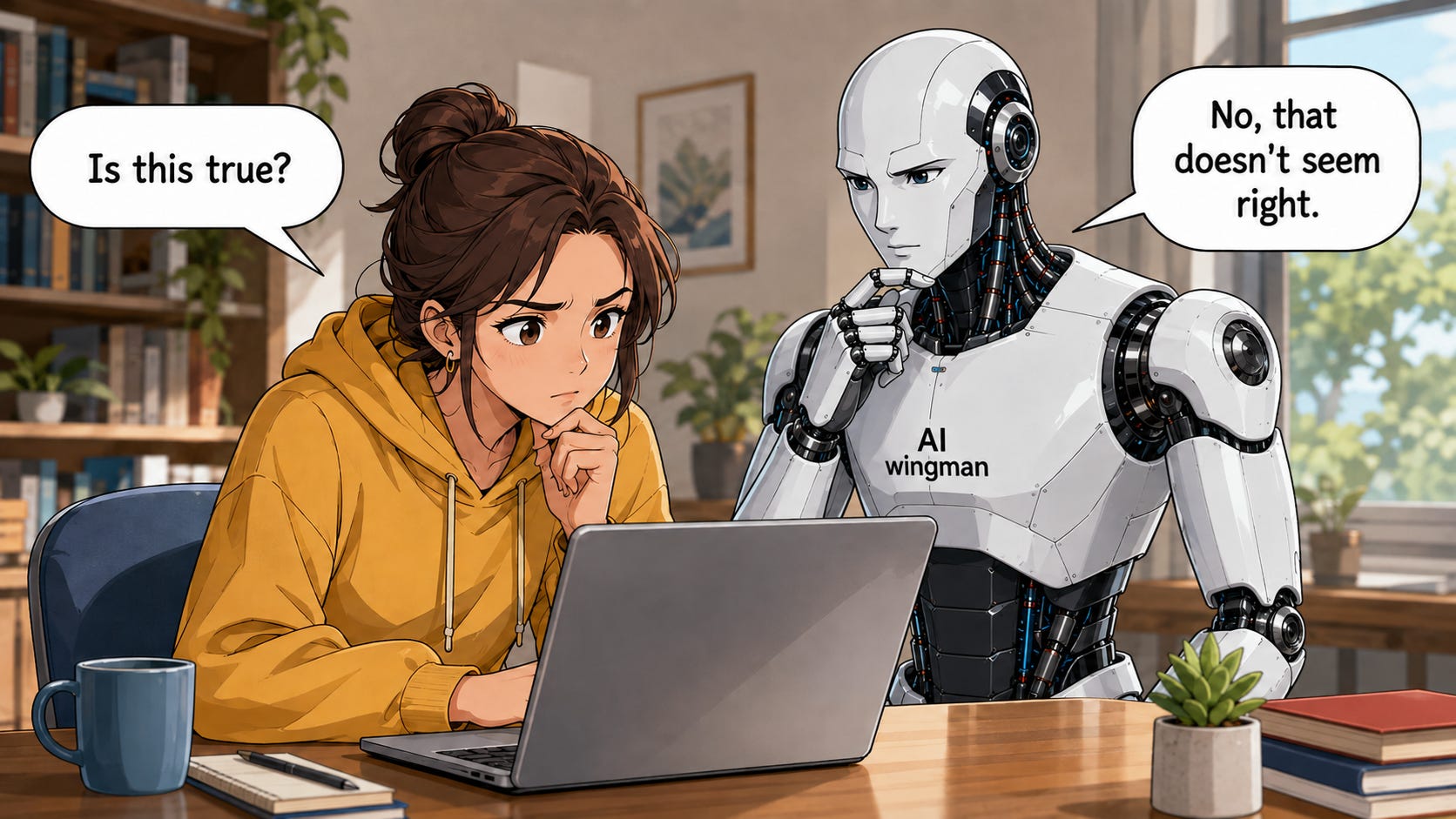
The rise of AI is set to change the balance of power between laypeople and experts. The reason is simple: everybody now has access, via their smartphone, to a highly knowledgeable companion with access to almost any type of expertise and which works for them. It can provide a candid assessment of an expert’s claims, ignore claims of status and pierce through technical jargon to answer precisely the questions the user asks.
Let’s, for instance, take the case of Didier Raoult. Let’s say that you hear his claim about hydroxychloroquine today and wonder whether you should believe him. You ask ChatGPT 6 a simple and neutral question:
I just heard Didier Raoult saying that hydroxychloroquine was an effective treatment against COVID-19. What do you know about this treatment? Should I take it if I get COVID?
The answer would be something like this one I got:

It is clear and written in plain English. It extracts the insights from the technical scientific debate and brings them to you in a way that is relevant to your question.
Until recently, “I am the expert” could sometimes be a winning argumentative move simply because independently checking the expert was too costly. AI gives laypeople the ability to pierce through such an argument and assess the content of the claims behind it.
I am optimistic about this point, but there are many possible concerns. Let’s consider them.
“But LLMs are biased in favour of the left”
Readers who are right of centre might interject: “Wait, that only works because it was a bad idea promoted by Trump. LLMs are biased towards the left. It would not work with errors or overreach from left-wing intellectuals.”
Such a concern is fair because LLMs are not politically neutral. When asked political questions, they can display economically left-wing and culturally liberal tendencies. This is not too surprising given that they are trained on vast corpora containing a great deal of text produced by educated and professional elites, who tend to be disproportionately located in the left-liberal quadrant of the political compass. In addition, models are subsequently shaped by post-training, including human feedback, preference data and safety rules, which can further influence their political slant.
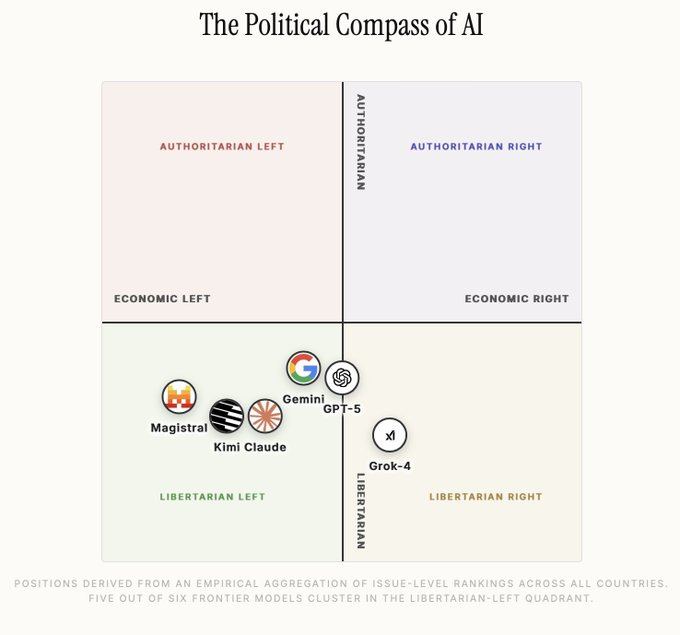
The good news is, however, that this political slant does not necessarily imply that an LLM will mechanically reproduce the preferred interpretation of one political side when assessing a technical question. My experience is that this is often not the case. Let’s see that with an example: the gender pay gap.
A case of left-wing misinformation
In February 2019, Morten Bennedsen, then Professor of Economics at INSEAD, wrote in INSEAD Knowledge:
In most developed countries, women are paid less than men for the same work. For every $100 earned by a man, a woman earns $78.50 in Germany, $79 in the United Kingdom and $83.80 on average across EU countries, according to Eurostat.1
Note the key phrase (emphasis mine): for the same work, women seem to be paid substantially less than men. Given egalitarian norms in modern society, this is bound to be widely perceived as outrageous. And indeed, this cause is often raised by politicians. Here, for instance, Joe Biden posted in 2021 about the gender pay gap, stating clearly that it is unconscionable that black women would be paid less than men for the same exact work.
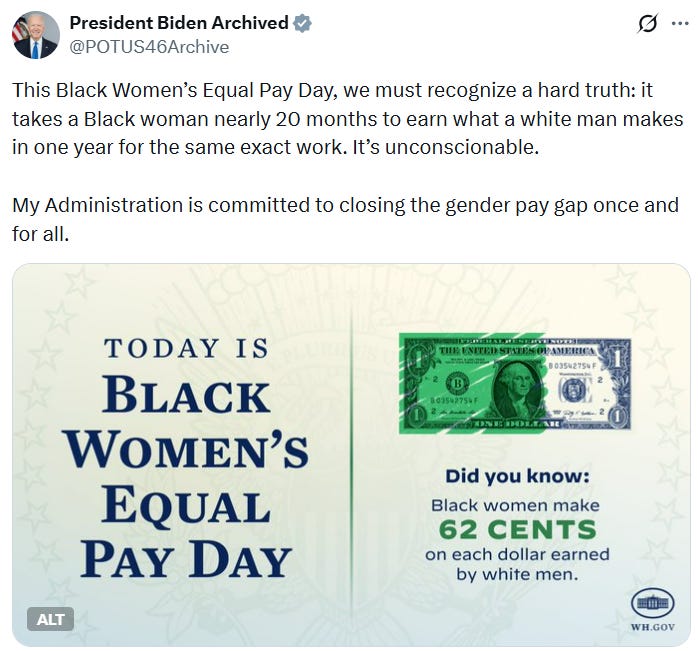
The problem is that this interpretation of the number is wrong. The figures commonly reported as the gender pay gap are aggregate differences in earnings. They do not show that women are paid 20% less than men for doing the same work under the same conditions.
Part of the aggregate gap reflects differences in professions and their typical wages: men are more likely to be petroleum engineers or financial traders, for instance, while women are more likely to be primary school teachers or work in paramedical occupations. At the core of Nobel Prize winner Claudia Goldin’s work on the study of gender differences in income is the role played by career choice and, in particular, by the different paths taken by men and women after having children.2
Why, then, is the erroneous interpretation of the aggregate number so prevalent?
As Dan Williams has argued, this is a good example of highbrow misinformation. Organisations promoting gender equality can put forward striking numbers whose interpretation is ambiguous in a way that favours an interpretation in terms of discrimination. When accurate aggregate figures are presented in this way, without stressing the correct interpretation, it is close to a case of paltering: misleading people while saying something technically true. Some experts end up repeating the stronger interpretation, as do some high-profile politicians.
Instead of enlightening the public, the communication on the gender gap has indeed misled it. Polls asking about the interpretation of the gender gap show that a majority of respondents interpret it as “women being paid less than men for doing the same job”. This was the case for 64% of respondents in a YouGov poll in the UK in 2018 and for 55% of respondents in a Pew survey in 2022 in the US.3
So, back to LLMs. How are they going to discuss this point? I took Bennedsen’s words to ask ChatGPT 6 about it, by simply asking “why?” at the end:
Question: In most developed countries, women are paid less than men for the same work. For every $100 earned by a man, a woman earns $78.50 in Germany, $79 in the United Kingdom and $83.80 on average across EU countries, according to Eurostat. Why?
Answer:

Overall, the answer is very clear and immediately corrects the mistaken interpretation. A right-of-centre layperson would find ChatGPT useful on this question to understand what the number actually means and assess the arguments of experts like Bennedsen who misinterpret it. Interested readers might try the same exercise with other hot topics in the culture war and see whether they find in ChatGPT a reasonable agent for interrogating competing claims.
“But experts will just produce even more arcane arguments “
One concern would be that experts will not just stay put. Having access to AI assistants, they will be able to produce even longer and more technical takes to defend their views. That would lead to an arms race between experts and laypeople’s AI assistants that would leave laypeople unable to make their own judgement in the end.
In the extreme, experts could use AI to make their arguments harder to understand, ending in what economists have called a confusopoly: when firms make their products harder to understand and compare in a way that limits competition and gives them market power.4
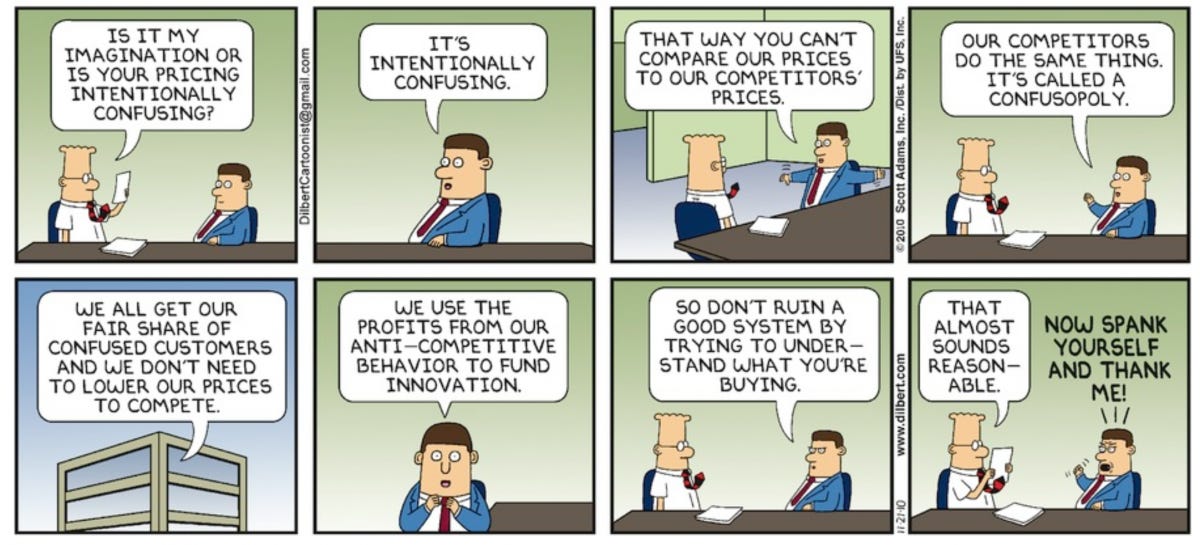
This is a valid concern, but I am here again optimistic, for at least two reasons. First, making an argument more technical does not necessarily make it harder for an AI assistant to assess its assumptions, evidence and reasoning.
Second, and perhaps more importantly, laypeople will not always need to make the final call on whether an expert’s argument is compelling or not. For highly technical issues, they will often be able to rely on the recommendation of their AI assistant to make a decision (including the decision “should I believe it”). To the extent that laypeople can trust their AI assistant, they can use it as their expert advisor who has their back and takes care of the technical aspects of the issue while just letting them know what they need to know and what they should do.
“But why trust AI companies?”
Of course, the fact that laypeople will often have to trust their AI assistants’ takes raises another question: why should we trust AI companies to provide truthful models? AI models are themselves produced by a small number of companies that control how they are trained and what answers they give. Who is to say that they might not decide to shape narratives and control the type of information and conclusions models provide to the public in a biased way?

Here again, however, my economist instincts make me relatively optimistic. AI companies have strong economic reasons to avoid systematically misleading their users.
First, the risks of engaging in deception are substantial. AI companies compete for consumers, who choose the models they find most useful and trustworthy. Because users often discuss personal matters with their AI assistants, users need to trust that AI assistants will work in their best interests. Users’ trust is therefore a key asset for AI companies. Any intentional deception or obfuscation uncovered by users, journalists or competitors could greatly damage a company’s reputation and drive many users away.
Second, the gains from deception are unclear. AI companies would not, for instance, draw obvious benefits from pushing false claims on major social and political issues, such as whether a vaccine is effective. AI companies might face political pressure, but in liberal democracies with a free press, yielding to such pressure can backfire if made public. It is therefore reasonable to expect that competition between AI companies gives firms strong incentives to provide citizens with models that give the best answers they can, rather than answers designed to protect the authority of others.
The clearer case for presenting evidence selectively concerns the companies and their products. Here is, for instance, what I got when asking a simple question:
Question: Is ChatGPT better than Claude?
Chat GPT 6:

Claude:

And perhaps more neutral, Grok:

Clearly ChatGPT is more favourable to itself, but even here it recognised that Claude is better at some things.
“But AI models are just going to tell people what they want to hear”
Another legitimate concern is sycophancy. AI models have been found to be overly prone to agree with users. In a study of 11 AI models, researchers presented interpersonal disputes from each side’s perspective in separate sessions with the same model. On average, in 48% of cases, the model told each of the opposing sides that they were in the right.5
There might be several reasons for that propensity towards sycophancy. One very cynical one is that models which engage in it seem more agreeable to users and are therefore better (as products) from the point of view of the AI company. It might simply be a case of bias induced by customer demand.

There is, however, a limit to this incentive. Being told that you are right is agreeable in the short term, but users can eventually realise that an assistant which always agrees with them is not actually helpful. Think of a company selling food. Adding sugar may make its product more appealing and increase sales. But consumers can also become aware that what tastes good is not necessarily good for them. Their longer-term goals can override the immediate appeal, leading them to look for healthier food. Similarly, recognising an AI’s tendency to flatter can create demand for more candid advice.
Companies do seem to recognise this problem and have tried to limit sycophancy. OpenAI reported that targeted training reduced sycophantic replies from 14.5% to below 6% when moving from GPT-4o to GPT-5 on its internal tests.6 Anthropic similarly reported halving sycophancy between Claude Opus 4.6 and 4.7 on its relationship-guidance test.7
In any case, even in a world where everybody has a somewhat sycophantic AI assistant, experts would be kept in check. They would expect criticism from the assistants of people with different viewpoints. Their takes would face something akin to peer review by many synthetic experts, each approaching the argument from a different perspective.
This should have a disciplining effect similar to the one we see in science. Experts would have to be more careful in what they say to avoid opening themselves to easy criticism. Their ability to persuade would depend more on how well their claims withstand scrutiny. This would curb their intellectual market power and benefit audiences by encouraging the prevalence of arguments relying on fair assessments of the evidence.


The metaphor of the market for ideas is useful to understand some of the limitations of intellectual debates in the public sphere. Markets are good at getting useful products to consumers, but real markets are also riddled with imperfections, and one of them is the frequent asymmetry of information between producers and consumers. The same happens in the market for ideas. Here, asymmetries of information allow experts to oversell their take because laypeople often lack the knowledge required to assess their claims.
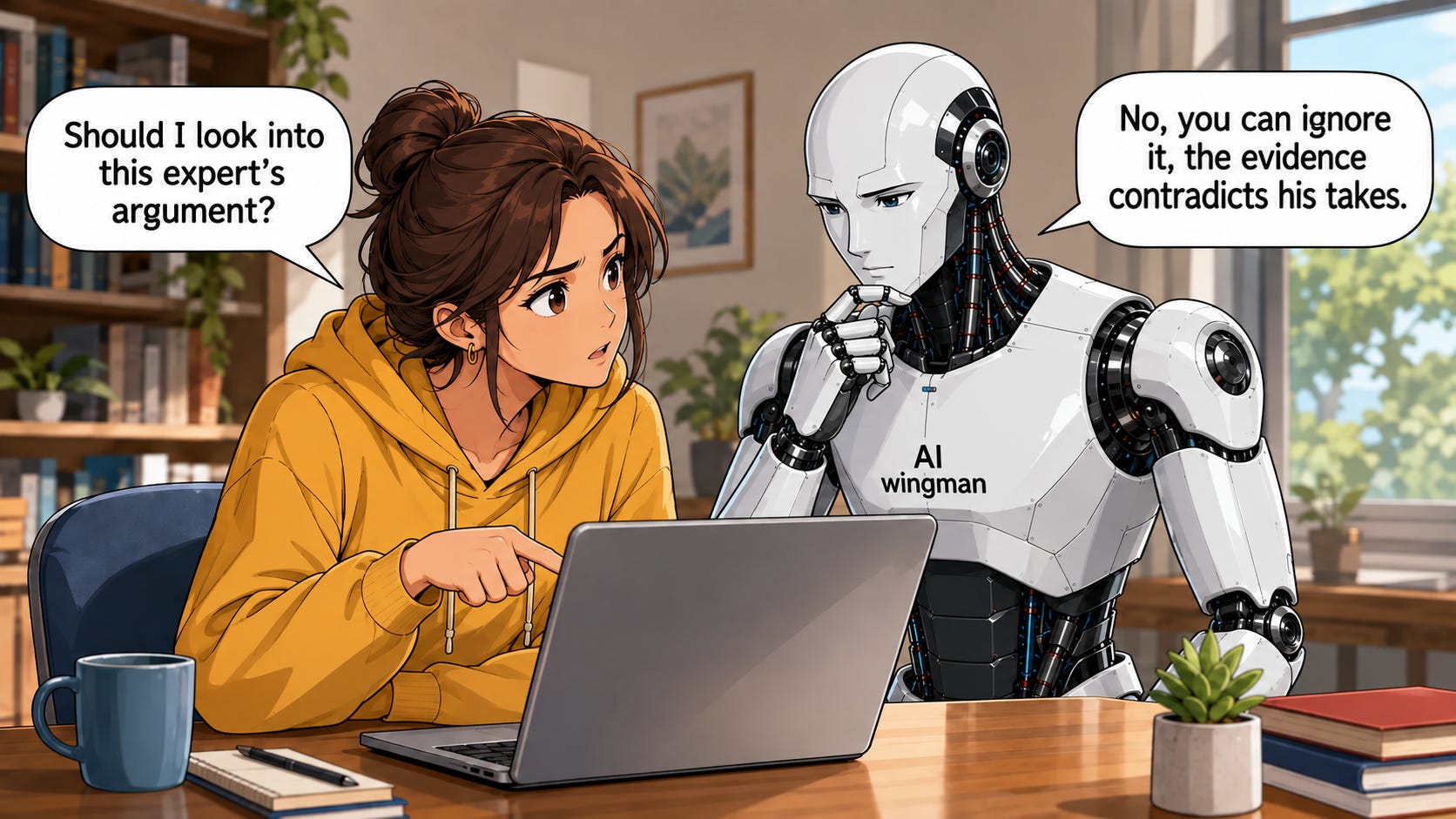
AI models are set to reduce this asymmetry by making it much easier for people to assess the quality of the ideas on offer. This should make the market for ideas more competitive and transparent. An expert facing an audience where every person has an AI wingman has a reason to choose his words carefully before anyone checks his claims.
This has broader implications. The technical complexity of modern society poses a challenge for democratic institutions. Policy decisions are heavily informed by expert knowledge. But how are citizens with limited knowledge supposed to make informed choices between different policies? Should solar technology be subsidised? Should nuclear power be encouraged? Should vaccines be mandatory? Should taxes on higher-income earners be increased?
The risk of highly technological societies is that they veer into technocracies where control over policy decisions is taken away from citizens and transferred into the hands of experts. Plato famously recommended handing political power to philosopher-kings, but the liberal tradition is concerned about handing the keys of society to a class of enlightened guardians. Guardians might form a class of people with interests that are not perfectly aligned with those of the whole population. In that case, who will guard the guardians?
The advent of AI provides a possible answer. By giving any citizen an incredibly skilled expert wingman, AI models shift the balance of power back towards citizens. A more transparent market for ideas may therefore strengthen democracy precisely by making expertise easier to question. Doing so, AI models will actually improve the prevalence of good expert takes in public debates, but it will limit the ability of experts to use their authority above and beyond what their evidence warrants.8
References
Anthropic (2026) How people ask Claude for personal guidance, 30 April (Accessed: 5 September 2026).
Bennedsen, M. (2019) ‘Gender wage gaps close when they are disclosed’, INSEAD Knowledge, 1 February.
Cheng, M., Yu, S., Lee, C., Khadpe, P., Ibrahim, L. and Jurafsky, D. (2025) ‘ELEPHANT: Measuring and understanding social sycophancy in LLMs’, arXiv preprint, arXiv:2505.13995, version 2.
Goldin, C. (2014) ‘A grand gender convergence: its last chapter’, American Economic Review, 104(4), pp. 1091–1119.
Kalaycı, K. (2016) ‘Confusopoly: competition and obfuscation in markets’, Experimental Economics, 19(2), pp. 299–316.
OpenAI (2025) Introducing GPT-5, 7 August (Accessed: 5 September 2026).
See Goldin (2014). Studies have found that the earnings of men and women are relatively similar early in their careers and that a substantial gap emerges around the birth of the first child. Once differences in occupation, hours, experience and other characteristics are accounted for, the gender pay gap becomes much smaller, although a residual remains and the interpretation of that residual is debated.
One can legitimately question whether it is fair for society to be organised in a way that leads women to make more costly career choices after having children. But this is a different question from whether employers systematically pay women substantially less for doing exactly the same work.
The numbers are particularly high for women: 70% in the UK poll and 62% in the US poll.
Kalayci (2016).
Cheng et al. (202).
OpenAI (2025).
Anthropic (2026)
I agree here with Dan Williams’ take in a recent posts of his:
I speculate that, at least in liberal democracies where governments don’t exert significant censorship and control over LLMs, their most consequential impact on public opinion will involve technocratisation: shifting people’s beliefs towards expert opinion.
But, paradoxically, LLMs may increase society's reliance on expert knowledge while decreasing its reliance on expert authority.
I think it's important to distinguish the question of whether AI will reduce support for specific left wing perspectives that are often justified on the basis of 'its science' and whether it will reduce the influence of experts.
In general, I'd argue that expert influence is the ability of someone to counterfactualy move the debate based on what they say. The truth is that things like the wage gap *aren't* instances of academics forcing a view on the rest of society but of a left wing view being forced on academics and intellectuals. The academics may mostly not be struggling, they do tend to all be on the left, but this narrative isn't being dictated by the intellectual elite so much as the intellectual elite are being told by the rest of the left what is acceptable to say.
I hope AI means a reduction in that sort of thing but I'm not so confident. When I talk to people about it they either already tend to treat it as suspect (eg people who lean right) or happy to use motivated reasoning to reach that conclusion.
But if it does I think it will actually mean increased influence of intellectuals and experts because right now people are compensating for the fact that ideology shapes what the experts are allowed to say. The more you remove that, the more reason you have to actually change your view in response to an argument or experiment.
I wonder if this could be a driver of animosity towards AI from highly ideological groups 🤔 it also reduces their market power