

This post is part of a series on the challenges posed by the rise of AI.1 I am fairly optimistic about the possible benefits of AI for society, but at the same time, one should appreciate that such a technology has the potential to disrupt existing institutions. In this post, I describe a possible scenario of how AI could upend one of the sectors most exposed to a technology that is making access to knowledge easier and cheaper: higher education.
In 2024, the educator James Bedford posted a diagram titled “The AI Wheel of Death” which represented the challenge AI and its use by students and educators might represent for universities. The diagram points to the risk of universities being squeezed out of the education process as their added value relative to a simple use of AI becomes progressively less clear.
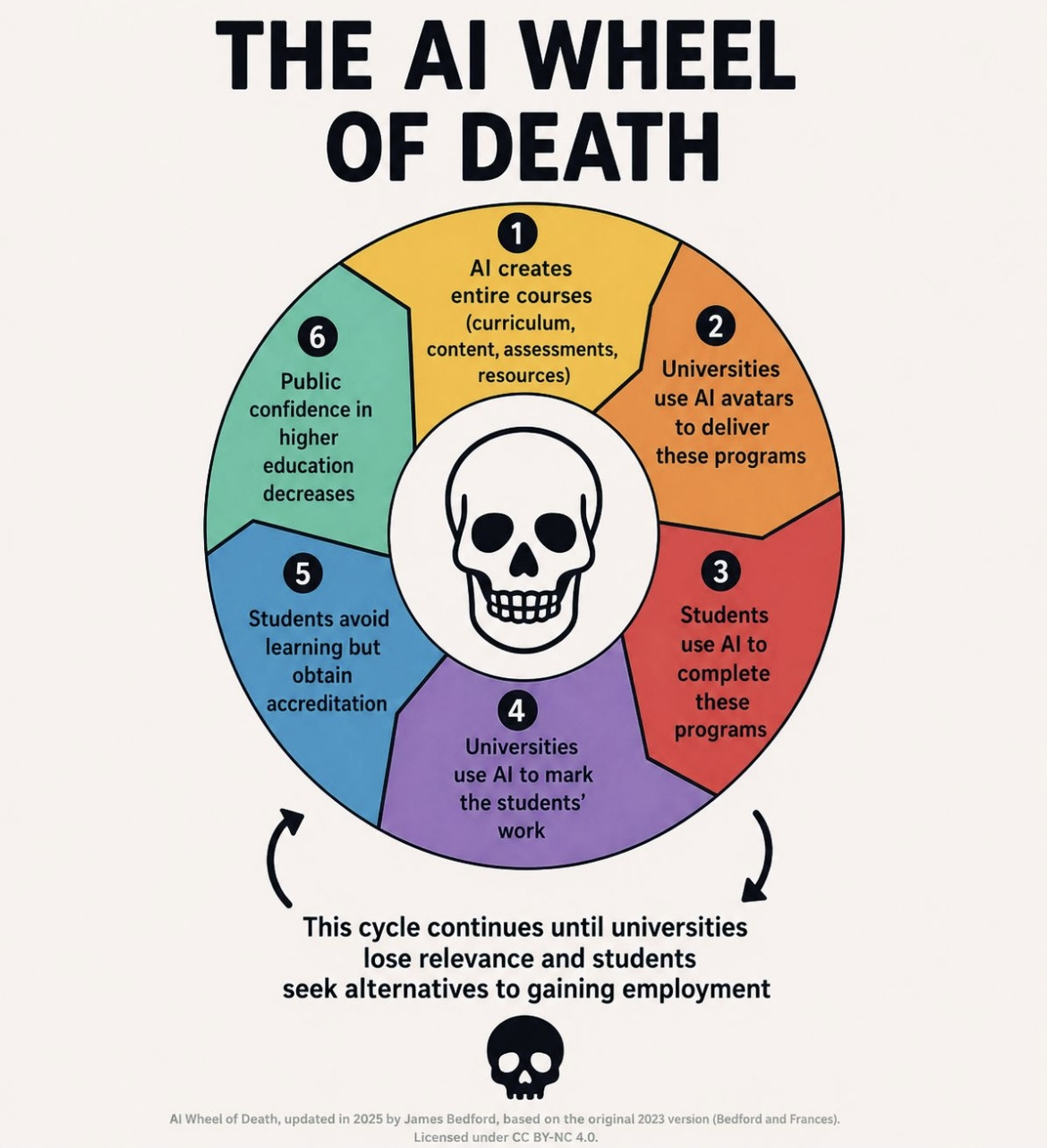
In this post, I develop this idea by presenting a fictitious scenario to illustrate how an AI revolution in higher education could unfold.
2028: Grok University
It is 2028, and Elon Musk is looking for another domain where to make a big impact with his technological innovations. Higher education catches his attention. AI opens up the possibility of providing personalised teaching at a much lower cost than conventional universities.
Musk has one of the world’s leading AI models, Grok, and the financial resources to develop the platform and fund its initial losses. He is therefore in a privileged position to attempt a bold disruptive move in higher education. Within months, his team announces Grok University, a suite of AI learning programmes promising to deliver “the best of human knowledge, personalised for every student, at a fraction of the cost of a traditional university degree.”
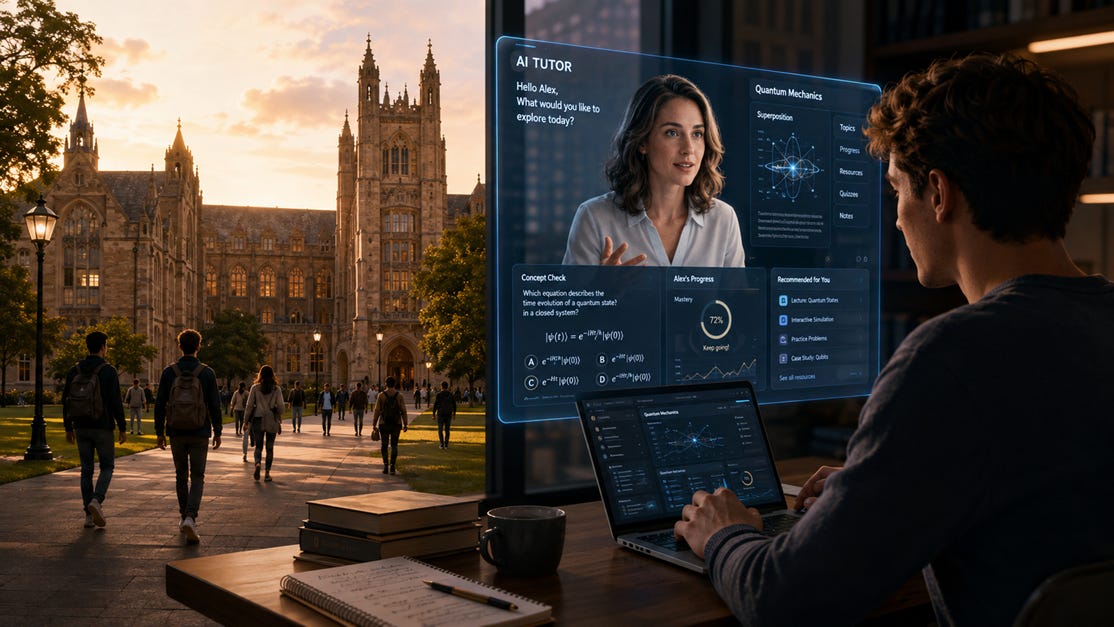
It launches with programmes in mathematics, statistics, computer science and engineering. Students pay US$1,000 per year, plus examination fees. Completing the equivalent of a three- or four-year degree costs around US$4,000. This cost is only a small fraction of the annual tuition fees, often exceeding US$50,000 per year, paid by full-fee students at leading American and British universities.
The technical side is relatively easy. High-quality material in mathematics and engineering is already available in textbooks, university notes, recorded lectures and open educational resources. Grok’s verbal and technical capabilities make it possible to train specialised tutors capable of explaining the material, answering questions and generating exercises.
The initial reception by public pundits is mixed. The Guardian runs the headline:
“Musk thinks he is a visionary by reinventing the failed MOOC experiment”
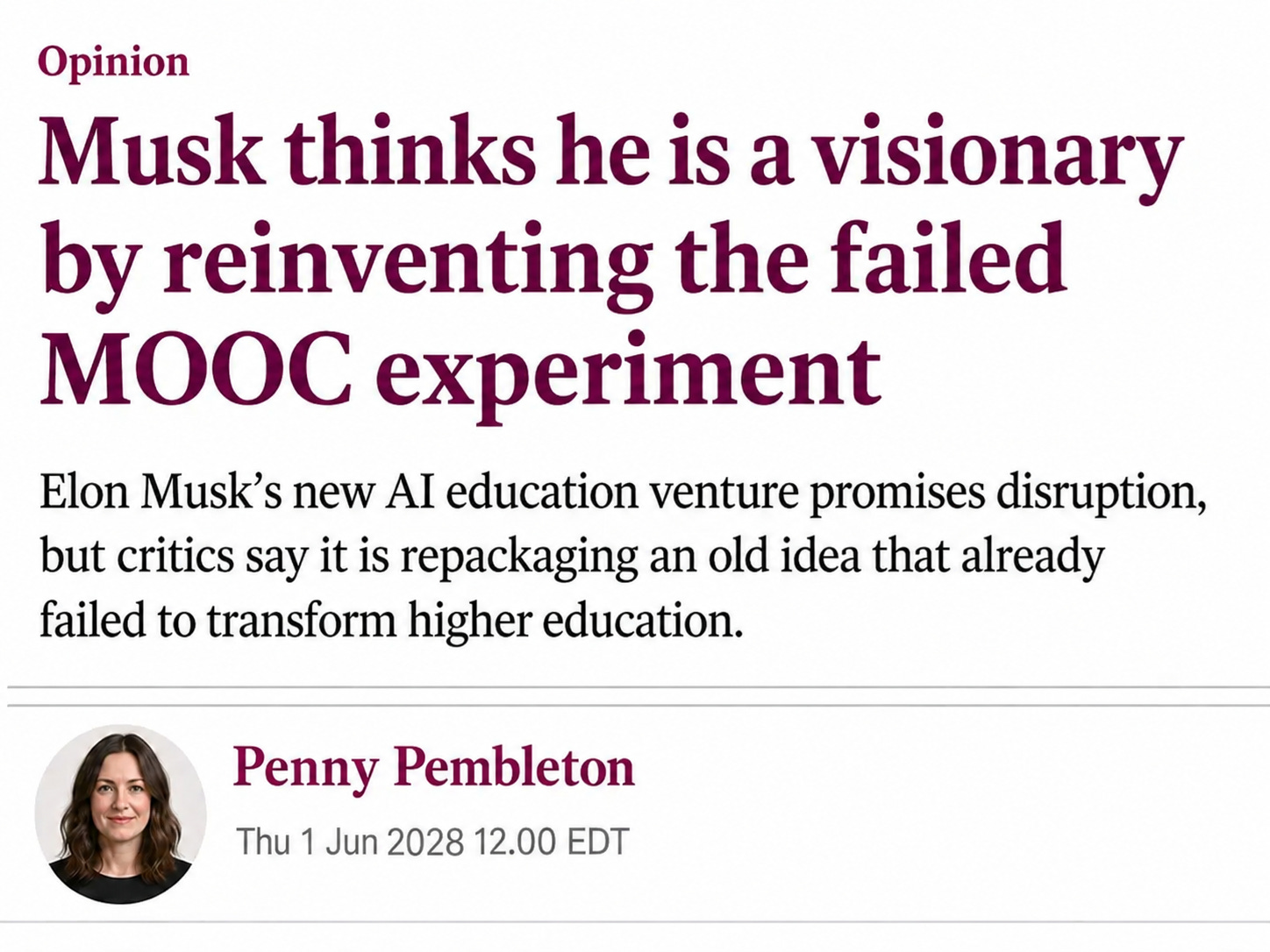
The criticism is not absurd. MOOCs (Massive Open Online Courses) had once been expected to revolutionise education by leveraging the possibilities offered by the internet to provide university content to a large proportion of the population. Yet, after the initial excitement, they failed to deliver the expected revolution in higher education. MOOCs survived and developed into a large market for online courses, professional certificates and degrees, but became only a relatively minor complement to conventional universities rather than substitutes for them.
The Guardian journalist is right that reinventing a past failure without accounting for the reasons for its failure is unlikely to work. But she could also have thought of an established technology subsequently displaced by a more intuitive one: the BlackBerry being upended by Steve Jobs’s iPhone. At first sight, the products were similar. The difference? Steve Jobs understood the behavioural keys to widespread appeal that the BlackBerry was missing. He retained portability and accessibility while making the iPhone so easy and intuitive to use that it massively expanded the number of people for whom the cognitive gains outweighed the cognitive costs of using it.
Similarly, Musk and his team of designers took stock of the limited success of MOOCs and identified two key behavioural barriers that had to be broken to provide a product with broad appeal: psychological motivation and economic returns.
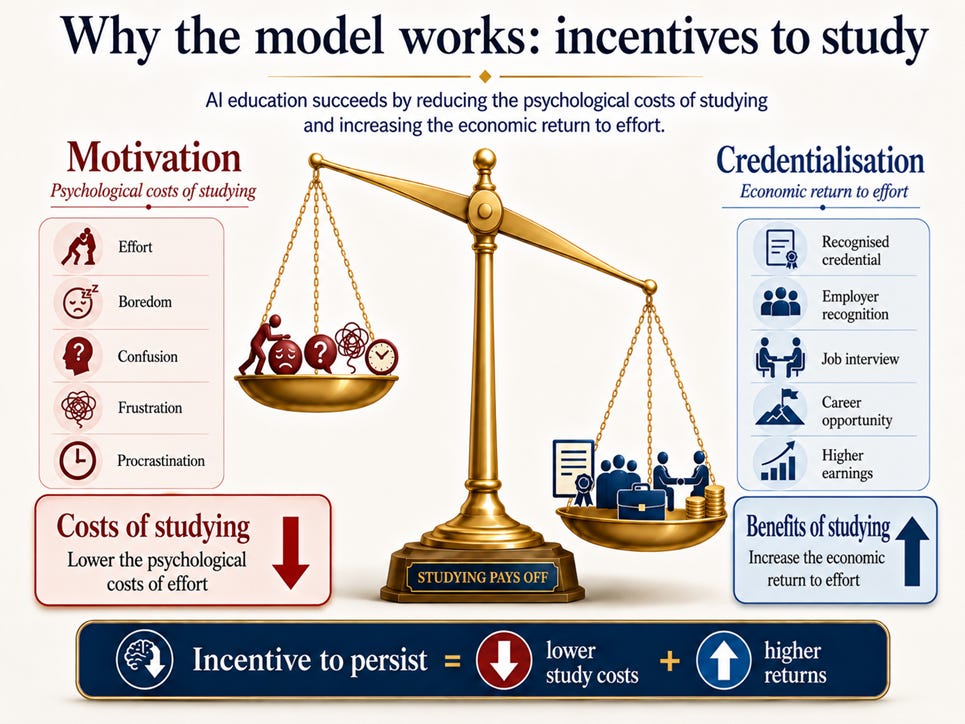
Let’s face it: we all typically lack the motivation to engage in repeated, painstaking small steps for long-term rewards. Failed savings plans, failed diets, languishing gym memberships and unused subscriptions to scientific magazines are all examples. This is known as present bias: we tend to value present rewards more than future rewards and often find it hard to delay gratification. It is the cause of behavioural plagues such as procrastination and doom-scrolling past the time when we should go to bed.
In education, it means that students often struggle to maintain a steady pace of work over several months, let alone several years.
MOOCs failed partly because of this. Left, literally, to their own devices, students had too many reasons to do something else rather than look at another slide containing complex knowledge to acquire. Video games, friends and social media were simply too much competition. Students started to lag behind while telling themselves that they would catch up, until the prospect became so unrealistic that accepting reality and dropping the course was the only option. For every 100 people registered at the start of an early free MOOC, something like five to ten ended up finishing it. These figures partly reflected the fact that registration cost nothing and many people had never intended to complete the course, but the difficulty of sustaining motivation was real.
Universities beat this systematic procrastination, somewhat, by offering a rigid schedule of lessons and assessments leading to examinations on given dates. The smaller amount of freedom is what helps students resist their short-term temptations and complete their studies. This success through binding commitment has famously been described by Jon Elster through the story of Ulysses having himself tied to the mast to resist the appeal of the Sirens.
To be a compelling educational product, an AI suite therefore needs to beat this motivational problem. The Grok University team understands the challenge and relies on two complementary strategies.
The first is that the flexibility of AI allows it to do something a university course cannot: personalise the progress of each student. This has a direct consequence: it can lower the cost of learning.
The cognitive cost of learning comes from two polar situations. When the content is too easy, it is boring and one wants to do something else. When the content is too hard, one is lost in front of a wall and sees little point in continuing. Good teaching presents the material in steps that are neither too small and boring nor too large and inaccessible. The sweet spot of learning is where these steps continue to arouse interest while providing new answers that we can understand.
Unfortunately, in a lecture theatre, a university professor can provide only one explanation at one pace. For some students, it will be too slow; for others, it will be too fast. AI tutors can avoid this problem by calibrating the difficulty to the level of the student. This is one of the real innovations of Grok University. It learns to identify each student’s level and maps it to adapted steps in the presentation of knowledge.
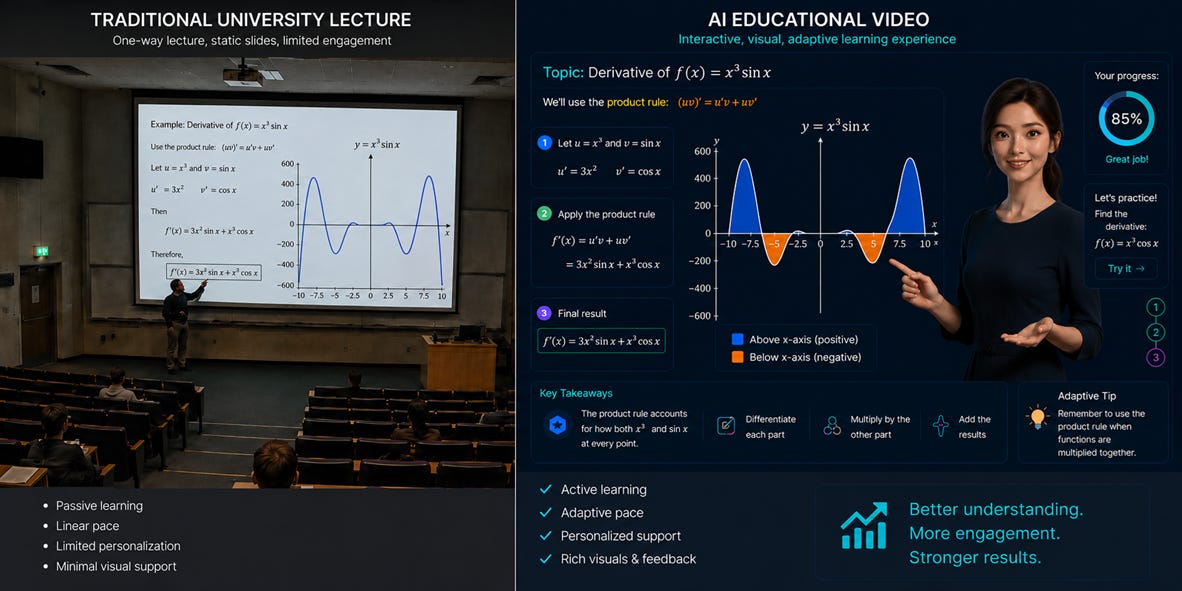
This makes learning more natural and easier. In practice, it lowers the cognitive cost of learning and therefore makes it more appealing relative to the other activities students might consider. With the addition of gamification and social-interaction features, the AI tutor is a product with a totally different appeal from a MOOC.
But personalisation alone cannot eliminate procrastination. A student can still postpone working with a perfectly calibrated tutor. Grok University therefore retains some of the discipline imposed by conventional universities. Its courses are organised around specific examination dates booked in a given city. The AI tutor does not only help students learn; it divides the programme into weekly targets, monitors their progress and intervenes when they start to fall behind. Students can join cohorts and compare their progress with others. The programme remains flexible, but students cannot postpone everything indefinitely.
Failing to overcome the challenge of students’ sustained motivation was not the only reason for MOOCs’ limited success. They had clearly been missing something even more critical. They seemed to assume that people learned primarily to acquire knowledge. If that were the case, people everywhere would be happy to connect online and learn new things.
There is clearly some degree of curiosity, as the success of science channels on YouTube testifies. But it is well known in economics that acquiring knowledge and skills is only one of the benefits of education. The other is signalling. By going to university and receiving a degree, students signal to potential employers, peers and partners their likely skills, capacity to work, ability to engage in conceptual thinking and ability to write in a structured and reasonable way.
MOOCs were useful, but a stamp saying “has completed a MOOC in engineering” was a very unclear signal. How difficult had it been? How did it compare with a standard degree? Had the person identified on the certificate actually completed the work?
MOOCs faced the fundamental challenge of credentialisation. Successful credentialisation rests on a coordination of beliefs. Students care about a degree because employers care about it, and therefore they try hard to obtain it. Employers care because they know that students care and try hard. Creating a new qualification outside the established norm faces the problem that nobody knows what it is worth. Even where identity was verified, employers had little experience with the qualification and no clear understanding of what different results meant.
For Grok University to work, Musk and his team therefore need to nail the challenge of credentialisation. This leads to the key innovation. Grok University has no campuses, but it has physical testing centres around the world. As early as 2029, candidates can sit exams in major world cities: Los Angeles, New York, Rio de Janeiro, London, Paris, Berlin, Delhi, Beijing and Tokyo. The goal is to cover all cities with more than two million inhabitants by 2035.
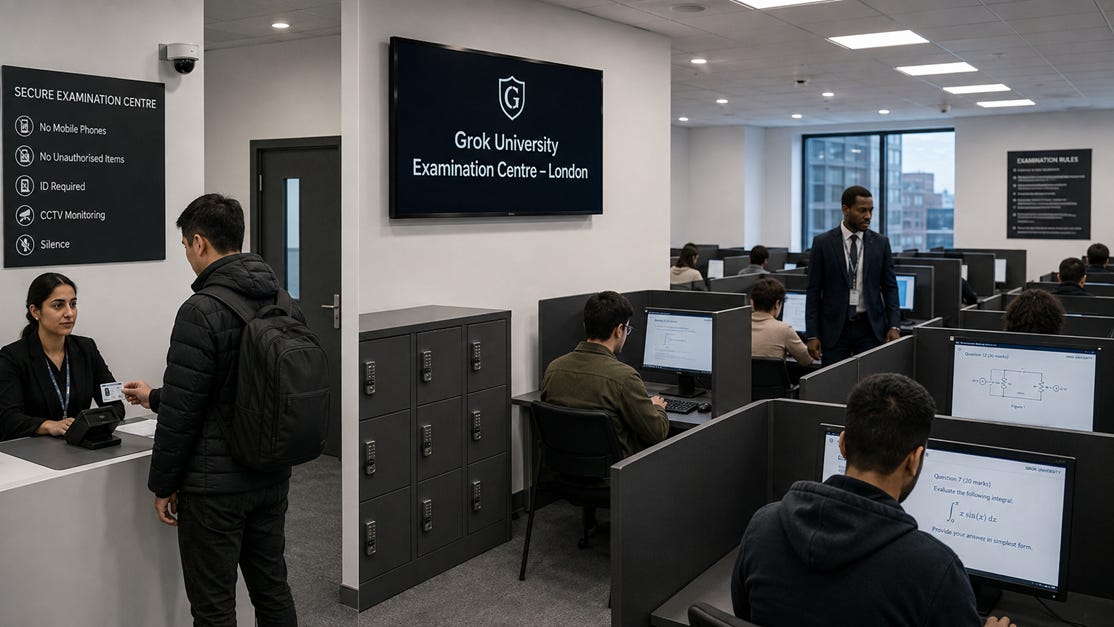
These centres offer face-to-face examinations where the identity of the participants is verified. The examination is taken under standardised conditions, and thereby provides useful information because participants’ scores can be compared across all testing centres. The tests are furthermore better at precisely identifying the level of each participant. They are adaptive: their difficulty changes throughout the examination until the system has estimated each candidate’s level across several dimensions.
Nonetheless, these new tests can work only if a circle of shared expectations settles around them. Students must think the tests are worthwhile because employers care, while employers must care because serious students take them and the scores convey useful information.
The logic is like a nuclear reaction: it can either take off or fizzle out. To give it a good start, Musk leverages another card in his hand: his control of SpaceX and xAI and his considerable influence over Tesla. These companies announce that applicants scoring in the top 1 per cent of Grok University’s mathematics, computing or engineering exams are guaranteed a first-round interview for relevant positions. This simple fact gives Grok University some practical relevance right away. There is a pool of potential students who see right away a possible practical outcome if they succeed at a Grok University exam.

By late 2028, Grok University already has 15,000 registered students. The behavioural test is still to come: will they drop out? In 2029, attendance at the first examination is better than expected. Of the students who pay for and book the first examination, more than 90 per cent turn up to sit it. Images of the first 50 top scorers visiting the SpaceX offices go viral on X. They give interviews describing how good the learning experience has been.
The start is a success. The path towards a revolution in higher education is nevertheless like the Uber revolution: switching from one equilibrium to another is never going to be easy.
Grok University plans to lose money for several years and become profitable only once it has more than 500,000 paying students. Too ambitious? Its low cost and ease of use are advantages that allow the product to continue growing. Musk commits around US$300 million to developing and marketing the platform, an investment easily within his financial capacity.
Many students initially register with Grok University as a way of acquiring material they need for their conventional university courses. The additional examination can complement their CVs if the score is good. In this way, the use of Grok University grows very rapidly without initially taking many students away from universities.
By 2030, the platform has reached 100,000 active learners across 15 fields of study. Grok University already has the equivalent number of learners of three full universities. In just two years, the rate of growth has been staggering. Everything seems to move faster with the advent of AI, and young students are willing to jump on the right trains.
The platform continues to grow. By 2032, it has 500,000 students. For students, a strong Grok score is increasingly seen as a powerful complement to a diploma. It is particularly useful for strong students from developing countries. While their universities have much less international recognition than leading Western universities, they can obtain an internationally recognised signal of aptitude through a high score at Grok University.
On the employers’ side, engineering and finance companies are the first to use top scores in mathematics and science from GU in their hiring process. Beyond these sectors, firms are progressively learning to associate different score levels with likely skill levels on the job. Grok University is really starting to offer the prospect of a credible alternative to traditional universities.
The size of the potential market for AI education and the visible success of Grok University start to attract new actors willing to get a slice of the pie. MIT is the first traditional institution of higher education to take the bold step of following the example of Grok University. It decides to leverage its technical reputation to become a key early player in this sector. In 2033, it launches its own suite of AI courses based on MIT teaching material. Here again, the courses are combined with physically supervised examinations leading to an MIT certificate. While a student following the AI programme does not become a full MIT graduate, the AI suite offers a lower-cost tier of MIT-branded education. The MIT name immediately guarantees a high degree of credibility. In the UK, Cambridge University follows shortly afterwards. Then other leading universities enter narrower fields in which they already have a strong global reputation.
The market for AI learning starts to explode. By 2035, it has reached two million active learners across the competing platforms. Grok University, with around 650,000 paying students, starts to become profitable.
As the credibility and status of AI learning and credentials grow, the price differential becomes harder for universities to justify. A fraction of students start to choose AI options with the aim of skipping university and its hefty fees altogether. This is a risky strategy for the first movers, but one worth trying given the initial savings. University can still be pursued afterwards if it does not work. But this strategy works increasingly often, as employers come to accept the value of AI credentials relative to degrees from traditional universities.
For several years, this growth has little visible impact on physical universities. Most students continue to use AI education as a complement to conventional university study. In 2036, universities experience the first clear impact. New enrolments in the fields most exposed to AI fall by around 5 per cent at lower-ranked institutions in the United States, Britain and Australia, where the added value of the traditional degree is less evident.
The tipping point comes between 2035 and 2040. By the end of the decade, around 20 per cent of new entrants in the most exposed disciplines in developed countries are choosing one of the many AI services available. The least affected fields are those requiring the most hands-on experience, such as medicine, nursing and laboratory science. Many regulated professions are also protected by administrative or professional rules requiring a university degree. On the other hand, in disciplines such as mathematics, computing, economics, finance and business, the decline is large.
Universities start closing entire disciplines and laying off staff in the affected fields. Among the least prestigious universities, many run into financial difficulty, enter administration or close their doors. Others merge. This is a major reversal for higher education, a sector that has seemed destined to be an almost permanently growing market.
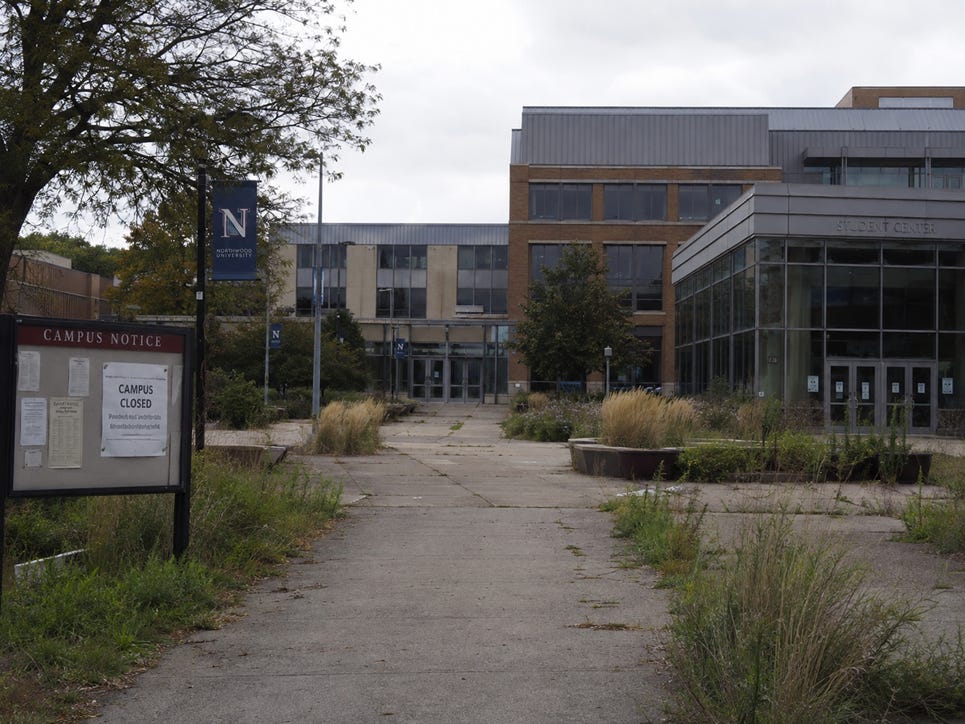
Elite residential universities resist the first wave of effects better than others. In addition to campus life, their comparative advantage also rests on reputation and networks. Higher education institutions providing practical training also show resilience to the advent of AI services.
The bulk of universities, however, face an industrial crisis. The AI market is captured by first entrants such as Grok University and world-famous institutions such as MIT and Cambridge, which can use their names to carve out a global share of the market. Universities outside this small circle are effectively locked out of the new market while simultaneously losing students from the old one. The technology makes teaching cheap, but the value of name recognition for AI certification makes the AI teaching industry close to a winner-take-all market.
END OF THE STORY
Will this happen?
In general, my predictions tend to be conservative. Institutions that have survived for a long time tend to continue to survive, a phenomenon labelled the “Lindy effect”. However, the opposite mistake to seeing a major crisis around every corner is failing to recognise systemic change when it is at the door. Sometimes things can change radically and quickly. As the saying often attributed to Lenin goes:
There are decades where nothing happens; and there are weeks where decades happen.
It is clear that AI is revolutionising access to and the production of knowledge. A decade ago, the automation debate centred on whether robots would take away the jobs of truck drivers. Today, it is PhD students who increasingly fear for their jobs.
Higher education is therefore an industry very much at the forefront of this technological revolution. The scenario above is intended to show what a credible overhaul of the industry could look like and how it could unfold.
Many factors could slow or prevent it. Enough students may value campus life and face-to-face interactions enough to avoid an exodus. Large proportions of employers may remain attached to traditional university degrees as a credible signal of qualification. In addition, government regulation and professional associations’ rules may protect existing accreditation systems. It is also possible that AI tutors might prove less effective than their advocates expect. Perhaps no major actor will decide to take the bold step of going all in, as Musk does in my fictional scenario.
So, do I think something like this could happen? Yes, I do. The advent of AI clearly has transformative possibilities, and universities seem likely to be among the institutions most affected by this technological revolution. Whatever happens, it would be misguided for people working in universities to assume, or hope, that things will remain roughly the same, with the present levels of resources and prestige continuing to flow towards universities and their staff.2
I have discussed AI risks, the moral status of AI agents, the implications of AI for peer-reviewed research and the impact of AI on the ability of laypeople to assess experts’ takes.
Economist Jason Potts has a recent working paper looking at the likely consequences of AI for universities’ ability to remain the gateway to higher education.
Interesting scenario build out. The relevance of signaling and the use of credentials to demonstrate meta qualities (as opposed to using the knowledge gained) seems archaic too.
Credentials in a technical field (eg say forensics) can be directly relevant to the job. Not so much in other cases. Perhaps, AI could also help save time and money by figuring out a better way for employers to assess skills.