
What is fairness?
The invisible rules that pervade our social interactions

In this series of posts, I am offering a deep explanation of what human morality is. My previous post presented a key insight from game theory: when people repeatedly interact with each other, opportunities to gain from cooperation naturally arise even when these people share no prior common interest. In this post, I look at the implication: people need to agree on a “fair” split of these possible gains from cooperation.
As he was launching his party’s manifesto for the 2024 British elections, the then leader of the Labour Party, soon to become Prime Minister, Keir Starmer, stated that:
[T]he pursuit of social justice and economic growth must go hand-in-hand.
— Keir Starmer (2024)
Over the past decades, the notion of “social justice” has become highly influential in public discourse. The term is now routinely invoked in political debates, policy discussions, and academic work as a guiding principle for evaluating social arrangements. Inequalities in income, wealth, education, and health are commonly assessed in terms of their fairness.

Yet, despite its ubiquity, the concept itself is rarely defined. It is largely taken for granted. What if we were to put it to the toddler’s acid test and ask a simple question: what is social justice? It is not an easy question to answer. In this post, I offer a simple answer to the question of what “social justice”, and the more traditional term behind it, “fairness”, actually mean.
What it is not
For readers unfamiliar with my previous posts, let me start by setting aside some common but misguided answers.
Fairness does not require religion to make sense
A frequent view is that fairness and justice derive from religion. Thou shalt not steal. Why? Because it is one of the commandments handed down to Moses on Mount Sinai.1
This view gets the direction of explanation wrong. Across different cultures and religions, we observe strikingly similar moral principles, such as the Golden Rule. This suggests that these principles are broadly appealing to humans and were incorporated into religious traditions that emerged independently, rather than originating from them.

Fairness does not require absolute moral laws
Another possibility is that there are objective moral laws “out there” that we can discover through reason. This position, associated with moral realism, is a secular modern version of the religious view: instead of divine commandments, there are external moral truths.
But this raises difficult questions about their nature and origin. Where do these principles come from, and how can we identify them with confidence? As I have argued in a previous post, this approach sits uneasily with a naturalistic understanding of the world. It has led many philosophers, from Kant to Parfit, into intellectual mazes with no way out, as they attempt to ground the idea that moral rules can be absolutely true.
Fairness norms are social rules
If moral and fairness norms are not externally given to us by a god, by logic or by some other thing out there, what are they? A simple answer is that they are rules of the social games we play. A very down-to-earth explanation is that moral rules are very much like those of a board game: they are not written into the fabric of the universe, but they are man-made and conventional. They are followed because they are commonly agreed upon by all participants.
For sure, moral rules feel more important than those of a board game. The reason is that they are the rules of a much more important game we play: the game of life.
[Y]es, moral rules are much more important to us than sporting rules because moral rules are the rules of the Game of Life, the one that determines our success and setbacks in life, at work, with friends or romantic partners, with family members, and so on. It makes perfect sense for us to have a moral sense that makes us care greatly about how the Game of Life is played. There is no reboot and no respawn in this game, and it determines everything that matters to us. — Optimally Irrational - Morality works without absolute moral truths
Cooperation and bargaining over its benefits
The importance of cooperation as a structuring aspect of social life
This answer raises a further question: what do we actually do in the game of life, and what kind of rules does it require? The answer is that we are a social species, and most of what we do consists of cooperating with others to achieve better outcomes. Cooperation is the scaffolding principle of life. It appears at all levels of biological and social organisation for a simple reason: when interactions are repeated, cooperating is often the best way to succeed.
Because cooperation is so pervasive, we can easily take it for granted and fail to notice it. Consider Alice, who lives in a large modern city. Every morning, she orders a coffee on her way to work. The barista makes a good coffee, and she pays for it. This may seem trivial, but many other possibilities did not occur. Alice could have run away with the coffee without paying. The barista could have used poor-quality ingredients to cut costs. What actually happens is a highly structured and mutually beneficial form of cooperation.
The same pattern continues throughout her day. She stops at a convenience store, takes a pack of biscuits, and waits in line rather than pushing ahead, even though she is in a hurry. She takes the tube and pays for a ticket, even though the gates are open. She gives way in a corridor to an elderly woman with a walker, even though she does not know her. At work, she listens to colleagues without interrupting them and contributes to a group project, even though it required giving up time she would have preferred to spend otherwise.
Nothing in Alice’s day appears remarkable. Yet it is precisely this dense web of cooperative behaviours that makes her orderly and comfortable life possible. Evolutionary anthropologist Sarah Hrdy captures this contrast with our closest relatives, the chimpanzees:
What if I were traveling with a planeload of chimpanzees? Any of us would be lucky to disembark with all ten fingers and toes still attached, with the baby still breathing and unmaimed. Bloody earlobes and other appendages would litter the aisles. — Hrdy (2009)
Cooperation allows humans to reach outcomes far beyond what any individual could achieve alone. Most of us would struggle to produce even simple goods in isolation. We cannot build a car or a phone, and most of us would not even be able to repair a television if it breaks.2 As the comedian Nate Bargatze jokes, if he were sent back in time, he would not be able to demonstrate that he came from the future: he could describe phones and satellites, but not explain how they work. What sustains our world is not individual ingenuity, but the large-scale cooperation of many people.3

Once we realise that we cooperate all the time with others to reach better situations, a natural question arises. The production of benefits by cooperation raises the question of the distribution of these benefits between the people involved.
How should the gains of cooperation be distributed?
“Who should get what?” is a question that comes naturally with cooperation. Who should get the last cookie in the jar? Who should get the promotion at work? Who should be the first author on an academic paper? Who should give way in a corridor? All these questions are about the distribution of the benefits of cooperation. Extended to society, the question of fairness points to debates about “social justice”: how much tax should the rich pay? Who should receive social subsidies—poor people, disabled people and how much?
One common mistake is to think that this question has a simple answer: equality. Everyone should get the same. But this raises an immediate issue: why equality? What principle justifies it?
Even if we accept equality as a starting point, it remains unclear what kind of equality we have in mind. Should it be equality of outcomes in all situations? If Alice did 90% of the work on a project and Bob only 10%, should they split the proceeds equally? If you meet an elderly woman in a narrow corridor, do you both have the same duty to give way? If a mother serves food to a toddler and a teenager, should both receive the same quantity?
These examples suggest that equality of outcomes is often inappropriate when people differ in their contributions or their needs. As Aristotle puts it:
The just, then, is a kind of proportion […] For if the persons are not equal, they will not have equal shares; it is when equals possess or are assigned unequal shares, or unequals equal shares, that quarrels and complaints arise.
— Aristotle
Avoiding quarrels over the distribution of the gains from cooperation requires finding appropriate proportions that will satisfy all participants. Since we do not have a simple, straight answer like “equality”, this requires a form of bargaining.
Bargaining, bargaining, bargaining
This is where Ken Binmore, a game theorist specialised in bargaining theory, brings a key insight to the question: fairness is a solution to the pervasive problem of distributing the benefits of cooperation.
Given how often we need to agree on how to share the gains from cooperation, it would be time-consuming and frustrating if we had to haggle each time. Imagine our lives if every mundane request unfolded like this:
Alice: Can you pass me the salt please?
Bob: What am I getting in return for my effort?
This is where the rules of fairness play a role. They are meta-rules, commonly shared and understood by all. We can use them to resolve our daily problems of allocating rights and duties seamlessly. When Alice, heavily pregnant, asks Bob, a healthy middle-aged man, for his seat on the tube, she can do so because she knows that Bob shares with her a norm of fairness that prescribes that a pregnant woman should have priority for a seat. Bob knows this too and understands Alice’s request. He stands up, and the allocation of rights of access to the seat is resolved quickly and without conflict.
Fairness norms are the grammar of our social interactions. They allow us to navigate social situations with minimal friction, helping us recognise what is due to others and what we are entitled to ask for ourselves.
Fairness norms are present at all times and guide our interactions. If they are absent from our everyday discussions, it is because they do not need to be voiced or discussed as long as they are followed. It is only when there are violations or disagreements that fairness talk emerges: people queue all the time without talking, or perhaps even thinking, about queuing as a first-come, first-served fairness norm. But if someone pushes in front of them in the queue, they might interject, “You can’t do that, I was here before you!”
The game theory of fairness, explained simply
If fairness norms help us settle recurring questions about who should get what, how exactly does that work? Binmore’s answer can be expressed more precisely with the tools of game theory. The ideas are somewhat technical, but the basic structure is simple.
Fairness as a way to agree on how to share the gains from cooperation
In my previous post, I described the game theory of cooperation. I used the case of “Prisoner’s Dilemma”, an interaction between two people, let's say Alice and Bob, where they can “cooperate” (C) or “defect” (D). Depending on their mutual choices, Alice and Bob get some “payoff”, which is a general measure of whatever they care about. It can measure monetary payoffs, but it can also include other things.
If the game is played only once, defecting is the best choice in terms of payoffs. Whatever the other person is doing, choosing to defect yields a higher payoff.
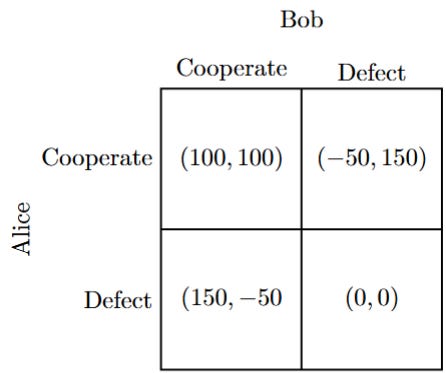
But if the game is played repeatedly, cooperation becomes possible. Indeed, if there is no clear end in sight to the repetition of this game, and if Alice and Bob are patient enough and therefore care about the possibility of future gains, then cooperation can become rational: they can adopt rules of conditional cooperation whereby they cooperate if the other has been abiding by these rules. As a consequence, instead of being stuck with the (0,0) payoffs, they can reach any average payoff in the grey area below.4
For instance, they can reach an average payoff of 100 each by cooperating all the time. To do so, they can adopt the “grim trigger” strategy: cooperate as long as the other player has always cooperated; defect forever if the other player has defected at some point.5 When both Alice and Bob follow this rule, neither of them has an interest in defecting, as they would lose the benefits from future cooperation.
Other rules are possible. For instance, they could adopt the rule of alternating between (C,D) and (D,C). This is a kind of cooperation where players take turns getting the highest payoff. This rule would lead to the average payoffs (50,50), represented by point x on the graph below.
This is not, by any means, the only possibility. Another option, for instance, would be to adopt the rule of alternating between (C,C) and (C,D). If they play this game every day of the week, they could have a convention to cooperate on some days and not on others. If they play (C,C) from Monday to Saturday and (C,D) on Sunday, they would get the average payoff represented by point y on the graph below. It is close to (C,C), but one-seventh of the way towards (C,D).
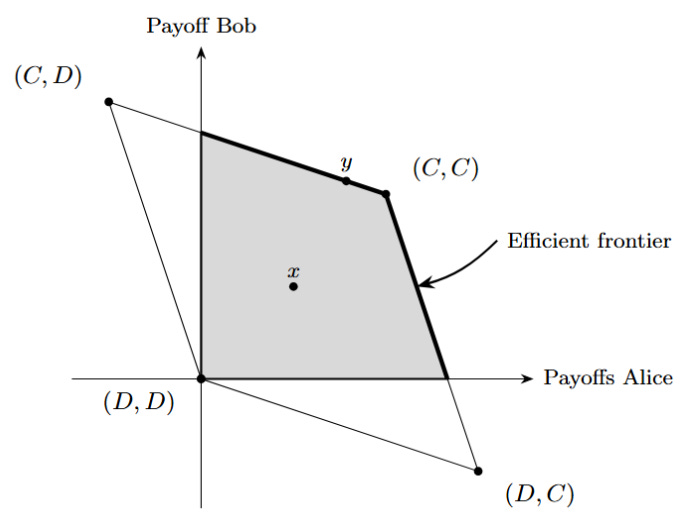
What rule should Alice and Bob agree on? It is clear that some rules are obviously better than others. It is better for Alice and Bob to be at point (C,C) than at point x. Similarly, y is clearly better than x because both Alice and Bob get more. Basically, every point to the North-East of x is a better option for Alice and Bob.
Among all the possible points in the grey area, all those on the bold dark line do not have points that are better in that sense: for each point on the bold dark line, there is no other point that Alice and Bob could reach where both of them could be better off.
We call that line the efficient frontier.6 It makes sense for Alice and Bob to want to be on the efficient frontier. Being below it is “leaving some money on the table”. Both Alice and Bob would agree to move away from (D,D) to get to one of the points on the efficient frontier.
But that is the extent to which they can agree. Among all the points on the efficient frontier, Alice and Bob’s interests are at odds. Bob would prefer to be as far to the left of this curve as possible, where his payoffs are higher, while Alice would prefer to be as far to the right as possible, where her payoffs are higher.
So, in the process of deciding how to share the gains from cooperation, there is both an element of cooperation—they both want to agree on a point on the efficient frontier—and an element of conflict—they have different preferences over which point on this frontier to reach.
In short, Alice and Bob have to bargain to find a mutually beneficial solution. If they cannot agree, they might be stuck at a lower point, like (D,D). The result of this negotiation is going to be some rule they will agree to follow in order to sustain cooperation and a way to share the benefits of cooperation.
Norms of fairness, which are common knowledge in society, help coordinate Alice and Bob’s expectations so that they can quickly agree on a solution without disagreement, which could threaten cooperation and without time-consuming haggling.
Fairness is not just “equality”
At this point, you might wonder “Why all the fuss?” Isn’t it clear that the situation where Alice and Bob both play (C,C) all the time gives Alice and Bob equal outcomes and is therefore the best and fairest solution? This intuition is understandable, but it goes too fast. It is biased by the fact that, in the game above, Alice and Bob are more or less identical: we know that they have similar preferences, and we are not told anything about them differing in any important way. A bit of introspection shows that “equality” is not a trivial answer when the people concerned are different.
Let’s consider a familiar situation. Alice and Bob have to agree on what series to watch on TV tonight. In fact, they face this situation every evening. It is a classic case of bargaining: they both prefer to agree because they like to watch something together. But they also have different preferences, which means that they would prefer to agree on different things. Let’s assume, for instance, that Alice prefers crime dramas (“Crime”) and Bob sci-fi series (“SF”). Let’s now assume that Alice and Bob differ in one simple but important way: the intensity of their preferences.
Let’s also assume that Alice enjoys Crime much more than Bob enjoys SF.7 To use the conceptual tools of game theory, let’s pick some numbers to reflect their utility in each situation. We can think here of utility as their subjective satisfaction. The matrix below shows their payoffs in utility. We will assume that Alice enjoys watching Crime with Bob 10 times more than watching SF with him, while Bob enjoys watching SF with Alice only twice as much as watching Crime with her.
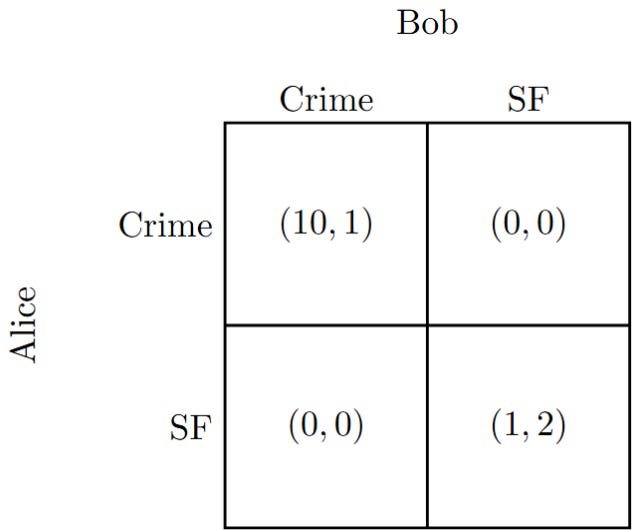
This game is a bit different from the Prisoner’s Dilemma. It is known as the “battle of the sexes”.8 There are two equilibria, that is, two situations where neither Alice nor Bob would want to unilaterally change their decision: (Crime, Crime) and (SF, SF). Even though Bob prefers SF, if he is currently watching a crime drama with Alice, with a payoff of 1, he does not want to leave the room to watch SF on his own, with a payoff of 0. Similarly, if Alice is watching SF with Bob, with a payoff of 1, she does not want to go and watch Crime on her own, with a payoff of 0.
While there are only two stable situations when this game is played on one evening, we know from the Folk Theorem that if Alice and Bob repeat this game every evening, they can do much more than pick either SF or Crime forever. They can decide on a rule to share viewing time in any way they want.9 A rule is an agreement on a way to decide what to watch each evening and to stick to this agreement as long as the other person does. By adopting such a rule, they can reach any average payoff in the grey area below.
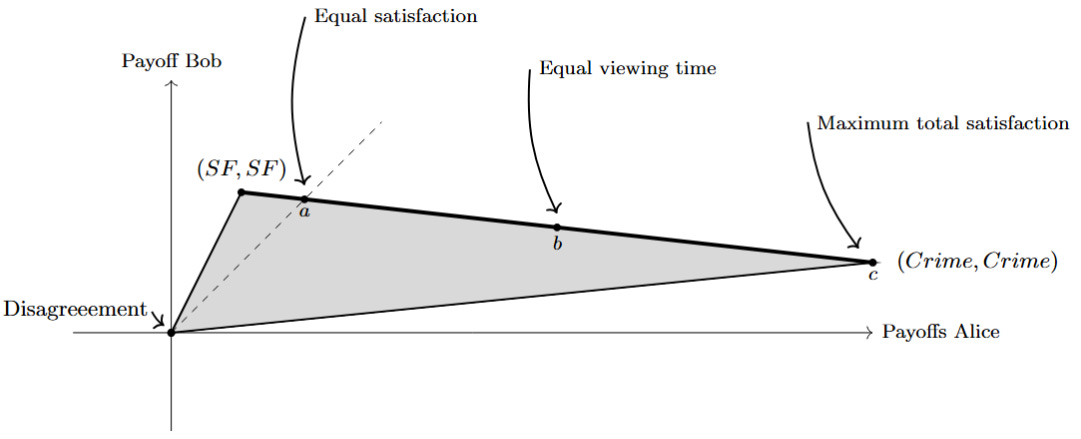
How should Alice and Bob decide how to agree on their viewing choices over time? This example shows that the notion of “equality” does not trivially point to a single solution. If they decide to have equal viewing time, for example by alternating each week, then they would be at point b in the picture above. Note that, when they do so, the enjoyment of Alice and Bob is different. Alice’s average satisfaction is then 5.5. It is higher than Bob’s satisfaction, 1.5. The reason is that whenever she watches a crime drama, she enjoys it much more than Bob enjoys SF. If they wish to equalise their subjective satisfaction instead, they should actually watch SF much more often together (9 times out of 10) and reach point a. They would then have equal satisfaction, but note that it would be quite low: 1.9.
What is “fair”: equal satisfaction (a) or equal viewing time (b)? Alice might argue that neither of these solutions is fair. She likes crime dramas much more than Bob likes SF. Why should they split their time evenly between them then? Indeed, given these preferences, Alice and Bob might well agree to watch SF only once in a while, while watching crime dramas most of the time. They would end up closer to point c, where the sum of their satisfaction is maximised.10
These kinds of asymmetric solutions between partners with different intensities of preference are often present because one partner is willing to give up on some of the things he or she does not care about as much as the other. One such asymmetry is comically illustrated by a scene from the film Mr. & Mrs. Smith (2005) featuring Jane (Angelina Jolie) and John (Brad Pitt) as a married couple with different preferences over the decoration of their house.

While the film plays on Jane’s fake pretence of being open to compromise, it is likely that John does not mind yielding to Jane’s wishes because he cares less about what the curtains are than she does. It is because this difference in preferences is common knowledge that Jane can claim an asymmetric bargaining solution that favours her preferences.
Norms of fairness
So how do Alice and Bob decide what is the fair sharing of viewing time between a, b, c, and all the other possible points? They could haggle to agree. But if they had to haggle every time they had to split the gains from cooperation, it would be cumbersome. They would have to debate who puts the bin out today, who does the laundry, who should repair the broken light in the pantry, and so on.
Norms of fairness are social conventions that have emerged to solve these problems in ways that are agreed upon by all. In the viewing example, Alice and Bob will share views about what kind of split each of them would expect to agree to. If it is closer to c, both Alice and Bob will understand that it is a shared expectation that the “right” way to agree is for them to watch more crime dramas. They will express this feeling by describing this solution as “fair”.
Being fair is rational
A key insight from this explanation of fairness is that it does not require us to assume that people are altruistic saints in order for them to behave fairly. Fairness rules point to equilibria of the games we play. Equilibria are self-sustaining. If you deviate from them, there are costs, typically in the breakdown of the cooperative relationship.
Cooperation is rational in the sense that it pays off from the point of view of the agent and that deviating from the commonly agreed rules of play is not worth it. For that reason, cooperation is stable. There is no need to assume a mysterious force or an external moral principle “binding” players for abstract reasons. Fairness norms are binding simply because they are equilibria and come with a structure of incentives that makes deviations unattractive.

Binmore’s argument is that fairness norms are shared conventions for solving recurring bargaining problems and reaching mutually beneficial agreements without constant haggling or mismatched expectations. This explanation demystifies fairness. Its “deflationary” nature is, however, polarising in my experience.11 Some find it extremely insightful, revealing the deep nature of fairness in a simple and almost necessarily true way. Others find it quite unappealing. The notion of fairness, intuitively, evokes something noble. Reducing it to bargaining must miss the mark, they counterargue.
To this criticism, I would stress that we should be suspicious of our intuitions as a guide to truth. Our ancestors had the intuition that the Earth was still and the universe centred around it. Their intuitions were wrong, and it is by carefully questioning them and accepting where the evidence leads us that we learned how different the world is from that view. There is no reason our intuitions should be especially accurate guides to truth. Evolution has given us intuitions to help us navigate successfully the particular environments we live in, not to understand the deep structure of the universe.
A second answer to the idea that fairness evokes something more noble than bargaining is that the fact that we like a conclusion or not cannot be an argument for or against it. Our decision to adopt a conclusion should be based only on the strength of the evidence for it, independently of whether it matches our initial preferences. Binmore’s framework provides the most compelling explanation of what fairness is and how it works. He grounds his explanation in fundamental and universal aspects of human life: the pervasiveness of cooperation and the associated need to agree on how to share the gains from this cooperation.
This post offers an introduction to Binmore’s theory of fairness, which goes beyond broad conceptual descriptions and gets to the heart of his insights. They arise from an understanding of cooperation as emerging from repeated social interactions and as creating gains that have, in one way or another, to be shared among the people who cooperate. My next post will address some natural questions that arise from this introduction to Binmore’s theory of fairness: How do fairness norms work in practice to help us solve our everyday problems? How do they evolve over time? Does this emphasis on bargaining mean that might makes right?
References
Binmore, K. (1994) Game Theory and the Social Contract. Volume 1: Playing Fair. Cambridge, MA: MIT Press.
Binmore, K. (1998) Game Theory and the Social Contract. Volume 2: Just Playing. Cambridge, MA: MIT Press.
Binmore, K. (2005) Natural Justice. Oxford: Oxford University Press.
Friedman, M. (1980) Free to Choose. New York: Harcourt Brace Jovanovich.
Harsanyi, J.C. (1977) Rational Behavior and Bargaining Equilibrium in Games and Social Situations. Cambridge: Cambridge University Press.
Hartley, L.P. (1953) The Go-Between. London: Hamish Hamilton.
Hrdy, S.B. (2009) Mothers and Others: The Evolutionary Origins of Mutual Understanding. Cambridge, MA: Harvard University Press.
Kant, I. (1998) Groundwork of the Metaphysics of Morals. Translated by M. Gregor. Cambridge: Cambridge University Press.
Labour Party (2024) ‘Keir Starmer launches “Change” – Labour’s general election manifesto’, 13 June. Available at Labour Party website.
Luce, R.D. and Raiffa, H. (1957) Games and Decisions: Introduction and Critical Survey. New York: Wiley.
Nayyeri, M.H. (2013) Gender Inequality and Discrimination: The Case of Iranian Women. New Haven, CT: Iran Human Rights Documentation Center.
Pareto, V. (1971) Manual of Political Economy. Translated by A.S. Schwier and A.N. Page. New York: Augustus M. Kelley.
Parfit, D. (2011) On What Matters. Oxford: Oxford University Press.
Rawls, J. (1971) A Theory of Justice. Cambridge, MA: Harvard University Press.
Read, L.E. (1958) ‘I, Pencil’, The Freeman, December. Available via Liberty Fund and FEE.
Starmer, K. (2024) ‘Speech at Labour Party manifesto launch, Manchester, 13 June 2024’. Labour Party.
Note that this is the seventh commandment in the Catholic tradition, but the eighth in Judaism and Protestantism.
Another illustration of the extraordinary feats of human cooperation was famously given by Milton Friedman, who used the example of a simple pencil to explain why no single individual could have made it.
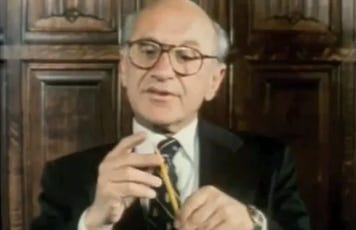
Look at this lead pencil. There is not a single person in the world who could make this pencil. Remarkable statement? Not at all.
The wood from which it’s made, for all I know, comes from a tree that was cut down in the state of Washington. To cut down that tree, it took a saw. To make the saw, it took steel. To make the steel, it took iron ore.
This black centre, we call it lead but it’s really graphite, compressed graphite. I’m not sure where it comes from, but I think it comes from some mines in South America.
This red top up here, the eraser, a bit of rubber, probably comes from Malaya, where the rubber tree isn’t even native. It was imported from South America by some businessmen with the help of the British government.
This brass ferrule—I haven’t the slightest idea where it came from—or the yellow paint, or the paint that made the black lines, or the glue that holds it together.
Literally thousands of people cooperated to make this pencil: people who don’t speak the same language, who practise different religions, who might hate one another if they ever met. — Source
Here is the full transcript:
I’ve thought about time travel. Like if I went back in time knowing everything I know now, I don’t think I would make a difference.
If I went back to the 20s and I saw some guy on an old phone, I would be like, “Okay, eventually they have phones you just carry in your pocket.”
And you’d be like, “Yeah, how do they do it?”
It’s like, “You know, I mean, I don’t know. I don’t know how they’re doing it. It’s like a satellite or something.”
And they were like, “What’s a satellite?”
Like, “Well, I shouldn’t have even brought that up then. It’s like a round metal dish or something that’s gonna go pretty high in the air.”
I honestly don’t think I could prove I’m from the future. I mean, they would want some proof. — Source
To the mathematically minded reader, the result of the folk theorem is the following: take all the points formed by the pairs of possible payoffs of the one-shot game. Any point in the intersection of the convex hull formed by these points and the set of points that give each player at least as much as he can guarantee himself if cooperation breaks down, (D,D), can be reached by the two players if the game is infinitely repeated and the players are patient enough. Alternatively, if the players are entirely patient, the same holds when the game has a sufficiently high chance of being repeated in each period. The reason is that any point in the convex hull can be reached, but only the points that give each player at least what he can secure on his own can be sustained, since otherwise a player would prefer to deviate and trigger the breakdown of cooperation.
Many other strategies would allow us to reach full cooperation.
Efficiency here means “Pareto efficiency”: a situation is Pareto efficient if there is no way to improve the payoff of one person without reducing the payoff of another person. If there is a way to improve the payoff of at least one person without penalising anybody, that situation is inefficient, in the sense that there are payoffs left on the table, so to speak. Vilfredo Pareto, who proposed this idea, was an Italian sociologist and economist in the early twentieth century.
Technical note, especially for economist readers. This seemingly simple sentence hides a difficult issue in economic theory. In standard economics, utility is usually not something that can be compared across individuals. It is mainly a way of representing each person’s own preferences. Even if one interprets utility more psychologically, as reflecting subjective satisfaction, it remains unclear how one unit of satisfaction for Alice could be compared with one unit for Bob.
Ken Binmore addresses this problem through the notion of empathetic preferences. These are the preferences Alice forms when she puts herself in Bob’s position and evaluates outcomes from his point of view. In that way, she can make sense of how much an outcome matters to Bob relative to how outcomes matter to her. This provides a basis for interpersonal comparison that standard utility theory, on its own, does not supply.
Such preferences were formalised by economist Harsanyi (1977) under the name of extended sympathy preferences.
The game was introduced by R. Duncan Luce and Howard Raiffa in their seminal book Games and Decisions (1957), where it is illustrated by a couple choosing between attending a prize fight or a ballet. The example captures a coordination problem with conflicting preferences over equilibria. The expression “battle of the sexes” predates game theory and reflects a broader cultural trope, which the authors adapted to label this strategic situation.
This statement might seem trivial. Do we need game theory to realise that Alice and Bob can alternate what they decide to watch over time? The result of the folk theorem is that such agreements can be equilibria of the repeated game they play. For instance, Alice and Bob can accept a simple rule:
“We alternate between watching Crime and SF each week. If, one week, one of us disagrees and does not respect this agreement, then we will not watch TV together anymore.”
With such a rule, it is rational for Alice and Bob to stick to the agreement. They do not need saint-like altruistic preferences or especially trustworthy traits. In reality, agreements are less formal and sanctions are less radical. But the same logic applies. If Bob says one evening that he does not want to watch a crime drama even though their possibly implicit agreement points to that evening being “Crime”, Alice might be annoyed at Bob and retaliate in different ways, including giving him a rain check the next time he suggests watching SF.
Importantly, these agreements, which give a payoff on the efficient frontier in bold in the graph below, can be sustained as an equilibrium.
The point c is what is called the utilitarian solution where the sum of utilities is the greatest.
A deflationary explanation is one that explain a phenomenon without appealing to anything especially lofty, mysterious, or intrinsically noble.
Normally, in market transactions we are not in the kind of bargaining situations described above. So the issue we face most of the time is whether to accept market determined wages and prices as fundamentally fair or not. As a general practical rule, efforts to produce alternatives run into rent-seeking public-choice type problems. So the question is not whether "we" can point to some idea better than the market but whether we will accept that the market produces rough fairness. I believe it does.
Nice analysis, from one naturalist to another.