

Recent events, from the widely criticised interview of the president of the US Anthropological Association to the scandal that unfolded around the late Jason Arday, a sociologist of education at Cambridge, have put the spotlight on a discipline in a state of strife.1 Without idealising the state of other disciplines looking at human behaviour, such as psychology and economics, sociology seems to face a whole different set of issues. Why? What is the problem with sociology (and neighbouring disciplines such as anthropology)? In this post, I look at the deep reasons why sociology might have become an epistemically weaker and ideologically more slanted discipline in the behavioural sciences than economics and psychology.
Pierre Bourdieu is perhaps the most cited social scientist.2 He was one of the most influential sociologists of the twentieth century and became actively involved in political debates during the final years of his life. In a documentary named “Sociology is a martial art”, released in 2001, a year before his death, he presented sociology as a way of equipping members of dominated groups with the intellectual tools to fight back against the “symbolic violence” of dominant groups.

In one scene of that movie, Bourdieu gathers a few collaborators around a table for a brainstorming session to find factual arguments about the negative social effects of “neoliberalism”. They look at different indicators for what they call an “index of liberalism prevalence”. Unfortunately, the exercise proves frustrating, and they struggle to find data that would indicate the negative consequences of that ideology. Statistics about murders, drug use and part-time work are considered without a clear connection between the data and neoliberalism. One collaborator suggests that they need finer data to identify differences in the evolution of life expectancy between higher and lower social categories. Another collaborator then interjects:
The problem—and I know a little about this—is that the gap tends to narrow. We cannot simply disregard indicators—or say that the indicators we use run counter to our thesis. But it is nevertheless a good thing that the healthcare system performs better today than it did in the past.3
Bourdieu concludes:
There is a delayed effect. I keep saying this. One of the strengths of neoliberal policy is, first, its secrecy, and the fact that its effects become apparent only over the very long term. By the time people have worked out what the policy is, they are already far behind—as with the WTO and so on. And its effects are discovered even later.
This excerpt is revealing of sociology’s political drift. The conclusion (neoliberalism is bad) is assumed. The data merely need to be found to illustrate it. When such evidence is not found, it is set aside: Bourdieu says that if we cannot see it, this is because it is invisible and takes a long time to emerge. In short, the approach is unfalsifiable: either we find data supporting the criticism of neoliberalism, or the data will come later.
Some might point out that this was not a “research session” but a “political discussion among researchers”, and that it therefore does not reflect how sociologists conduct research. Unfortunately, the growing rejection of scientific neutrality within the discipline weakens this distinction. Sociologists now routinely state that they pursue political aims through their research.
In Theses on Feuerbach, Marx famously stated:
The philosophers have only interpreted the world, in various ways; the point, however, is to change it. — Marx (1845)
Many researchers in the humanities seem to have adopted this mantra, particularly in sociology. In 2026, American Sociological Association President Shelley Correll stated that sociology should be “unapologetic in its ambition to create a more equitable world”.4 Indeed, in a 2018 survey of 479 American sociology professors, 62% agreed with the statement “I support Marx’s dictum to change the world,” while 15% disagreed.5

At the same time, the discipline has experienced a noticeable decline in institutional standing in recent years. From 2011–12 to 2020–21, its share of all US bachelor’s degrees fell by more than 20%.6 And its professional association has shrunk by more than one-third, from around 15,000 in 2007 to around 9,000 in 2024. These figures do not prove that politicisation caused the decline, but the two at least occurred alongside each other.
So why has it become so politicised? Here I present what I think is the underlying explanation: sociology evolved as a discipline with weaker formal and empirical constraints than economics and psychology, for some good reasons. While sociology produced very insightful perspectives on social dynamics, it developed less stringent epistemic standards for confronting ideas and discourse with facts and logic. Consequently, when academia moved markedly left, sociology had fewer methodological guardrails against an ideological drift.7
Sociology’s top-down view of society
To start with, we need to recognise that society and social phenomena are very hard objects to study. As the saying, commonly attributed to Murray Gell-Mann, goes:
Imagine how hard physics would be if electrons could think.
Faced with this complexity, there are roughly two possible strategies: a reductionist one that starts from the constituent units of social groups and tries to build our understanding from the ground up, and a “holistic” one that starts from social phenomena and considers the logic that emerges directly at this level.
These paths have broadly been those taken, respectively, by economics and sociology. Economists have started from individual behaviour and tried to build models explaining aggregate social patterns. Sociology, partly under the influence of Émile Durkheim, took the opposite path. Durkheim was keen to establish the boundaries of the emerging discipline by drawing a clear line between explanations of social phenomena and those that tried to explain society through what happens in people’s minds. He famously defined sociology as the study of social facts that have, in a sense, emergent properties that cannot be reduced to individual behaviour:
A social fact is any way of acting, whether fixed or not, capable of exerting over the individual an external constraint; or which is general over the whole of a given society whilst having an existence of its own, independent of its individual manifestations. — Durkheim (1895)
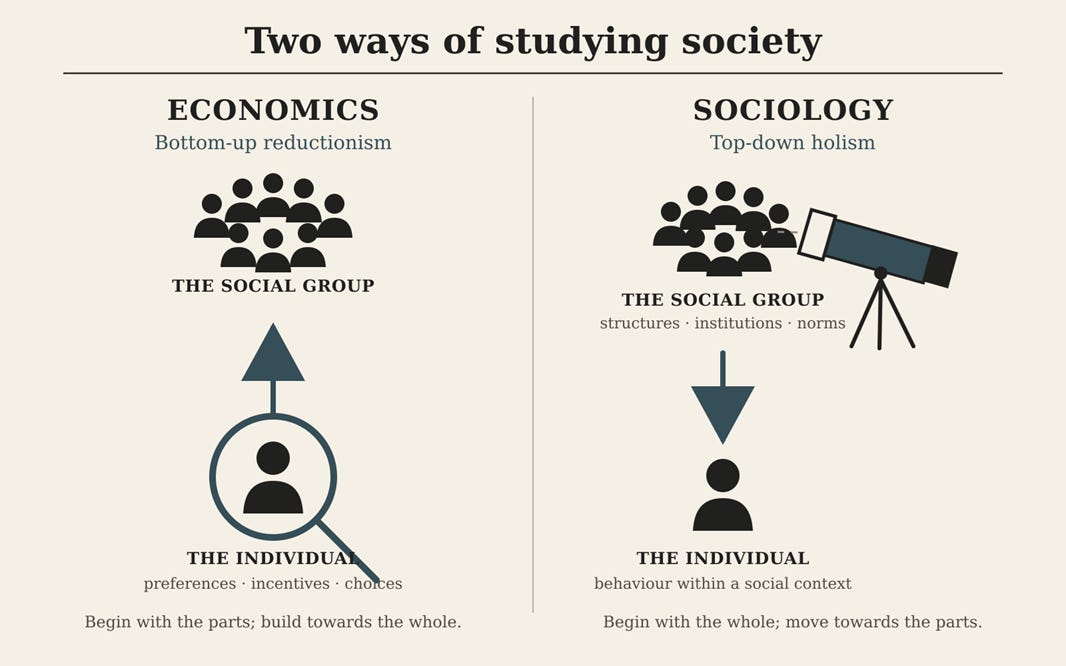
The holistic approach has both advantages and disadvantages. Its advantage is that it lets us take in complex social phenomena, such as culture, norms and religion, and analyse the logic that seems to emerge at their level without waiting to understand all the individual interactions producing them.
In comparison, the reductionist route taken by economics is tedious to start with. Economists have traditionally reduced people to an overly simple representation of a rational agent consistently trying to make the best decisions given his preferences. The individualistic models are precise and mathematically tractable, but they often seemed to miss the rich complexity of motives and actions in the social world: religion, love and social identity appeared (at least initially) quite foreign to this model. A common joke among economists who realised the limitations of their method was the lamppost one: an economist is like someone who searches for their keys under a lamppost, knowing that the keys are likely not there, but it is the only place with light.

The epistemic challenge facing sociology
Because of its holistic starting point and its rejection of explanations built from individual behaviour, sociology tended not to have a unified theory of individual behaviour. In comparison, economics had a unified theory, even though it was often unrealistic because it assumed too high a degree of rationality. Sociological accounts instead often portrayed individuals as mere vessels for social phenomena: in short, muppets shaped and moved by social dynamics. This is well illustrated by discussions of “gender roles”, where men and women are often described not as agents of their own fate but as filled with desires and duties determined for them by society.
Following Durkheim, sociology assumes that social facts such as cultures, rituals and norms constrain individuals. But what exactly are these constraints? Why do most people comply with them? Why do some rebel? By starting from the top, sociology lacked a clear theory articulating individual agency with collective constraints. Starting from individuals, economists progressively developed such a theory, showing how collective dynamics emerge from individual agency through the tools of game theory. The detour took a long time, but economics now offers a more explicit account of this articulation than sociology. In short, the reach of the lamppost’s light slowly expanded, bringing clarity to an ever wider range of social phenomena.
Sociology’s epistemic standards fell behind those of economics and psychology
Science is about finding patterns in the world, systematising them, and providing explanations that help us understand and predict them. In this endeavour, careful measurement and the use of mathematical models have played a major role in the development of science.
The conceptually richer route taken by sociology came at a cost. Its object of study, “social facts”, is not clearly and unambiguously delineated. Where does a “social norm” begin and end? What exactly is a “culture”, a “ritual” or a “social class”, and how should it be measured? In comparison, economists and psychologists could more readily begin with clear units of observation: individuals and their actions. Choices can be observed and described in unambiguous ways: we can observe whether Alice chooses vanilla ice cream rather than chocolate ice cream.
The risk of building a discipline without clear observational foundations is that, while it can produce more interesting discussions right away, it does so on looser conceptual frameworks. The contrast is like that between a geographical surveyor and a literary travel writer. Freed from the tedious rules of surveying, a good writer may immediately say many interesting things about a place. Eventually, however, the slow work of surveying may produce a systematic map that recovers many of the writer’s insights while showing that many others were wrong.
In its use of formal tools to study human behaviour, sociology has fallen behind economics and psychology. For sure, one can find quantitative work in sociology—often of very good quality—particularly in demography, survey research and network analysis. But this does not shape the bulk of the discipline.
Sociology’s theories of society
Mathematics plays a central role in science, often through simple models that aim to capture a specific dynamic in the world. In physics, one can represent the trajectory of a planet by assuming that its mass is concentrated at a point in space, even though we clearly know this is not the case. But doing so helps us focus on the key features that matter and produces a model that can make precise predictions that can be tested.
Because social facts are hard to define, sociology may have been at a disadvantage in developing tight and rigorous mathematical models. Economists developed a highly formal theory of decision built on the observation of choices. This work in economics produced very elegant theories. They were simplistic and came to be criticised by psychologists such as Kahneman and Tversky. But what observers often fail to appreciate is that behavioural economics, a research field born partly from the psychological critique of economic models, led to more realistic models, not to the abandonment of models altogether. Open a theoretical economics article today influenced by behavioural economics and you will find mathematical models that are, if anything, more complex than those of “old standard economics”.
To be fair to sociology, the mathematical modelling of social facts is hard. Indeed, if it were easy, economists, who happily prowl across the other social sciences, would have done it a long time ago. How do you put a “culture”, a “ritual” or a “religion” into a simple mathematical model? Economists now have good ideas about how to model these social phenomena, but this required the long detour through game theory developed from the mid-twentieth century onwards. It did not come easily.
I suspect that this is a key difference that put economics and sociology on different paths. In the competition for attention among scientists, smart academics with astute observations about social facts may have had relatively more success than those using frustratingly simple and tedious models. Much of economics was also literary in the early twentieth century, but formal economists eventually came to dominate the field because their elegant theories seemed to offer a prospect of progress: they looked like tools that could be used and developed further.
Sociology’s empirical methods
While scientists produce “theories”, they also try to assess how well these theories explain the world by testing their predictions against data drawn from factual observations. The empirical methods they use typically rely on a combination of statistics and experimentation.
In this domain, it is undiplomatic to say, but nonetheless true, that sociology as a field trails economics in the standards it applies to empirical research. Sociologists have developed sophisticated statistical techniques to describe social facts and their evolution. But these techniques often do not allow researchers to disentangle correlation from causation: if umbrellas and rain tend to appear together, do umbrellas cause rain, or does rain cause umbrellas?
Perhaps because of the quantitative nature of many of its traditional objects of study—prices, incomes, and quantities produced and exchanged—economics developed a close relationship with statistics and created a dedicated subfield, econometrics, to apply statistical methods to economic data.
Over recent decades, identifying precisely and carefully what causes what in society has become central to empirical economics. Economists have largely moved beyond linear regression (ordinary least squares or OLS) as a way of establishing causality and now use a wide range of techniques designed to try to extract as-good-as-experimental results from data collected in the world. In leading applied economics journals, an analysis claiming to show a causal effect using only a simple OLS regression would typically be rejected by editors and reviewers. In comparison, OLS regression is still routinely used to discuss causality in sociology.
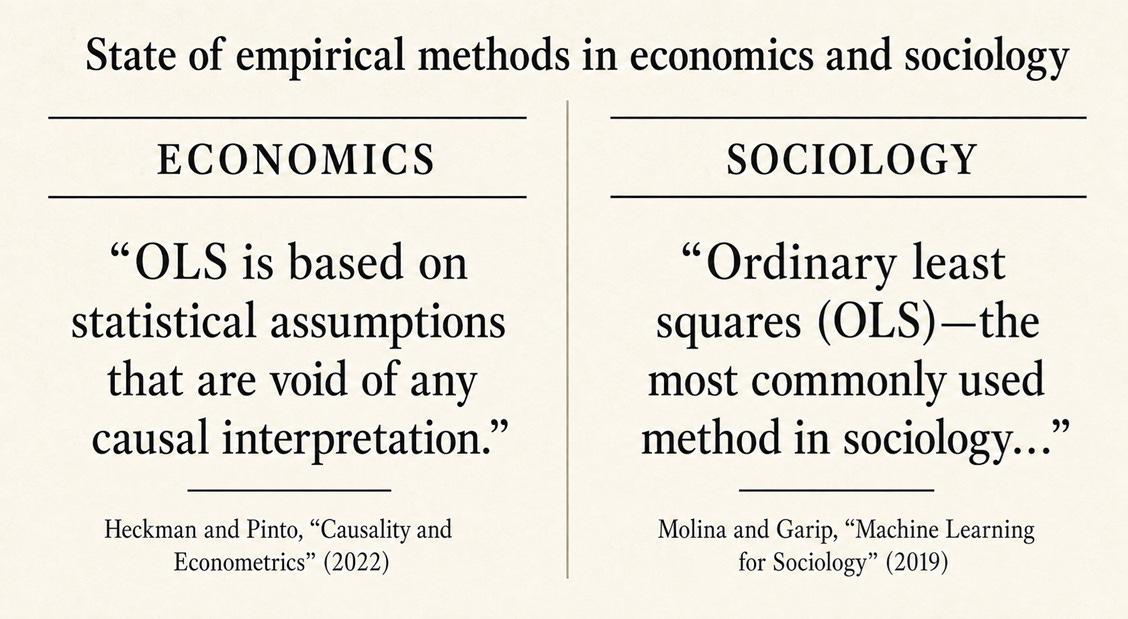
An attentive reader might point out that economics is a bit special among the social sciences in its heavy use of advanced statistical techniques. Psychology does not use them to anywhere near the same extent and might therefore face the same issues. But psychology had a big advantage: its object of study, individual behaviour, can be studied through experiments. Early on, psychologists put people in carefully designed situations to study how they reacted. The experimental method is a cornerstone of scientific progress, and psychology developed a culture of experimentation and considerable expertise in the statistical tools required to study experimental data. This helped build a large body of systematically recorded empirical findings upon which theories, even when not mathematical, could be built and tested.
Sociology could rarely use this method on its characteristic objects at the relevant scale: you cannot experiment with entire societies and write a paper such as: “Study of religious beliefs as a function of impending doom. We randomly varied the risk of asteroid impact across 100 societies and observed how it affected religious beliefs […].” In a sense, sociology faced the difficulty that its object of study—social facts—was too big to chew directly. It meant that the centre of gravity of the discipline was shaped around conceptual models expressed in words and the observation of statistical regularities that could describe social patterns without necessarily identifying what caused them.
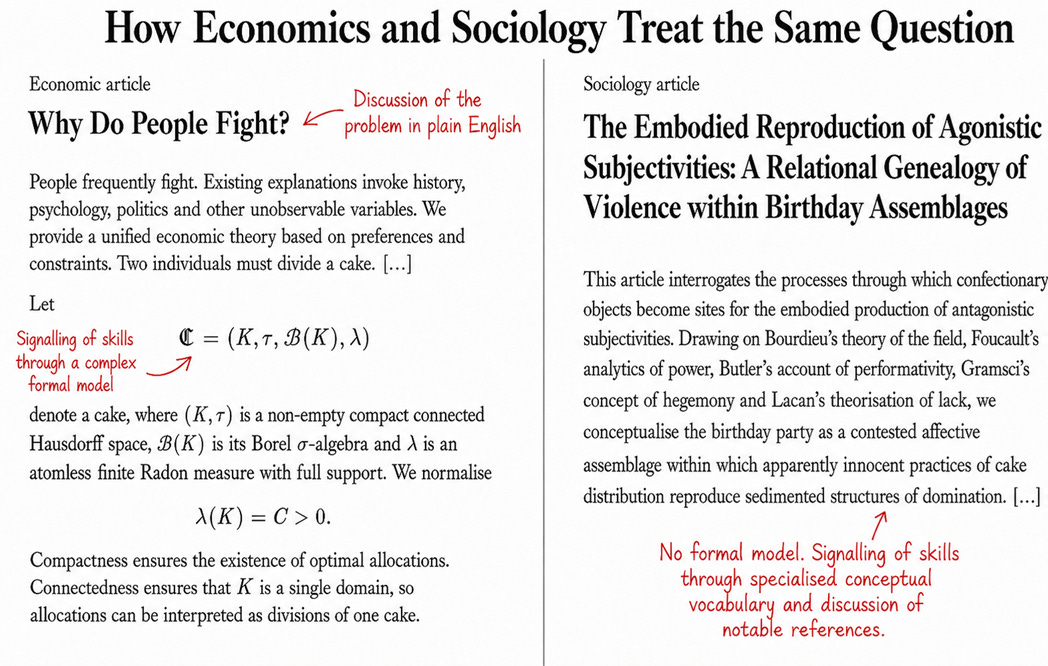
I believe that the difference in formalism between economics and sociology helps explain sociology’s distinctive way of writing in conceptual lingo. In the competition for attention, disciplines developed different ways for researchers to signal their intellectual skills. Economics came to reward mathematical rigour and formal explanation, psychology rewarded experimental ingenuity, sociology often rewarded astute observations expressed through conceptual and specialised language. This produces a somewhat ironic difference between sociology and economics. While economic papers are often centred on a mathematical or statistical model impenetrable to laypeople, their introductions are typically written in plain English and are more accessible than those of sociology articles.8
The lower degree of mathematical and statistical formalisation in sociology has important consequences. One of the major problems in science is the freedom researchers have to say what they want to say rather than what the evidence should really lead them to say. Researchers might have different reasons for preferring some possible conclusions: their worldview, their psychological preferences or their previous public support—and reputational investment—in specific ideas. Often, it is simply that their results will be more likely to be published if they find conclusions deemed interesting by their peers.
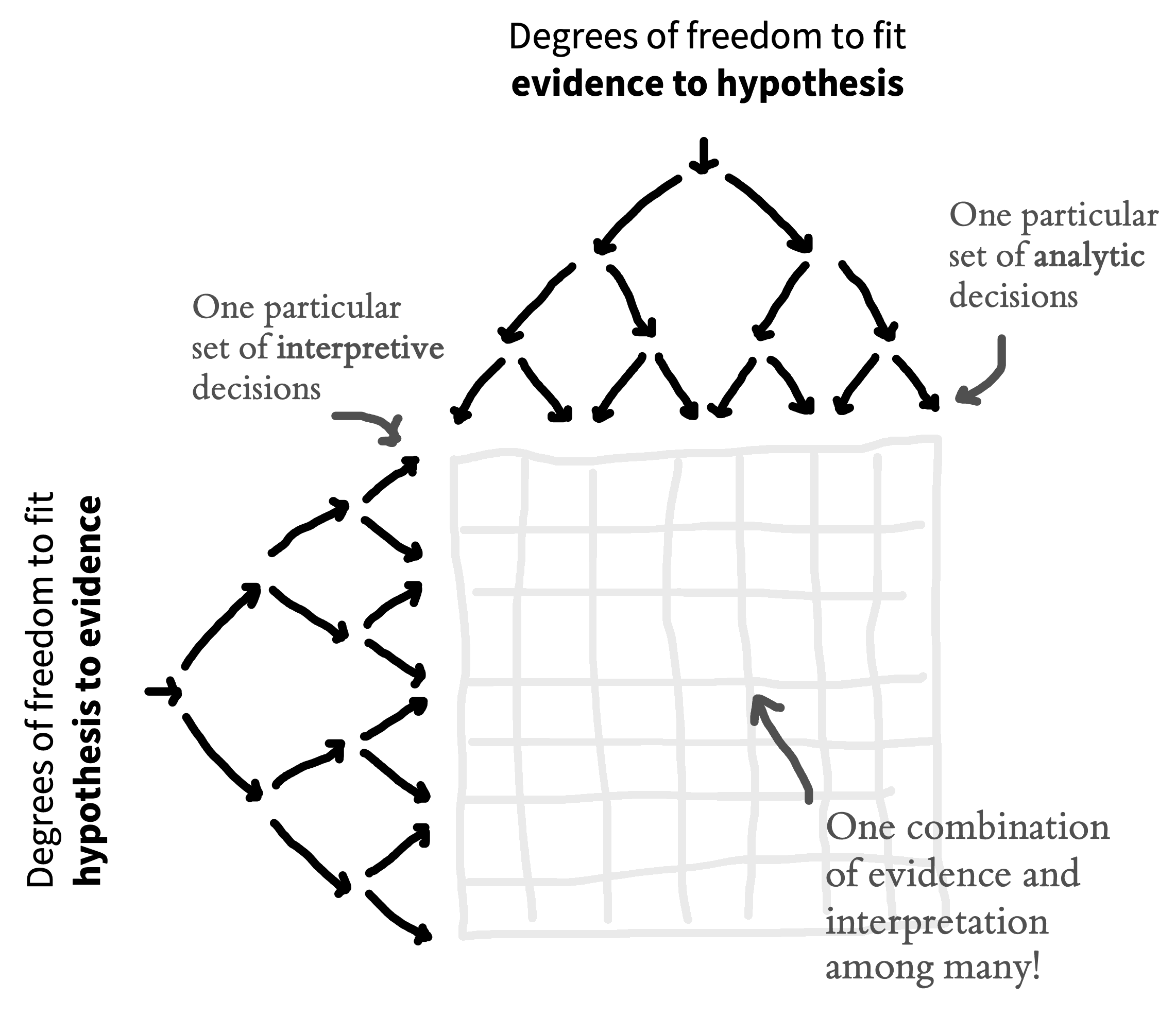
Formal models impose conceptual constraints on researchers. They limit the conclusions you can reach. Once you lay out your hypotheses, a given conclusion follows whether you like it or not. The freedom remains in the choice of assumptions, but at least those assumptions are made visible. Even with its experimental and statistical methods, the replication crisis in psychology showed how much freedom researchers could retain. And the lack of unified theory in psychology afforded researchers in that discipline more freedom to find quirky and surprising results that were appealing enough to publish.9
Sociology’s centre of gravity was constrained neither by psychology’s experimental discipline nor by economics’ formal theory and methods for identifying causes. The degrees of freedom can therefore be packed to the rafters: in the definition of the object, its measurement, the choice of data, the statistical analysis and finally the interpretation of the results.
Qualitative studies are a perfect example. Very good insights can come from listening to different people’s perspectives and synthesising them into a general conclusion. But, in light of the replication crisis in psychology, one should appreciate the extraordinary freedom this gives researchers, compared with quantitative techniques, to select and interpret pieces of evidence and cobble them together into a colourful depiction of reality.

In parts of sociology, and in closely related fields such as education and critical studies that draw heavily on its theories and methods, the influence of postmodernism led researchers to treat “lived experience” as evidence. In the most radical versions, particularly autoethnography, all hell breaks loose. Your perception of your own history becomes the data, and the narrative you craft to make sense of it becomes the result. The researcher, the object of study and the interpretation are rolled into one, leaving almost nothing independent against which the conclusion can be tested.
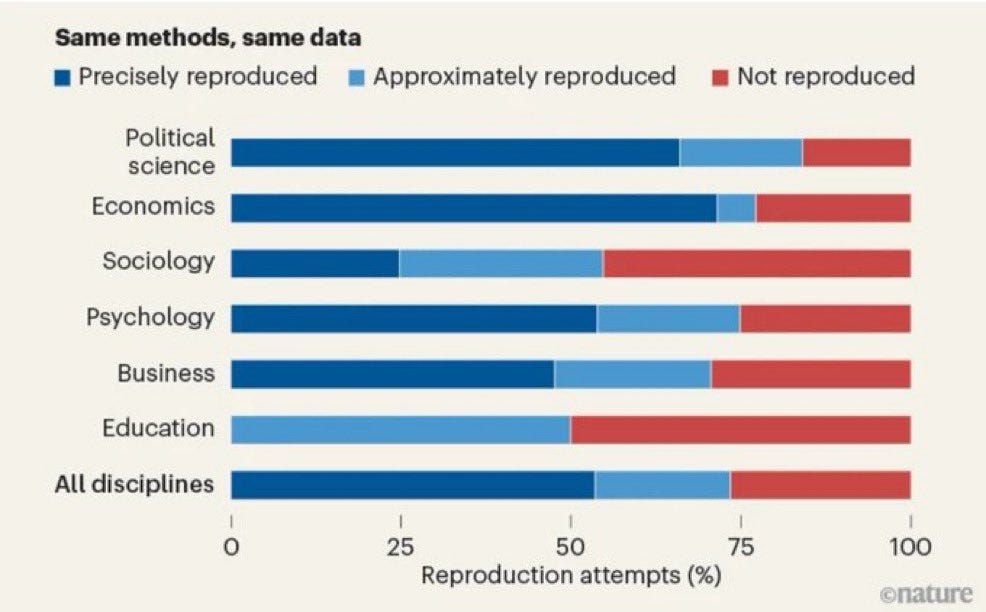
It is therefore not surprising that sociology and education—the two fields brought together in Jason Arday’s professorship in sociology of education—performed worse than psychology in a large study of reproducibility recently published in Nature. Faced with the same data and intended analysis as the original researchers, only around half of the papers in sociology and education were reproduced even approximately, while none of the education papers was reproduced precisely. Economics and political science substantially outperformed the other fields.
Weak epistemic constraints and ideological drift
These weaker epistemic constraints left sociology less protected against biases arising from researchers’ own preferences. This matters because, over recent decades, there has been a substantial leftward shift in academia. This political shift was part of the broader gentrification of the left, which progressively made highly educated urban middle classes the central component of left-wing parties’ electoral base in modern liberal democracies. In academia, the effects of this evolution are quite striking. Conservative scholars have nearly disappeared from social science departments.10
This evolution is visible in published research. A recent study used an AI model to classify the political stance of nearly 600,000 social-science abstracts published between 1960 and 2024. It found that the politically relevant output of every discipline was left of centre and that all disciplines moved further left after 1990. The further left a discipline was, the more ideologically homogeneous its output tended to be.
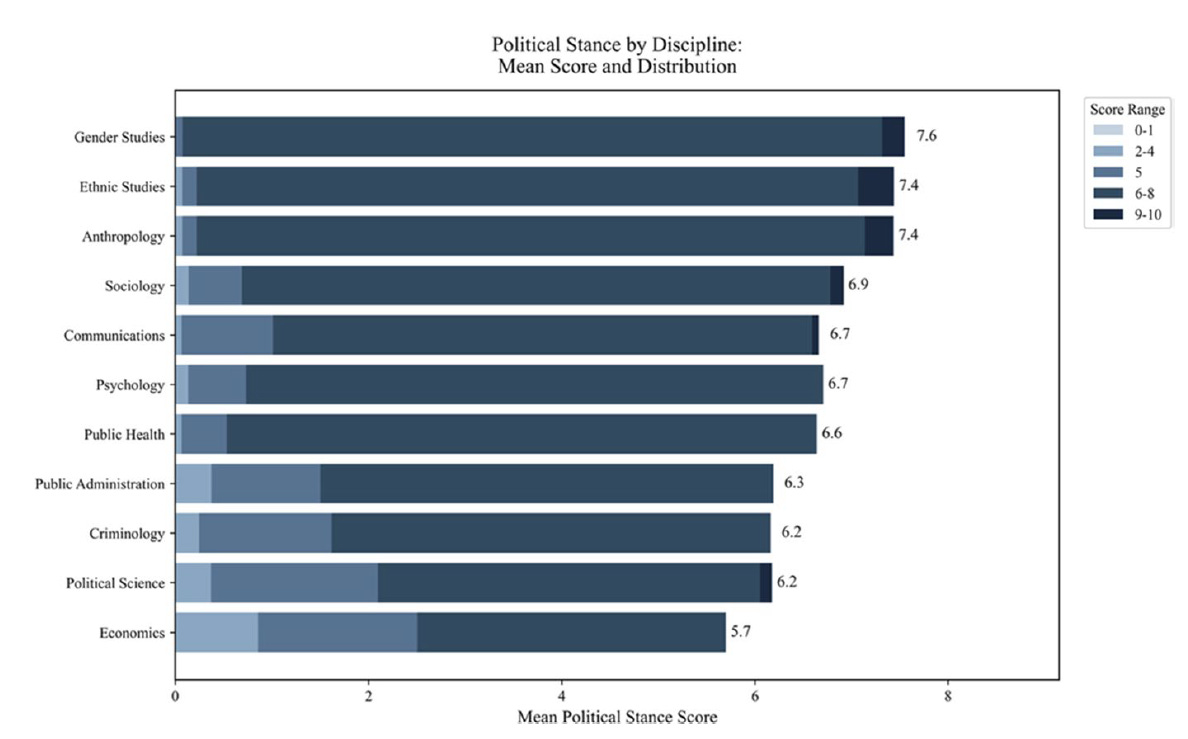
Historically, sociologists have tended to be more left-wing than economists, whose dominant theories have generally been more favourable to capitalism and markets. But it is interesting to note that the leftward political evolution since the 1990s has also occurred in economics.11 Open an economics journal today and you are more likely to encounter studies of labour-market discrimination and how to reduce it than studies arguing for financial deregulation or lower wealth taxes.
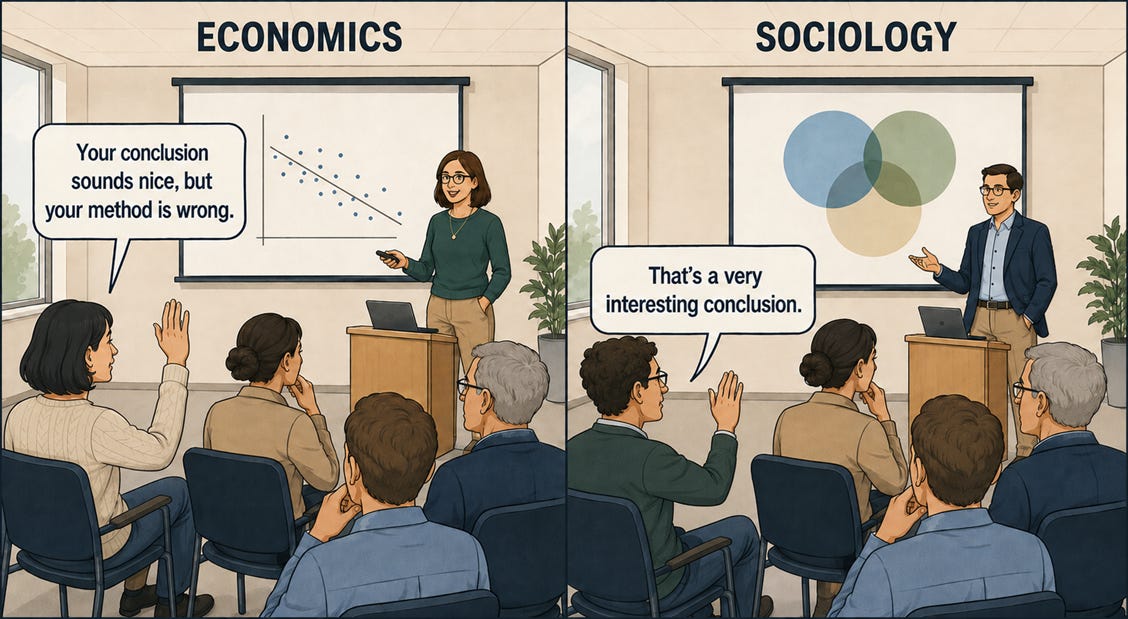
The difference, however, is that the methodological constraints in economics have provided stronger guardrails against ideologically motivated reasoning. Economics seminars are notoriously tough, and a paper’s adherence to accepted methods is closely scrutinised. You might present a paper with conclusions congenial to a left-wing audience and nonetheless see it shredded to pieces because its methods are unconvincing.
My experience of sociology seminars is different. They are much kinder, and comments are more likely to concern the positive or negative implications of the conclusion itself. Discussing these implications might be relevant, but it can also veer into an appeal to consequences, with a study judged according to whether it reaches the desired conclusion. That is clearly not how science should work.12
With fewer methodological guardrails and the field’s ideological composition moving increasingly far from that of the wider population, political activism became increasingly dominant in sociology. The same occurred in neighbouring fields such as anthropology. These disciplines came to grant status not only to scholars advancing left-wing ideas, but increasingly to those who actively declared their desire to change society in the direction they thought it should move. Signs of activist commitment became a way of acquiring recognition in the field.

Against Marx’s famous call not merely to interpret the world but to change it, Max Weber insisted that social scientists should separate empirical inquiry from their political commitments.
An empirical science cannot tell anyone what he should do—but rather what he can do—and under certain circumstances—what he wishes to do. — Weber (1904)
The recent evolution of sociology and neighbouring disciplines such as anthropology has vindicated Weber’s concerns. Whenever scientific inquiry is treated as part of a conflict waged against opposing political coalitions, truth is often the first victim.
It would be wrong to describe sociology as uniquely affected by ideological problems. Valid criticisms of the undue influence of researchers’ political views and preferences can regularly be made in other social and behavioural sciences, certainly including economics. However, I think it is fair to say that, among the social sciences, this problem looms substantially larger in sociology, as the discipline seems to have become institutionally political.
Can sociology be saved? The example of political science provides a useful case study. For a while, political science was strongly influenced by sociology and mostly applied sociological theories to political questions. The formal methods of economics, in particular game theory and econometrics, have, however, gained ground in that field, with quantitative political science now closely resembling applied economics. This type of research now dominates leading political science journals. The gain in methodological rigour is noticeable.
In many other areas of sociology, the same is now possible. The tools of game theory provide deep insights into what social norms are and how people interact in society, mixing elements of cooperation and conflict. The problem is that papers using such methods and ideas would often be about as welcome in sociology journals as Galileo’s defence of heliocentrism was in the seventeenth-century Catholic Church. The obstacle lies in the field’s current norms and in the priority given to political preferences by those who hold decision-making power within it.
The sad truth is that a young scholar seeking to understand society, and possibly even to improve it, is likely to be better off doing a PhD in economics. Inequality, culture and social policy are all covered in very rigorous ways in economics journals, and much of the research most likely to inform policymaking is written by economists.
Sociology does, however, have something to contribute. It has a great tradition of thinkers with insightful perspectives that can complement the often dry approach of economists. There is a world in which new generations of sociologists willing to study and understand the world manage to gain the upper hand over ideologically driven colleagues producing epistemically weak work largely to support their predefined conclusions. Given the current influence of ideology over scientific inquiry in important parts of the field, whether this world is ours remains unclear.
References
American Sociological Association (2025) ASA membership counts, 1970 to present.
American Sociological Association (2026) ‘Annual Meeting’.
Bourdieu, P. (1980) ‘Le sociologue en question’, in Questions de sociologie. Paris: Les Éditions de Minuit, pp. 37–49.
Durkheim, É. (1982 [1895]) The Rules of Sociological Method and Selected Texts on Sociology and Its Method. Edited by S. Lukes and translated by W.D. Halls. New York: Free Press.
Gelman, A. and Loken, E. (2013) The Garden of Forking Paths: Why Multiple Comparisons Can Be a Problem, Even When There Is No “Fishing Expedition” or “p-Hacking” and the Research Hypothesis Was Posited Ahead of Time.
Heckman, J.J. and Pinto, R. (2022) ‘Causality and econometrics’, NBER Working Paper No. 29787.
Horowitz, M., Haynor, A. and Kickham, K. (2018) ‘Sociology’s sacred victims and the politics of knowledge: Moral foundations theory and disciplinary controversies’, The American Sociologist, 49(4), pp. 459–495.
Kahneman, D. and Tversky, A. (1979) ‘Prospect theory: An analysis of decision under risk’, Econometrica, 47(2), pp. 263–291.
Lee, S.M. (2026) ‘Is anthropology hopelessly politicized?’, The Chronicle of Higher Education, 10 July.
Manzi, J. (2026) ‘The ideological orientation of academic social science research 1960–2024’, Theory and Society, 55, article 25.
Marx, K. (1976 [1845]) ‘Theses on Feuerbach’, in Marx, K. and Engels, F., Collected Works, vol. 5. New York: International Publishers, pp. 3–5.
Miske, O., Abatayo, A.L., Daley, M. et al. (2026) ‘Investigating the reproducibility of the social and behavioural sciences’, Nature, 652, pp. 126–134.
Molina, M. and Garip, F. (2019) ‘Machine learning for sociology’, Annual Review of Sociology, 45, pp. 27–45.
Muthukrishna, M. and Henrich, J. (2019), “A Problem in Theory,” Nature Human Behaviour, 3, 221–229.
Rubin, A.T. (2026) ‘The status of scholarly standards in sociology’, Vanderbilt University, 6 August.
Sánchez-Tójar, A., Wicherts, J.M. and Willer, R. (2026) ‘Huge meta-research project puts claims in social-science papers to the test’, Nature, 652, pp. 39–41.
U.S. Department of Education, National Center for Education Statistics (2024) ‘Table 325.92: Degrees in economics, history, political science and government, and sociology conferred by postsecondary institutions’, Digest of Education Statistics, 2022.
Weber, M. (1949 [1904]) ‘“Objectivity” in social science and social policy’, in Shils, E.A. and Finch, H.A. (trans. and eds), The Methodology of the Social Sciences. Glencoe, IL: Free Press, pp. 49–112.
This post was largely written before Jason Arday’s death. His death is tragic, but it does not remove the institutional questions raised by his appointment or the broader disciplinary issues discussed here.
Link to the video (placed at the right timestamp)
Horowitz et al. (2018)
A recent report by Ashley Rubin on politicisation in the social sciences and humanities described the extent to which sociology has become politicised and the negative impact this has had on the quality of its scholarship (Rubin, 2026). Here I complement this account by looking at the deeper reason why sociology has become more politicised than other disciplines.
Joseph Heath also wrote recently a post on sociology and its ideological travail that is interesting, with a focus on the intellectual content of sociology’s politicisation.
Bourdieu suggested that the style of writing in sociology was due to conceptual rigour:
The pursuit of rigour often requires sacrificing elegant, apparently clear formulations for language that is heavier but more exact and controlled. — Pierre Bourdieu (1980)
I instead think that it is due to the equilibrium of the academic game played in the field, and that what a sociological article says could often be said in plain English with limited loss of meaning. In the same way, economic papers might be overly formal because simple models would be dismissed as trivial.
See Muthukrishna and Henrich (2019) for a discusion of this issue.
A 2018 survey of 479 sociology professors found that only 2% identified as conservative, with another 2% identifying as libertarian (Horowitz, Haynor and Kickham, 2018).
The 1969 Carnegie survey of 58,000 American university faculty found that 79% of sociologists identified as left or liberal, compared with 57% of economists.
For sure, plenty of seminars in sociology do not work that way. However, my own experience suggests a noticeable difference in that regard between economics and sociology.
A great read. Thanks.
What comes to kind immediately is the tendency of leftists (and many sociologists) to criticize the quantitative nature of Econ in the opposite way. They often claim that Econ uses fancy equations and tables to give an intellectual veneer to their naked promotion of the interests of capital.
I did my PhD in game theory so... Yeah.
I share some of the views but I think the overall picture of the discipline is conveys is not representative. I wrote an answer. I hope some people find it interesting: https://substack.com/@lsage1/p-212004938