

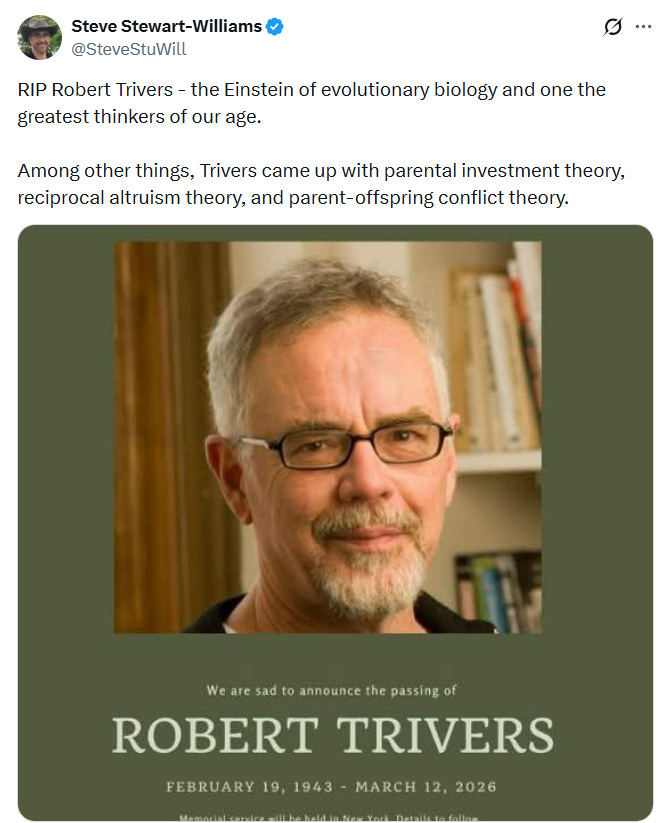
Steve Stewart-Williams announced early this week that Robert Trivers passed away.
Trivers was one of the most—perhaps the most—influential evolutionary biologists of the 20th century. His work should be much more widely known in social and behavioural sciences, in particular in economics, as Trivers’ intellectual approach is very much in line with a game theoretic understanding of social interactions.
It is hard to overstate the importance of his work. Einstein famously published four groundbreaking papers in 1905, a year often referred to as his “Annus mirabilis”, during which he revolutionised physics. Trivers might be said to have had a “Quinquennium Mirabile” for the five years between 1971 and 1976, during which he produced a series of ideas that revolutionised evolutionary biology.
Reciprocal altruism - 1971
Evolution is often conceived as implying that people should be selfish and cynical. This view is mistaken. As early as Darwin, evolutionary thinkers have suggested that cooperation was fully compatible with evolution. That being said, how cooperation evolved was, for a long time, an unresolved problem. One seemingly intuitive answer was proposed by Vero Wynne-Edwards: altruism is good for the group and hence altruism will be selected to help the group survive. Some old animal documentaries illustrated this idea, describing the old wildebeest allowing itself to be caught and eaten by the lion so that the younger ones in the herd could survive.
This idea, now labelled “group selection”, does not work. Selection operates at the individual level. If altruists sacrifice themselves for the group, the group might benefit, but the altruists in it will tend to disappear over time. So, self-sacrificial altruism is not something that we would expect to be selected.1
In 1966, the evolutionary biologist George Williams proposed an alternative solution in his book, Adaptation and Natural Selection. He argued that a lot of apparently “group-beneficial” helping can, in principle, be compatible with natural selection when helping tends to be repaid inside stable social relationships.
Robert Trivers built on this insight and published, in 1971, one of the most influential papers in evolutionary biology, The Evolution of Reciprocal Altruism. In it, he describes how conditional rules of the form “I scratch your back if you scratch mine” could naturally evolve and explain the prevalence of cooperation in the animal world.
The human altruistic system is a sensitive, unstable one. Often it will pay to cheat: namely, when the partner will not find out, when he will not discontinue his altruism even if he does find out, or when he is unlikely to survive long enough to reciprocate adequately. And the perception of subtle cheating may be very difficult. Given this unstable character of the system, where a degree of cheating is adaptive, natural selection will rapidly favor a complex psychological system in each individual regulating both his own altruistic and cheating tendencies and his responses to these tendencies in others. As selection favors subtler forms of cheating, it will favor more acute abilities to detect cheating. — Trivers (1971)
Trivers then goes on to explain the rich tapestry of human moral emotions: we long for good friends who are likely to be good, we get angry at cheaters and can be willing to punish them at substantial costs to ourselves, we feel gratitude and sympathy towards altruistic acts and guilt towards our own violations of the implicit rules of reciprocity.
This emotional tapestry creates the setting for even more complex games, where people leverage these emotions strategically. Trivers, for instance, describes how some cheaters can use these emotions to their advantage.
Apparent acts of generosity and friendship may induce genuine friendship and altruism in return. Sham moralistic aggression when no real cheating has occurred may nevertheless induce reparative altruism. Sham guilt may convince a wronged friend that one has reformed one’s ways even when the cheating is about to be resumed. Likewise, selection will favor the hypocrisy of pretending one is in dire circumstances in order to induce sympathy-motivated altruistic behavior. — Trivers (1976)
Trivers’ insights align closely with those of game theory on the rationality of cooperation in repeated interactions. Indeed, Trivers was aware of the game-theoretic results and mentions them in his article.
Reciprocal altruism has become one of the main explanations of the emergence of cooperation between non-kin. Cooperation does not require society to be populated by saint-like figures; it works with humans as they are, warts and all. It is indeed the blend of cooperation and conflict in social interactions that explains the rich nature of our social emotions and the many mini intrigues layered into our social relations.
Parental investment -1972
One year after his paper on reciprocal altruism, Trivers published another major paper, Parental Investment and Sexual Selection. This provides a simple and illuminating answer to a question asked from time immemorial: why are men and women different?
Trivers starts from a very simple basic fact: men and women differ in the investment they put into making a child. In sexual reproduction, a male and a female each produce gametes, and a new child is developed from the fusion of the two. All known animals that reproduce sexually are anisogamous: they have different gamete sizes.2 We conventionally call females the sex with the largest gamete size and males the sex with the smallest.
This difference in gamete sizes creates an asymmetry that puts members of both sexes on different strategic paths to achieve higher fitness. With a lower investment in any given child, males have a greater incentive to look for many females to provide their gametes to. On the contrary, females have to be more cautious. Any child is a more costly investment for them. Because they invest more, they have fewer opportunities to have children. It is therefore worth investing more in each of them.
Since the female already invests more than the male, breeding failure for lack of an additional investment selects more strongly against her than against the male. In that sense, her initial very great investment commits her to additional investment more than the male’s initial slight investment commies him.3 — Trivers (1972)
In the class of mammals, this asymmetry builds up from a fairly small difference between sperm and egg into massive differences in biological investment. In humans, women carry and sustain a developing baby for nine months. One would therefore expect that these very different investment costs and benefits lead to very different behavioural strategies and psychologies for anything related to sexual behaviour.
Indeed, since men are seeking a mate who will bear most of the initial investment required to bring a child into the world, they evolved a psychology that is relatively more promiscuous and oriented towards short-term mating. A philanderer can potentially initiate several baby-making processes at little physiological cost to himself. On the other hand, women should care more about what men are bringing to the table; they should therefore be relatively more concerned with the quality of the genes provided and, if possible, with the willingness of the man to commit to a long-term relationship and invest his time and resources in raising their children.
Trivers uses differential parental investment to explain a number of patterns observed across the animal kingdom: the greater tendency of males to desert their partners, the greater choosiness of females, who typically decide with whom to mate from a pool of pretenders, and the greater, sometimes violent, competition between males. More broadly, this framework also helps explain associated sex differences, such as higher male mortality and greater male body strength in species where success depends on winning intra-male competitions.
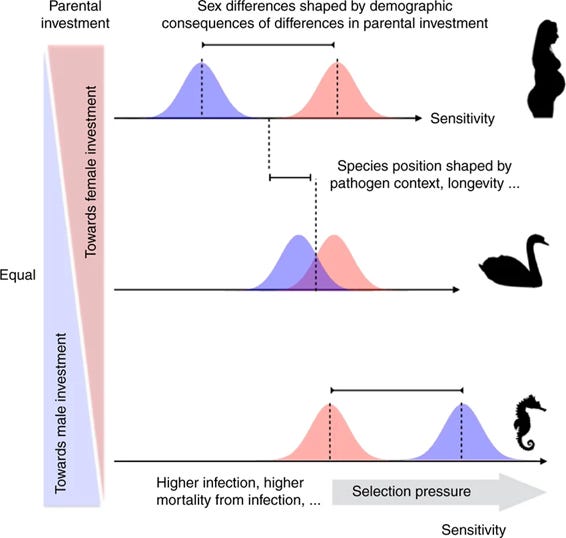
Critics of evolutionary theory sometimes argue that it does not make any predictions that can be tested and that it only rationalises what has already been observed. Trivers’ work is one of the best examples disproving this accusation. In his paper on parental investment, Trivers argues that the differences in behaviour between males and females should reflect the degree of asymmetry in their parental investment. As a result, animals with more parental investment asymmetry should show greater asymmetry than those with less, and if we ever find animals with role reversals, we should also observe reversals in strategies. And indeed, we observe that in animals with less asymmetry in parental investment, like swans, the differences between males and females are less noticeable. In the rare cases where male investments are larger, like in seahorses, where the females literally place their eggs in the belly of the male who incubates them, we observe a role reversal, with females courting males and competing for access to them.
Parental investment theory offers a simple and compelling answer to the age-old question of why men and women differ in their preferences and psychological traits—often captured in the popular expression that men are from Mars and women are from Venus: much of this can be traced back to the asymmetric size of gametes, which generates broader asymmetries in investment. Men’s and women’s fundamental differences in these preferences and traits are not a reflection of social indoctrination;4 they are adaptive strategies that differ because men and women have been dealt different cards by nature in the game of life.5
Parent Offspring Conflict - 1974
In 1974, Trivers published a paper that speaks to any parent: Parent-Offspring Conflict. In this article, he explains that while parents and children are genetically closely aligned—which explains the close cooperation between family members—they are not perfectly aligned. There are always elements of conflict, and recognising this helps make sense of the sometimes complex dynamics within families.
Following the now widely accepted gene-centred view of evolution, evolution selects traits that maximise the chance of our genes being reproduced. From that perspective, children's and parents’ genetic interests are not identical. Children should care about their own success and, to a lesser degree, about the success of their siblings with whom they share, on average, 50% of their genes.
Parents, on the other hand, are equally related to their children. They should care about these equally. In addition, they should care about themselves above and beyond caring about their kids, to the extent that they could have additional children in the future.6 This leads to several areas of tension.
Children have an interest in overclaiming the attention and resources of their parents. Parents of newborns are familiar with the unrelenting demands of their baby, waking up during the night, crying frequently, and often draining parents of energy. Parents end up conflicted because, while they love their child, they would often want to give less attention than what is requested from them. They would like to sleep more, have more time for themselves, and so on. But from the baby’s point of view, it is optimal to ask for more resources than parents are willing to give. Any resource received by the baby 100% benefits him or her. Any resources (including health) saved by the parents might be used to have children later, but this is not as important for the baby as the immediate benefits of additional resources received now.

Hence, there are constant conflicts, with children asking for more resources than their parents are willing to give them. Weaning a child, which is usually required for a woman to ovulate again and have additional children, is, for instance, often a challenge, as the child resists it.
Obviously, children cannot argue like lawyers, so they compete for greater attention and resources using what Trivers calls “psychological manipulation”.
The offspring can cry not only when it is famished but also when it merely wants more food than the parent is selected to give. Likewise, it can begin to withhold its smile until it has gotten its way. Selection will then of course favor parental ability to discriminate the two uses of the signals, but still subtler mimicry and deception by the offspring are always possible. — Trivers (1974)
In fact, the conflict happens already before birth, in the mother’s womb. Foetuses overclaim maternal resources, slightly to the detriment of the mother’s health. Mothers’ physiology has been designed to counterbalance these claims, and the balance reached is the result of an internal tug-of-war. Some significant health issues associated with motherhood are a reflection of an imbalance in this internal battle. The tendency to experience diabetes during pregnancy can, for instance, be seen as one reflection of this conflict, with the foetus and placenta pushing for greater access to maternal glucose than is optimal for the mother’s own health.
Obviously, overall parents tend to love their children and children tend to love their parents, but Trivers showed—with a theory now largely supported by empirical research— that the whole picture is more complex, because there are always also elements of conflict in parent-offspring relations.
Self-deception - 1976
There is a widely known tendency for people to engage in motivated reasoning and believe that they are better than they are. Psychologists have often explained this as a reflection of the fact that we enjoy having flattering beliefs. An evolutionary perspective makes this answer somewhat puzzling. Evolution does not select psychological traits that make us happy, but traits that make us successful. Hence, if we tend to delude ourselves into thinking that we are better than we are, there must be a reason outside of our mind: it must somehow be useful.7

In the preface to Dawkins’ The Selfish Gene, Robert Trivers proposed a solution to this problem: our tendency to self-deceive, to think we are better than we are, may serve as a mechanism that enables us to deceive others more effectively. He wrote:
If … deceit is fundamental to animal communication, then there must be strong selection to spot deception and this ought, in turn, to select for a degree of self-deception, rendering some facts and motives unconscious so as not to betray – by the subtle signs of self-knowledge – the deception being practiced. —Trivers (1976)
Commenting on this assertion, psychologist Steven Pinker remarked, “This sentence... might have the highest ratio of profundity to words in the history of the social sciences” (2011).
Trivers starts from the idea that, in communication, deception is widespread. This is a reasonable assumption. As stated by Dawkins (1976): “It may well be that all animal communication contains an element of deception right from the start, because all animal interactions involve at least some conflict of interest.”
In a 2011 paper with Bill von Hippel, Trivers developed this idea further, listing how self-deception can help. When trying to deceive, people may face cognitive load (the cognitive work required to make sure a web of lies does not have glaring contradictions). Given that lying is a betrayal of trust and is sanctioned when it is found out, it is risky, and people can get nervous about being found out, possibly showing signs of nervousness. Finally, people might try to mask signs of nervousness, thereby also behaving in a way that indirectly suggests lying. Self-deception, by inducing people to believe in their own lies, so to speak, can eliminate these possible clues while leading others to believe the preferred story of the person self-deceiving.
Trivers’ theory of self-deception has been supported by empirical research (including research I have contributed to). It explains what seems to be one of the most irrational patterns of human behaviour as emerging from strategic incentives.

Trivers has been one of the most influential evolutionary biologists, and his papers are still worth reading today. His insights, published more than 50 years ago, are fascinating. They often align very well with economic theories of behaviour, and it is therefore regrettable that his ideas are not more well-known in economics, and in particular in behavioural economics.
A key feature of Trivers’ take across these contributions was to see that beneath the world of social interactions we observe, there are deep structures in terms of incentives that shape the game we play. Understanding these games and their structures helps us make sense of the seemingly endless complexity of human psychology and social dynamics. In several key contributions, Trivers helped lift the veil on the underlying logic of human behaviour.
References
Coleman, R.M. and Gross, M.R. (1991) ‘Parental investment theory: the role of past investment’, Trends in Ecology & Evolution, 6(12), pp. 404–406.
Darwin, C. (1859) On the Origin of Species. London: John Murray.
Dawkins, R. (1976) The Selfish Gene. Oxford: Oxford University Press.
Dawkins, R. and Carlisle, T.R. (1976) ‘Parental investment, mate desertion and a fallacy’, Nature, 262, pp. 131–133.
Pinker, S. (2011) The Better Angels of Our Nature: Why Violence Has Declined. New York: Viking.
Sargent, R.C. and Gross, M.R. (1985) ‘Parental investment decision rules and the Concorde fallacy’, Behavioral Ecology and Sociobiology, 17, pp. 43–45.
Trivers, R.L. (1971) ‘The evolution of reciprocal altruism’, The Quarterly Review of Biology, 46(1), pp. 35–57.
Trivers, R.L. (1972) ‘Parental investment and sexual selection’, in Campbell, B. (ed.) Sexual Selection and the Descent of Man 1871–1971. Chicago: Aldine, pp. 136–179.
Trivers, R.L. (1974) ‘Parent-offspring conflict’, American Zoologist, 14(1), pp. 249–264.
Trivers, R.L. (1976) ‘Foreword’, in Dawkins, R. The Selfish Gene. Oxford: Oxford University Press.
Trivers, R. and von Hippel, W. (2011) ‘The evolution and psychology of self-deception’, Behavioral and Brain Sciences, 34(1), pp. 1–16.
Williams, G.C. (1966) Adaptation and Natural Selection: A Critique of Some Current Evolutionary Thought. Princeton: Princeton University Press.
Wynne-Edwards, V.C. (1962) Animal Dispersion in Relation to Social Behaviour. Edinburgh: Oliver & Boyd.
There is a modern version of group selection which avoids this pitfall: multilevel selection. The idea is that if the altruist helps the group enough, then groups with more altruists can grow enough for the number of altruists to grow even though their proportion decreases in the group. This explanation requires the effect of altruism to be large enough, with groups competing and splitting often enough, and intergroup migration to be small. In comparison, the reciprocal altruism explanations, and all those closely related that rely on conditional cooperation, do not require these specific conditions. I find them, therefore, more compelling.
There are good reasons to think that this asymmetry is an equilibrium, in that situations with purely identical gamete sizes are not stable. In the investment into offspring, animals face what game theorists would recognise as a hold-up problem. Once two individuals have invested in an offspring, they may both prefer for it to survive, but each would prefer the other to bear the cost of care. If one parent leaves quickly after mating, it leaves the other in a bind: abandoning the offspring may lead to its death, so the remaining parent may prefer to stay and care for it even if it has been short-changed in the interaction. Anticipating this, a parent who stays may have stronger incentives to invest further. This logic makes equal investment a potentially unstable knife-edge situation, while situations in which one parent provides most of the care may be more stable.
This statement was criticised by Dawkins and Carlisle (1976), who saw in it a case of the sunk cost fallacy: current parental investment, they argued, should depend on expected future benefits, not on a desire to avoid “wasting” past investment. We know from economics that the fact that we have already invested a great deal in something does not by itself imply that we should continue. Our choices should be driven by expected future returns, not by past investments.
It is possible, however, to restate Trivers’ point more carefully. If reproductive resources are limited, past and future investments are not independent. Past investment can reduce a parent’s remaining lifetime reproductive success, so the value of the current brood has to be assessed relative to the value of future broods (Sargent and Gross, 1985; Coleman and Gross, 1991). In that sense, the relevant logic is not that sunk costs as such should govern future choices, but that past investment can alter a parent’s future options and thereby the expected return to continued investment in the present offspring.
Socialisation clearly adds a layer to it, but the mistake of some social scientists is to ignore that this social layer does not explain everything. It is built on a deeper biological reality.
I have written previously about how this issue is at the heart of Austen’s novels, where heroines often have to avoid the deceptive appeal of men who seem charming but are actually not of good character and not committed to a long-term relationship. It is this deep understanding of women’s and men’s stakes and strategies in romantic relationships that still makes her novels so popular today.
Not that this “should” is not normative. I am not saying we have any kind of obligation. Instead, it is just saying that evolution implies that in the long run, organisms are selected to maximise the survival and reproduction of their genes, and to achieve that goal, they should care about their own success and the success of other people they are related to, to the extent they are related.
Dan Williams’ latest post criticises the idea that we would engage in wishful thinking simply because we enjoy having some convenient beliefs.
Thank you for this brilliant article and for introducing his work - a must read . I never knew about Trivers work.but it comes ontime for me. I am working on understanding the behavior of fear and its conflict with judgement
So, senior year at UCSC I moved into a house on High St across the street from the university. It had been his house, we got lots of his mail. Plus they left things.
Regardless, not being a socio/anthro/psych major, I hadn't heard of him so I started reading about this and psychobiology. It was a memory shock to see this article.