

In the previous post, I described how norms of fairness evolve over time to reflect the structure of power in society. If so, how should we explain change over time, and what is the role of political actors, in particular those pushing society in one direction, such as greater equality?
In Victor Hugo’s Les Misérables, the young Gavroche is shot on Paris’ barricades during the June 1832 Rebellion. As he dies, he sings his famous final lines:
I fell to the ground,
It’s Voltaire’s fault,
My nose in the gutter,
It’s the fault of…
Before he can complete the expected rhyme, “Rousseau”, a second bullet stops him short.1
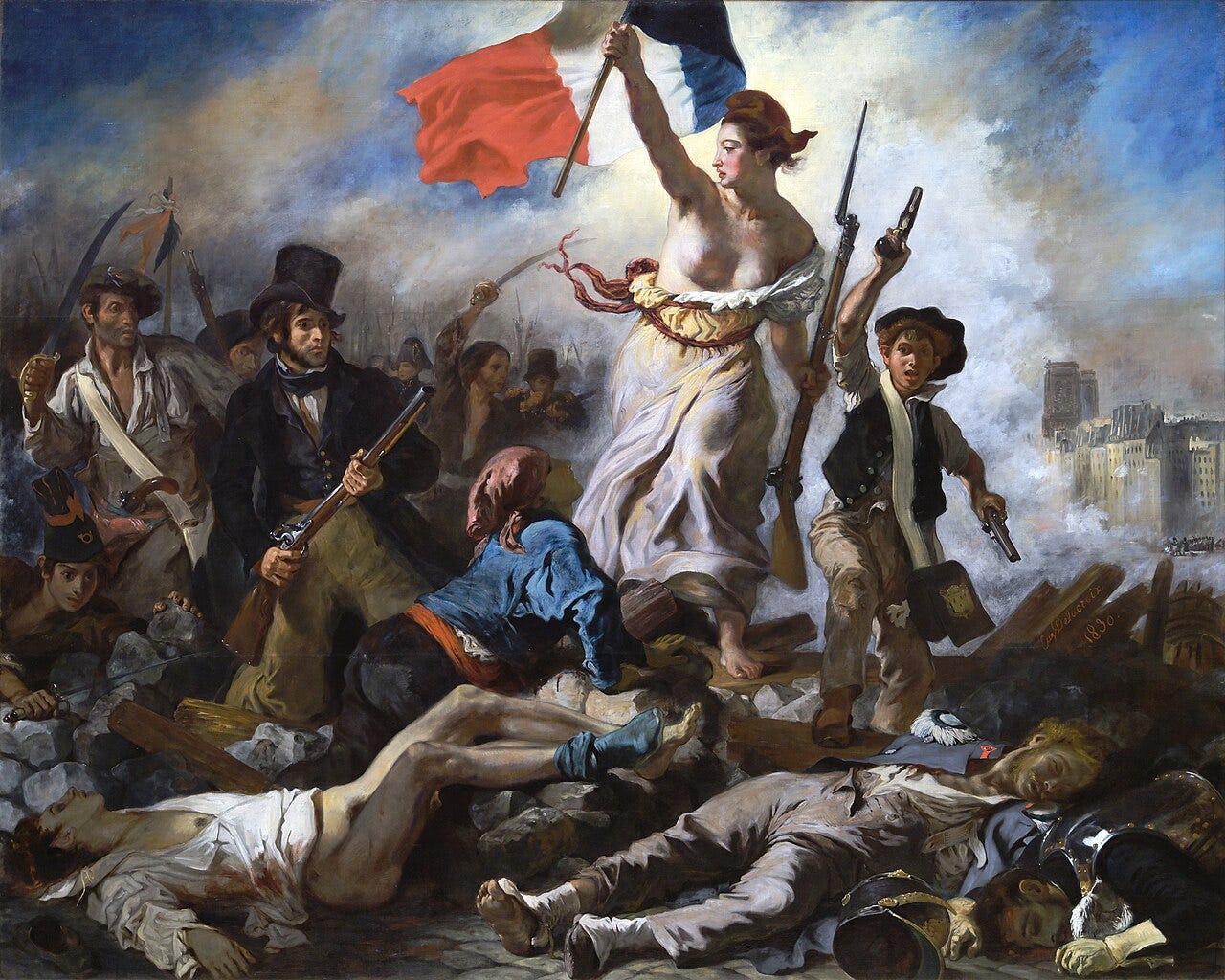
Gavroche’s actions and words are a good illustration of one vision about social change: it is actor-driven. Social change happens because some key players make it happen. Some of these players are intellectuals like Voltaire and Rousseau. They propose new ideas which are often described as if they would not have seen the light of day without them. Other players are political activists like Gavroche. They drive practical changes by mobilising popular support for these new ideas.
This actor-driven vision can be read in alternative histories where we are told that without this or that person’s writings or actions we would not be where we are now. For instance, historian Ian Mortimer said about the French Revolution:
Without the French Revolution, it is difficult to see how the great social reforms of the 19th century – the abolition of slavery, universal education, the rights of women to act as independent property owners, public health, and the diminution of capital punishment – would have proceeded as they did.2
It is fair to think that these changes would not have proceeded as they did without the specific events of the French Revolution. However, the actor-driven perspective on social change risks mistaking the wave that sweeps away old institutions for the tide of change that carried it, and that would likely have carried another wave had this one not done so.
The timescales of the evolution of fairness norms
I have previously argued that the dominant ideas in a society are part of a social contract that reflects the balance of power in that society. If so, how does political change happen? Game theorist Ken Binmore proposed distinguishing different timescales to understand how social contracts shape our actions and are shaped by social changes.
Daily interactions
In our daily interactions, which take place over hours and days, we can ignore changes in social and cultural norms. What Alice and Bob consider fair for their relationship today, they are likely to consider fair tomorrow.3
It is why social conventions about what is fair and unfair work: they are common knowledge. Hence, when Alice and Bob have to decide about what is a fair split, for instance who should wash the dishes tonight, Alice knows what Bob will find “fair”, Bob knows what Alice will find “fair”, Alice knows that Bob knows what she will find “fair”, Bob knows that Alice knows what he will find “fair”, and so on.
If you replace “fair” by “deemed acceptable by prevailing conventions about how to share duties and rewards”, it becomes clear how commonly known fairness norms help Alice and Bob agree in their daily decisions without too much haggling and friction. Fairness norms act as a coordination device to solve bargaining problems. They can do so precisely because they are themselves not renegotiated in our everyday interactions.
Fairness norms are sticky in everyday life because common expectations do not change in an instant. They are built from shared practices over time. Alice can trust that Bob will respect the norm because he has done so in the past.
Social evolution
While fairness norms are rigid from one day to the next, they clearly evolve across time. We do not have the same fairness norms as in the 1950s, let alone the norms of the 19th century and previous centuries.
Norms change because society changes. If fairness norms reflect the structure of bargaining power in society, they will progressively change as this structure changes. While norms are sticky in the short term, norms that point to bargaining solutions that no longer match the actual balance of bargaining power will be eroded over time. Those who can get more will progressively ask for more at the margin, or at some point reject the existing norm altogether and claim what they are able to get using their raw bargaining power.
The movie Send Help provides a condensed version of that dynamic: a meek employee, Linda, ends up stranded on an island with her bossy manager, Bradley, after a plane crash. In the office, Bradley was mean and overbearing and Linda was obedient. On the island, Bradley is injured and cannot do much. The power relationship is inverted, with the norms of interaction and expected respect shifting in favour of Linda.
We’re not in the office anymore, Bradley. No help is coming. You just have to accept that this is how things are now.

This type of evolution can be illustrated by another situation experienced by all parents seeing their children through their teenage years. As children progressively transition towards adulthood, their bargaining power grows, and with it their claim to new rights and respect. The family social contract is therefore regularly under strain as conflicts arise between old rules, such as “you can’t go out late” or “you can’t have your phone after 8pm”, and growing children’s contestation of these rules. Even if parents are willing to accommodate, tensions arise from the progressive unsuitability of old rules and the difficulty of continuously coordinating on new expectations.4
The same logic happens at the social level when the social contract needs to be renegotiated in the face of social change. The Marxist Antonio Gramsci had this famous description of the troubling times when the equilibrium of a social contract has to be abandoned before a new one has emerged:
The crisis consists precisely in the fact that the old is dying and the new cannot be born; in this interregnum a great variety of morbid symptoms appear. — Gramsci Prison Notebooks.
Fairness norms are useful in the short term, precisely to prevent such uncertainty, where everything is renegotiated all the time. But in the long term, they evolve to slowly adapt to the reality of the balance of power in society.
The role of individual actors in social change
Over the past centuries, there has been a movement towards greater equality, which is in line with our modern sense of justice (and perhaps with deeply ingrained preferences for equality5).
In the naturalist perspective from this Substack, these changes have been driven by social changes, such as the growing importance of markets and free enterprise, which are likely to be more efficient when people are given autonomy, property rights and therefore bargaining power. Urbanisation and industrialisation have also likely increased the bargaining power of the masses by placing mobilisable crowds within arm’s reach of the centres of power.
This evolution creates the underlying tide of change, which makes the historical movement of societies towards more egalitarian social contracts less mysterious. But if so, what of the political actors advocating and implementing such changes?
Coordinating change
It would be wrong to conclude that political actors are useless. They play a critical role in shaping the treacherous move from an old to a new social contract. A social contract works like an equilibrium: it creates a pattern of behaviour and expectations that match each other. People know the rules to follow, expect others to follow them, and find it in their interest to follow these rules given the expectation that others will. Moving from one equilibrium to the next is risky as rules are renegotiated and people stop having a common understanding. Things are in the air. Better deals might be up for grabs for some, while worries about what others may try to change may grip others.
Change can be messy and conflictual. Political actors driving change act here as coordination devices, pointing to new rules and organising a new consensus which becomes the new normal. Having a vision for a new social contract, being decisive, and being able to build a large supportive coalition are key skills that can make such a move smoother and more successful.
Shaping the coalition supporting change
The choice of a new social contract is intrinsically linked with the formation of a coalition supporting this change, typically because its members are poised to benefit from this evolution. It is almost by definition a key skill of leading political actors to be able to build a coalition of groups willing to coalesce behind a leader and their project, whether it is a clear ideological one or a fuzzy one mostly attached to their persona.
This practical ability to attract popular support and build a coalition is key for change to be successful, regardless of whether the proposed social contract is good or not. Outstanding politicians, in terms of pure political skills, are often those who manage to reshuffle the political order and create new coalitions to back their ascension to power.6
Shaping the choice of a new social contract
In addition to organising change, political actors shape it. There are practically infinitely many ways to organise society. A key question is therefore which arrangement to choose. Binmore points to three key features of any workable social contract:
Stability given individual incentives: a social contract can work only if it is an equilibrium, that is, if everybody has an interest in it persisting. If it is not, people will not follow that contract, and it will progressively break down.7
Efficiency: some social contracts might lead to better social outcomes than others for all members of society.8
Fairness, or stability given social groups’ bargaining power: a workable social contract will reflect the balance of power in society. A social contract that would not would feature tensions and conflicts as those with greater bargaining power than what the contract gives them would contest it.9
Political actors play a critical role when moving from an old social contract to another one and ensuring that the new contract is stable, efficient and fair. History is full of attempts at change that proved damaging because the newly proposed social contract failed on one of these measures.10

It would be easy to conclude that if fairness norms track the evolution of the balance of power in society, there is little role left for political action. The opposite is true. Political actors play a critical role in coordinating social movements and leading societies towards new social contracts. Their skill in building and maintaining a supporting coalition matters. So does the kind of social contract they choose to defend.
The evolution of moral and fairness norms in history was not primarily driven by individuals who invented new norms out of nowhere. It was pushed by the tide of social change. But the specific wave that brings change, and the type of change it brings, still matter a great deal.
References
Binmore, K. (2005) Natural Justice. Oxford: Oxford University Press.
Gramsci, A. (1971) Selections from the Prison Notebooks of Antonio Gramsci. Edited and translated by Q. Hoare and G. Nowell Smith. London: Lawrence & Wishart.
Hugo, V. (1862) Les Misérables. Brussels: A. Lacroix, Verboeckhoven & Cie.
Mortimer, I. (2014) ‘The 10 greatest changes of the past 1,000 years’, The Guardian, 30 October.
Pfiffner, J.P. (2010) ‘US Blunders in Iraq: De-Baathification and Disbanding the Army’, Intelligence and National Security, 25(1), pp. 76–85.
The rhymes are in the original French:
Je suis tombé par terre,
c’est la faute à Voltaire.
Le nez dans le ruisseau,
c’est la faute à [Rousseau].
Ian Mortimer, ‘The 10 greatest changes of the past 1,000 years’, The Guardian, 30 October 2014.
Big changes can happen, for instance, if Alice stumbles on a book by feminist Judith Butler, which changes her worldview in her relationship, but they are rare.
This is why commonly known age thresholds for accessing higher status and greater rights are useful. They are in a sense arbitrary: why being allowed to drive on your 16th birthday and not the day before? But they help coordinate expectations and smooth the evolution of rights over time, avoiding uncertainty about timing that could generate conflicts.
In Binmore’s framework, there is also a third timescale, biological evolution. Over the timescale of generations, evolution may favour psychological dispositions that help individuals navigate social interactions successfully. Some fairness intuitions may therefore reflect dispositions shaped in small-scale ancestral societies. Given that life in large hierarchical states is relatively recent on the timescale of our species, it is credible that some deep preferences for equality were shaped in earlier and more egalitarian social environments.
The French President Emmanuel Macron is a good example. In 2017, he broke a decades-long opposition between two mainstream parties in France, one on the left and one on the right, to carve out a new centrist coalition that led to the near collapse of the old mainstream parties.
In the US, Donald Trump has also reshuffled the political cards, creating a different coalition from those that supported previous Republican presidents.
Example of failure at stability: the attempt to organise a form of family socialism in kibbutzim in the 20th century, with children raised collectively rather than within the nuclear family, is a good example. It went too far against parents’ preferences to live with their children, and nuclear family life eventually regained its importance.
Example of failure at efficiency: the attempt to organise economic relations in a highly centralised way in communist countries is an example of a move towards a less efficient social contract. Social contracts based on markets and property rights have historically been much more economically efficient than those imposing a top-down structure, such as serfdom or centrally planned communism.
Example of failure at fairness: new rules may not be in line with bargaining power, either because they are too favourable to past centres of power, or because they give too little to old centres of power still able to resist. The French Restoration in 1815 can be seen as an example of the first case: the Bourbon monarchy tried to preserve too much of the old aristocratic and monarchical order after revolutionary and Napoleonic France had already transformed the balance of social power. Charles X’s restrictive July Ordinances triggered the July Revolution of 1830. Iraq after 2003 can be seen as an example of the second case: de-Baathification and the disbanding of the Iraqi army excluded large parts of the old state and military apparatus from the new order. That settlement gave too little to groups with enough organisational and coercive capacity to resist, helping fuel the insurgency.
A good example is the Russian Revolution of 1917. As an agrarian society, Russia was not predestined to follow the path of a proletarian revolution. Lenin’s skills and drive, and the organisation of the radical Bolshevik party he led, were likely decisive in producing that outcome. After the February Revolution of 1917, Russia had a fragile Provisional Government, while power was also contested by the soviets. Lenin and the Bolsheviks exploited this unstable situation and seized power in October, leading to the establishment of a communist regime that lasted most of the 20th century.
Reminds me of one of the reasons I think polyamory leads to massively more drama than monogamy:
"there are no defaults people can fall back to, so there’s room for disagreement and fighting constantly.
Imagine every time you started or ended a relationship, you had to establish every social norm from scratch.
Is it OK for partner to have sex with your best friend?
Is it OK to kiss somebody else in front of your partner?
What about them having sex in your bed when you're out of town?
Is it OK to have sex with another person then tell your partner the details?
Is your partner allowed to bring his lover to Christmas with your family? What about your kid’s birthdays?
If your partner’s lover is having a mental health breakdown, is it OK for your partner to go comfort her when it’s your day with him?
The list is endless, and so will your arguments about it.
That really is so much of poly.
Just so many emotionally fraught conversations."
Full post here: https://katspartz.substack.com/p/why-i-think-polyamory-is-net-negative
This is a great series, discussing Binmore’s framework of moral evolution with consideration of social power relationships.
Life is not fair. But that doesn’t mean life is unjust, if justice is the avoidance of injustice. Where injustice is based on human action (including inaction). The “justice system” can only punish those who have acted unjustly, been unfair.
Sadly, fairness is used as a synonym for justice, which is clear when looking at human beauty. Some people are more beautiful than others, and it’s not fair, but there’s no justice system which can equalize the outcomes. A Harrison Bergeron regime of making the lovely folk put on ugly making make-up & clothes is a possible system, but one that is unjust.
The claim that “natural rights are nonsense” is falsified by the evolution of fairness, based on ideas like natural rights. The changes in society follow certain ideas, and ideas that cause changes are, because of the changes, not nonsense. Marxist socialist ideas are unsustainable and wrong, yet are not nonsense.
Sustainability is the right criteria for evaluating the fairness balance negotiations. Thus I judge America’s Life, Liberty, & Propriety 1776 ideas as better, and more important, than the French Fraternity, Liberty, Equality (& the American Revolution as more important).
A key weakness I feel is the inability to know if the current balance really is on the efficient frontier. Tho focus on improving everybody, Pareto optimally, is the right goal.
With Musk becoming the world’s first trillionaire, there’s a huge amount of politicians demonizing him, calling him immoral, for being so successful. The critics are mostly wrong, but there’s no justice is a huge truth that such vast wealth, fairly (followed the rules!) earned, nevertheless depends on the majority accepting the results, in comparison with other possible govt arrangements.
Is he paying his fair share in taxes? Or the optimal? I think not quite. The after tax income of the median worker should be rising at a level equal to or greater than the top decile, 90%. That’s my own articulation of a fair tax & spend system (alternative?).